Faculty Medical Sciences, Department of Neurology and Neurosurgery, Stem Cell Research Laboratory, University of Warmia and Mazury, ul. Warszawska 30, 10-082, Olsztyn, Poland.
Cell Tissue Res. 2012 Nov;350(2):215-23. doi: 10.1007/s00441-012-1486-5. Epub 2012 Aug 24.
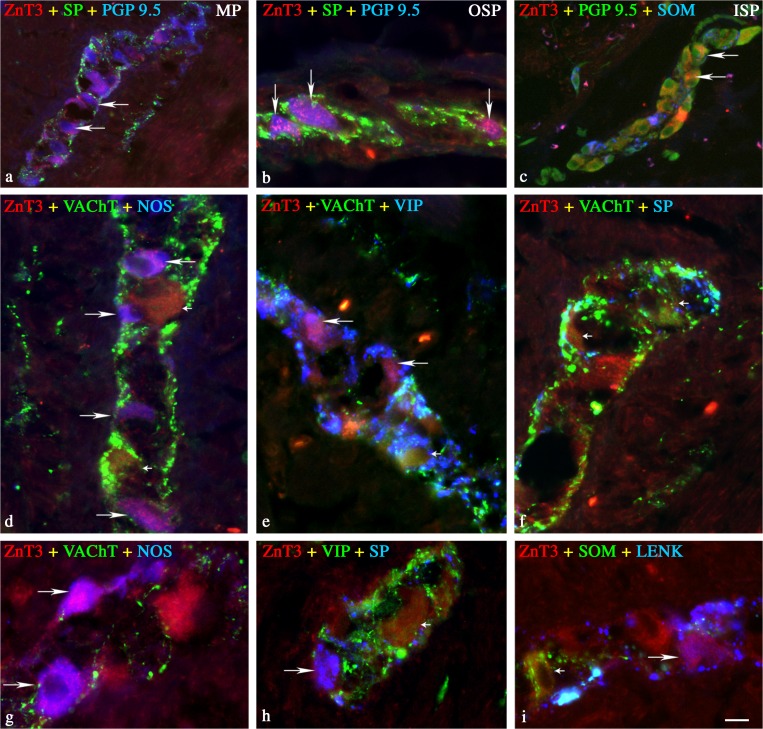
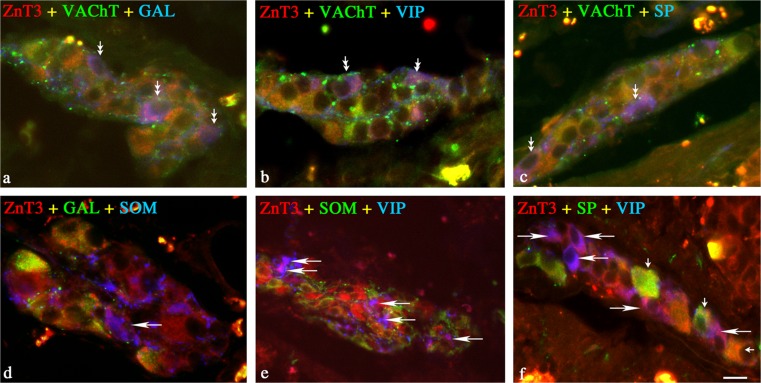
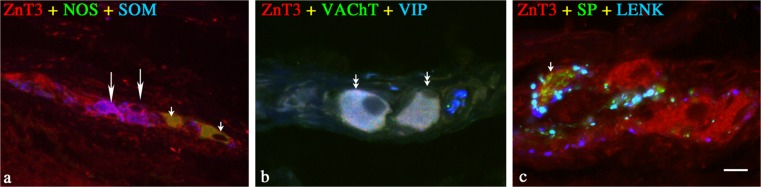
Zinc ions in the synaptic vesicles of zinc-enriched neurons (ZEN) seem to have an important role in normal physiological and pathophysiological processes in target organ innervation. The factor directly responsible for the transport of zinc ions into synaptic vesicles is zinc transporter 3 (ZnT3), a member of the divalent cation zinc transporters and an excellent marker of ZEN neurons. As data concerning the existence of ZEN neurons in the small intestine is lacking, this study was designed to disclose the presence and neurochemical coding of such neurons in the porcine jejunum. Cryostat sections (10 mμ thick) of porcine jejunum were processed for routine double- and triple-immunofluorescence labeling for ZnT3 in various combinations with immunolabeling for other neurochemicals including pan-neuronal marker (PGP9.5), substance P (SP), somatostatin (SOM), vasoactive intestinal peptide (VIP), nitric oxide synthase (NOS), leu-enkephalin (LENK), vesicular acetylcholine transporter (VAChT), neuropeptide Y (NPY), galanin (GAL), and calcitonin-gene related peptide (CGRP). Immunohistochemistry revealed that approximately 39%, 49%, and 45% of all PGP9.5- positive neurons in the jejunal myenteric (MP), outer submucous (OSP), and inner submucous (ISP) plexuses, respectively, were simultaneously ZnT3(+). The majority of ZnT3(+) neurons in all plexuses were also VAChT-positive. Both VAChT-positive and VAChT-negative ZnT3(+) neurons co-expressed a variety of active substances with diverse patterns of co-localization depending on the plexus studied. In the MP, the largest populations among both VAChT-positive and VAChT-negative ZnT3(+) neurons were NOS-positive cells. In the OSP and ISP, substantial subpopulations of ZnT3(+) neurons were VAChT-positive cells co-expressing SOM and GAL, respectively. The broad-spectrum of active substances that co-localize with the ZnT3(+) neurons in the porcine jejunum suggests that ZnT3 takes part in the regulation of various processes in the gut, both in normal physiological and during pathophysiological processes.
富含锌神经元(ZEN)突触小泡中的锌离子在靶器官神经支配的正常生理和病理生理过程中似乎具有重要作用。直接负责将锌离子转运到突触小泡中的因子是锌转运蛋白 3(ZnT3),它是二价阳离子锌转运体的成员,也是 ZEN 神经元的良好标志物。由于缺乏有关小肠中 ZEN 神经元存在的资料,因此本研究旨在揭示猪空肠中此类神经元的存在和神经化学编码。对猪空肠的冷冻切片(10μm 厚)进行常规双重和三重免疫荧光标记,以 ZnT3 与其他神经化学物质(包括泛神经元标志物(PGP9.5)、P 物质(SP)、生长抑素(SOM)、血管活性肠肽(VIP)、一氧化氮合酶(NOS)、亮氨酸脑啡肽(LENK)、囊泡乙酰胆碱转运体(VAChT)、神经肽 Y(NPY)、甘丙肽(GAL)和降钙素基因相关肽(CGRP)的免疫标记进行各种组合。免疫组织化学显示,在空肠肌间(MP)、外黏膜下(OSP)和内黏膜下(ISP)丛中,分别约有 39%、49%和 45%的所有 PGP9.5 阳性神经元同时为 ZnT3(+)。大多数 ZnT3(+)神经元在所有丛中也为 VAChT 阳性。VAChT 阳性和 VAChT 阴性 ZnT3(+)神经元均表达多种活性物质,根据所研究的丛,其共定位模式不同。在 MP 中,VAChT 阳性和 VAChT 阴性 ZnT3(+)神经元中最大的群体是 NOS 阳性细胞。在 OSP 和 ISP 中,ZnT3(+)神经元的大量亚群分别是 VAChT 阳性细胞,共表达 SOM 和 GAL。在猪空肠中与 ZnT3(+)神经元共定位的广谱活性物质表明,ZnT3 参与了肠道中各种过程的调节,包括正常生理和病理生理过程。