Jones Tiffani Alvey, Hernandez Diane Z, Wong Zoë C, Wandler Anica M, Guillemin Karen
Institute of Molecular Biology, University of Oregon, Eugene, OR, United States of America.
Humans and the Microbiome Program, Canadian Institute for Advanced Research, Toronto, Ontario, Canada.
PLoS Pathog. 2017 Oct 19;13(10):e1006631. doi: 10.1371/journal.ppat.1006631. eCollection 2017 Oct.
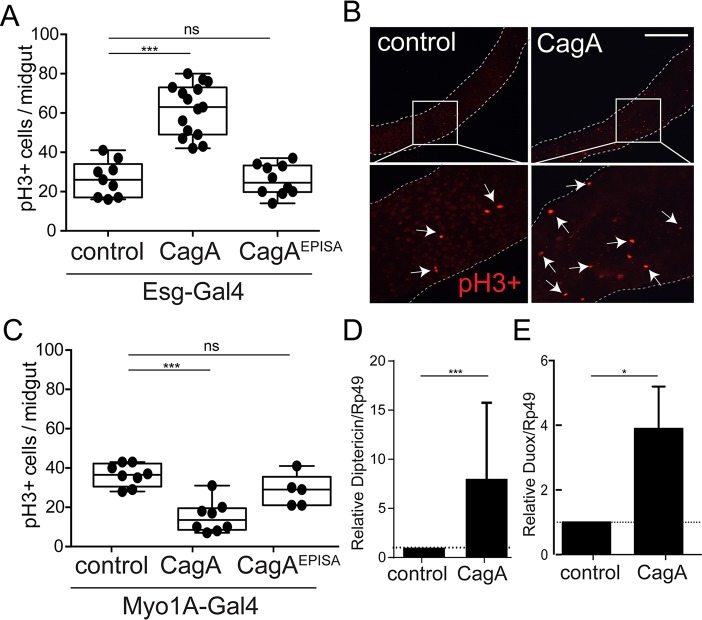
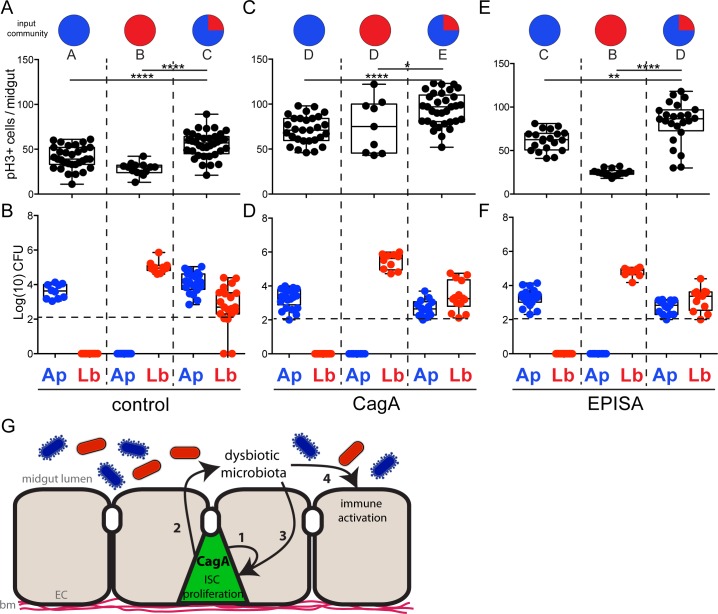
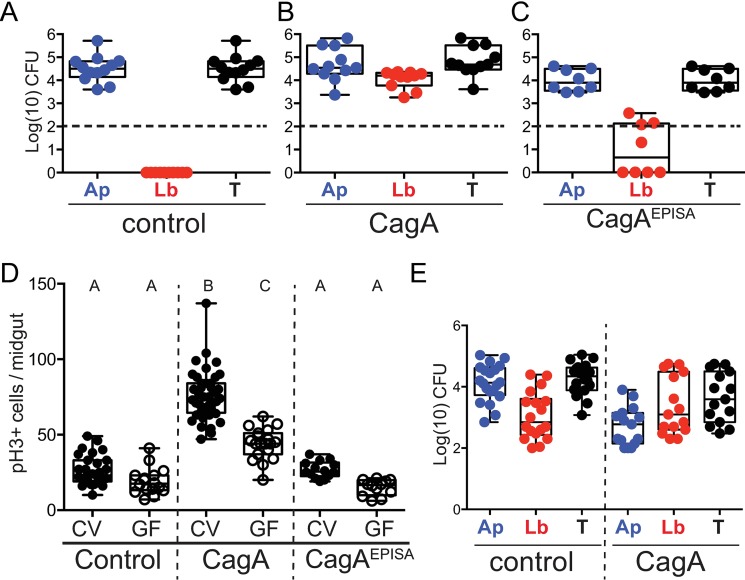
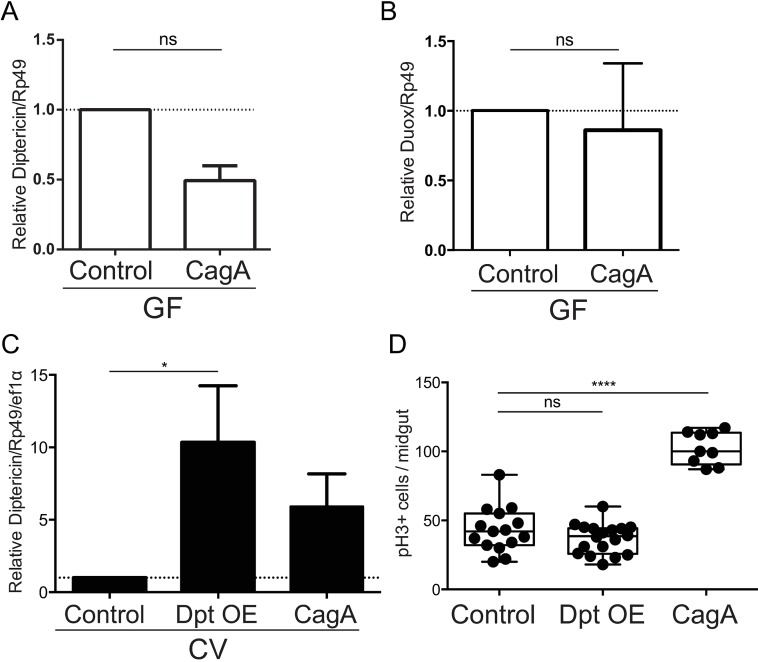
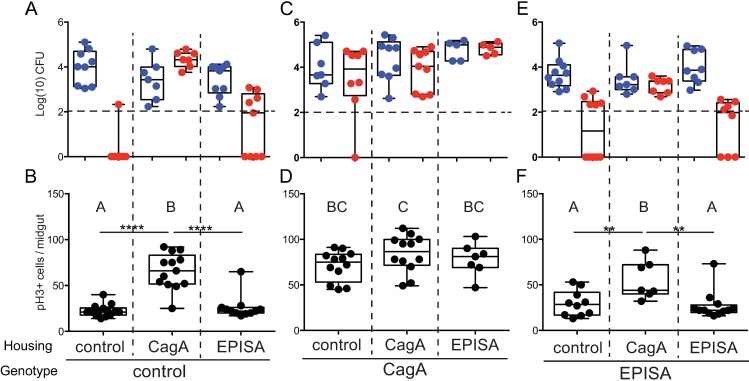
Gut microbiota facilitate many aspects of human health and development, but dysbiotic microbiota can promote hyperplasia and inflammation and contribute to human diseases such as cancer. Human patients infected with the gastric cancer-causing bacterium Helicobacter pylori have altered microbiota; however, whether dysbiosis contributes to disease in this case is unknown. Many H. pylori human disease phenotypes are associated with a potent virulence protein, CagA, which is translocated into host epithelial cells where it alters cell polarity and manipulates host-signaling pathways to promote disease. We hypothesized that CagA alone could contribute to H. pylori pathogenesis by inducing microbial dysbiosis that promotes disease. Here we use a transgenic Drosophila model of CagA expression to genetically disentangle the effects of the virulence protein CagA from that of H. pylori infection. We found that expression of CagA within Drosophila intestinal stem cells promotes excess cell proliferation and is sufficient to alter host microbiota. Rearing CagA transgenic flies germ-free revealed that the dysbiotic microbiota contributes to cell proliferation phenotypes and also elicits expression of innate immune components, Diptericin and Duox. Further investigations revealed interspecies interactions are required for this dysbiotic CagA-dependent microbiota to promote proliferation in CagA transgenic and healthy control Drosophila. Our model establishes that CagA can alter gut microbiota and exacerbate cell proliferation and immune phenotypes previously attributed to H. pylori infection. This work provides valuable new insights into the mechanisms by which interactions between a specific virulence factor and the resident microbiota can contribute to the development and progression of disease.
肠道微生物群有助于人类健康和发育的多个方面,但微生物群失调可促进增生和炎症,并导致癌症等人类疾病。感染致胃癌细菌幽门螺杆菌的人类患者的微生物群发生了改变;然而,在这种情况下,微生物群失调是否导致疾病尚不清楚。许多幽门螺杆菌的人类疾病表型与一种强效毒力蛋白CagA有关,该蛋白被转运到宿主上皮细胞中,改变细胞极性并操纵宿主信号通路以促进疾病。我们假设,单独的CagA可能通过诱导促进疾病的微生物群失调而导致幽门螺杆菌发病机制。在这里,我们使用CagA表达的转基因果蝇模型,从幽门螺杆菌感染的影响中遗传分离毒力蛋白CagA的影响。我们发现,果蝇肠道干细胞中CagA的表达促进了细胞过度增殖,并且足以改变宿主微生物群。在无菌条件下饲养CagA转基因果蝇表明,失调的微生物群导致细胞增殖表型,并引发先天免疫成分Diptericin和Duox的表达。进一步的研究表明,这种依赖于CagA的失调微生物群需要种间相互作用才能促进CagA转基因果蝇和健康对照果蝇的增殖。我们的模型表明,CagA可以改变肠道微生物群,并加剧先前归因于幽门螺杆菌感染的细胞增殖和免疫表型。这项工作为特定毒力因子与常驻微生物群之间的相互作用导致疾病发展和进展的机制提供了有价值的新见解。