Department of Experimental and Clinical Pharmacology, University of Minnesota Minneapolis, MN, USA.
Front Cell Infect Microbiol. 2012 May 9;2:64. doi: 10.3389/fcimb.2012.00064. eCollection 2012.
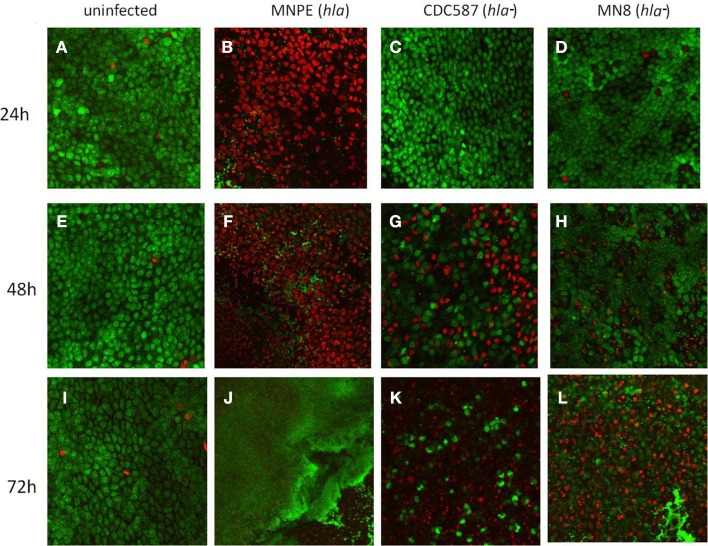
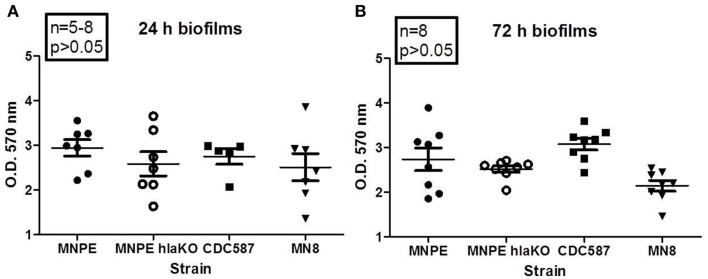
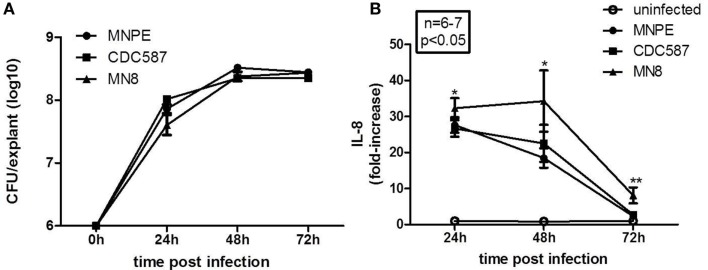
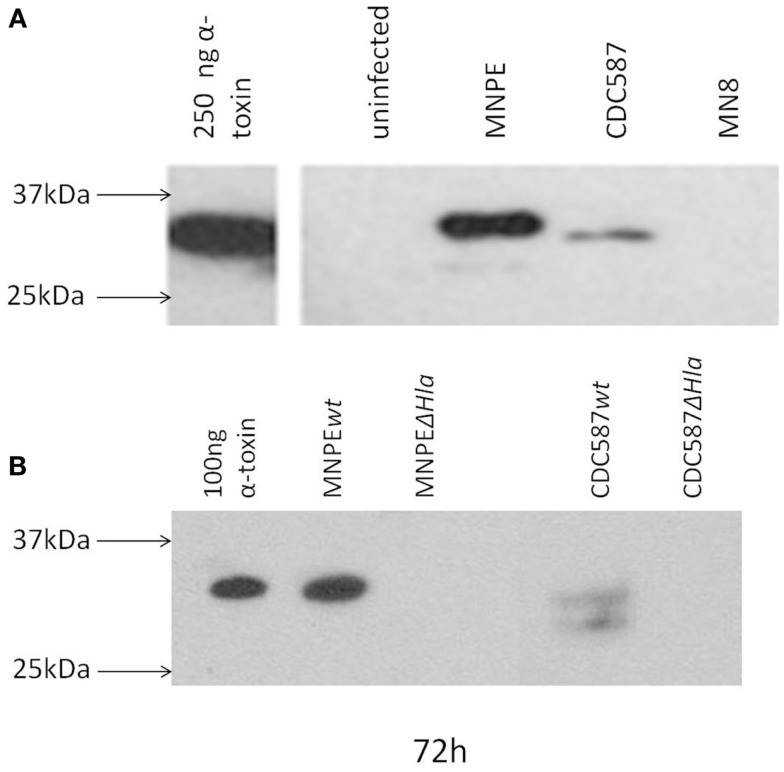
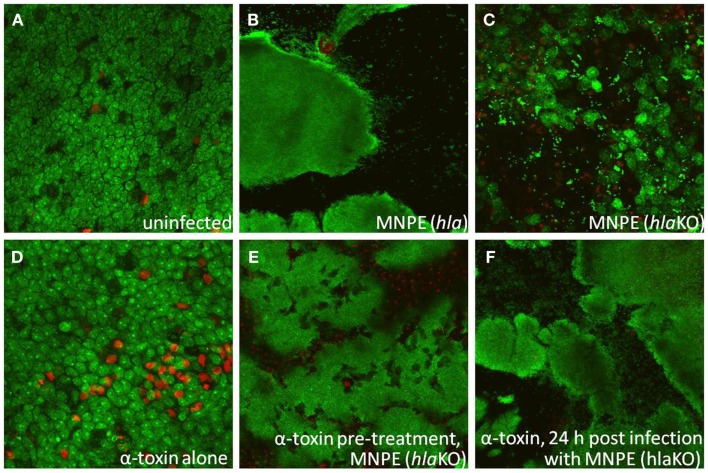
Staphylococcus aureus causes many diseases in humans, ranging from mild skin infections to serious, life-threatening, superantigen-mediated Toxic Shock Syndrome (TSS). S. aureus may be asymptomatically carried in the anterior nares or vagina or on the skin, serving as a reservoir for infection. Pulsed-field gel electrophoresis clonal type USA200 is the most widely disseminated colonizer and the leading cause of TSS. The cytolysin α-toxin (also known as α-hemolysin or Hla) is the major epithelial proinflammatory exotoxin produced by TSS S. aureus USA200 isolates. The current study aims to characterize the differences between TSS USA200 strains [high (hla(+)) and low (hla(-)) α-toxin producers] in their ability to disrupt vaginal mucosal tissue and to characterize the subsequent infection. Tissue viability post-infection and biofilm formation of TSS USA200 isolates CDC587 and MN8, which contain the α-toxin pseudogene (hla(-)), MNPE (hla(+)), and MNPE isogenic hla knockout (hlaKO), were observed via LIVE/DEAD® staining and confocal microscopy. All TSS strains grew to similar bacterial densities (1-5 × 10(8) CFU) on the mucosa and were proinflammatory over 3 days. However, MNPE formed biofilms with significant reductions in the mucosal viability whereas neither CDC587 (hla(-)), MN8 (hla(-)), nor MNPE hlaKO formed biofilms. The latter strains were also less cytotoxic than wild-type MNPE. The addition of exogenous, purified α-toxin to MNPE hlaKO restored the biofilm phenotype. We speculate that α-toxin affects S. aureus phenotypic growth on vaginal mucosa by promoting tissue disruption and biofilm formation. Further, α-toxin mutants (hla(-)) are not benign colonizers, but rather form a different type of infection, which we have termed high density pathogenic variants (HDPV).
金黄色葡萄球菌可引起人类多种疾病,从轻度皮肤感染到严重的、危及生命的超抗原介导的中毒性休克综合征(TSS)。金黄色葡萄球菌可能无症状地携带在前鼻腔或阴道或皮肤中,作为感染的储库。脉冲场凝胶电泳克隆型 USA200 是分布最广泛的定植菌,也是 TSS 的主要原因。细胞毒素 α-毒素(也称为α-溶血素或 Hla)是 TSS 金黄色葡萄球菌 USA200 分离株产生的主要上皮促炎外毒素。本研究旨在表征 TSS USA200 菌株(高(hla(+))和低(hla(-))α-毒素产生菌)在破坏阴道黏膜组织方面的差异,并对随后的感染进行特征描述。通过 LIVE/DEAD®染色和共聚焦显微镜观察 TSS USA200 分离株 CDC587 和 MN8 的组织活力,CDC587 和 MN8 含有α-毒素假基因(hla(-))、MNPE(hla(+))和 MNPE 同源基因 hlaKO(hlaKO)。所有 TSS 株在黏膜上的细菌密度相似(1-5×10(8)CFU),在 3 天内具有促炎作用。然而,MNPE 形成生物膜,导致黏膜活力显著降低,而 CDC587(hla(-))、MN8(hla(-))和 MNPE hlaKO 均未形成生物膜。后两种菌株的细胞毒性也低于野生型 MNPE。向 MNPE hlaKO 中添加外源性、纯化的α-毒素恢复了生物膜表型。我们推测,α-毒素通过促进组织破坏和生物膜形成,影响金黄色葡萄球菌在阴道黏膜上的表型生长。此外,α-毒素突变体(hla(-))不是良性定植菌,而是形成一种不同类型的感染,我们称之为高密度致病变体(HDPV)。