National Center for Biotechnology Information, National Library of Medicine, National Institutes of Health, Bethesda MD, USA.
Front Cell Infect Microbiol. 2012 Jun 29;2:89. doi: 10.3389/fcimb.2012.00089. eCollection 2012.
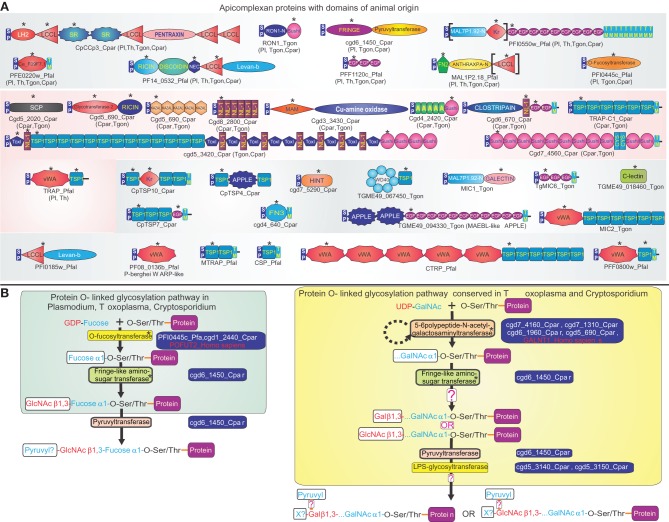
The endosymbiotic origin of eukaryotes brought together two disparate genomes in the cell. Additionally, eukaryotic natural history has included other endosymbiotic events, phagotrophic consumption of organisms, and intimate interactions with viruses and endoparasites. These phenomena facilitated large-scale lateral gene transfer and biological conflicts. We synthesize information from nearly two decades of genomics to illustrate how the interplay between lateral gene transfer and biological conflicts has impacted the emergence of new adaptations in eukaryotes. Using apicomplexans as example, we illustrate how lateral transfer from animals has contributed to unique parasite-host interfaces comprised of adhesion- and O-linked glycosylation-related domains. Adaptations, emerging due to intense selection for diversity in the molecular participants in organismal and genomic conflicts, being dispersed by lateral transfer, were subsequently exapted for eukaryote-specific innovations. We illustrate this using examples relating to eukaryotic chromatin, RNAi and RNA-processing systems, signaling pathways, apoptosis and immunity. We highlight the major contributions from catalytic domains of bacterial toxin systems to the origin of signaling enzymes (e.g., ADP-ribosylation and small molecule messenger synthesis), mutagenic enzymes for immune receptor diversification and RNA-processing. Similarly, we discuss contributions of bacterial antibiotic/siderophore synthesis systems and intra-genomic and intra-cellular selfish elements (e.g., restriction-modification, mobile elements and lysogenic phages) in the emergence of chromatin remodeling/modifying enzymes and RNA-based regulation. We develop the concept that biological conflict systems served as evolutionary "nurseries" for innovations in the protein world, which were delivered to eukaryotes via lateral gene flow to spur key evolutionary innovations all the way from nucleogenesis to lineage-specific adaptations.
真核生物的内共生起源将两个截然不同的基因组结合到了细胞中。此外,真核生物的自然历史还包括其他内共生事件、吞噬性消耗生物以及与病毒和内寄生生物的密切相互作用。这些现象促进了大规模的水平基因转移和生物冲突。我们综合了近 20 年的基因组学信息,来说明水平基因转移和生物冲突之间的相互作用如何影响真核生物新适应的出现。我们以 Apicomplexa 为例,说明来自动物的水平转移如何促成了独特的寄生虫-宿主界面,这些界面由黏附和 O-连接糖基化相关结构域组成。由于在生物和基因组冲突中对分子参与者多样性的强烈选择,适应性出现了,这些适应性通过水平转移得以分散,并随后被用于真核生物特有的创新。我们使用与真核染色质、RNAi 和 RNA 处理系统、信号通路、细胞凋亡和免疫相关的例子来说明这一点。我们强调了细菌毒素系统的催化结构域对信号酶(如 ADP-核糖基化和小分子信使合成)、免疫受体多样化和 RNA 处理的诱变酶的起源的主要贡献。同样,我们讨论了细菌抗生素/铁载体合成系统以及基因组内和细胞内自私元件(如限制修饰、移动元件和溶原性噬菌体)在染色质重塑/修饰酶和基于 RNA 的调控出现中的贡献。我们提出了这样的概念,即生物冲突系统是蛋白质世界创新的进化“苗圃”,通过水平基因流将这些创新传递给真核生物,从而激发从核发生到谱系特异性适应的关键进化创新。