Midwest Alcoholism Research Center, Department of Psychiatry, Washington University School of Medicine, 660 S. Euclid Avenue, Campus Box 8134, St. Louis, MO 63110, USA.
Drug Alcohol Depend. 2013 Feb 1;128(1-2):20-9. doi: 10.1016/j.drugalcdep.2012.07.015. Epub 2012 Aug 21.
Parental substance use disorder (SUD) is associated with a range of negative offspring outcomes and psychopathology, but the clustering of these outcomes into subtypes has seldom been examined, nor have the familial and environmental contexts of these subtypes been reported. The present study examines the clustering of offspring lifetime substance use and psychiatric disorders into subtypes and characterizes them in terms of familial and non-familial influences using an offspring-of-twins design.
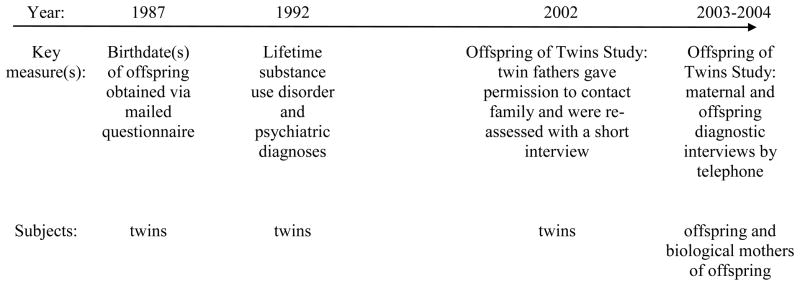
Telephone-administered diagnostic interviews were used to collect data on psychiatric disorders and SUD from 488 twin fathers, 420 biological mothers and 831 offspring. Latent class analysis (LCA) was used to derive subtypes of lifetime comorbidity in offspring. Familial risk and environmental variables associated with each subtype (i.e., parenting, childhood physical or sexual abuse, perceived sibling and peer substance use) were identified using multinomial logistic regression.
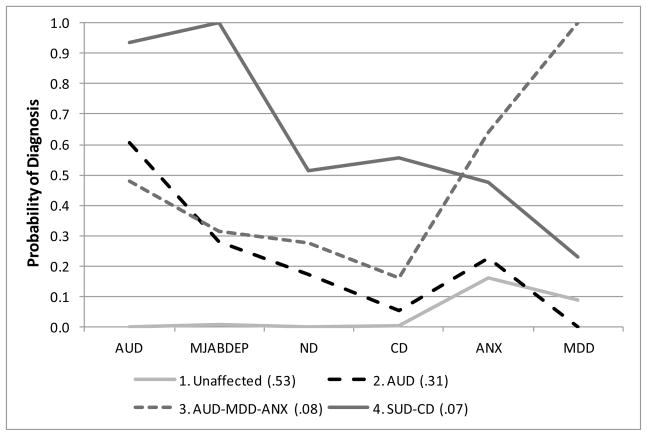
Four classes identified by LCA were characterized as (1) unaffected, (2) alcohol abuse/dependence, (3) alcohol abuse/dependence comorbid with anxiety and depression, and (4) alcohol, cannabis abuse/dependence and nicotine dependence comorbid with conduct disorder. Inconsistent parenting, childhood physical/sexual abuse, and perceived sibling and peer substance use were significantly associated with profiles of offspring comorbidity after adjusting for familial vulnerability. Some associations were specific (i.e., perceived peer alcohol use to the AUD class), while others were general (peer smoking to all 3 comorbidity classes).
We observed distinct subtypes of psychiatric and SUD comorbidity in adolescents and young adults. Subtypes of offspring psychopathology have varied associations with parental psychopathology, family environment, and sibling and peer behaviors.
父母物质使用障碍(SUD)与一系列负面的后代结果和精神病理学有关,但这些结果的聚类成亚型很少被研究,也没有报告这些亚型的家庭和环境背景。本研究使用双胞胎后代设计,检查后代终生物质使用和精神障碍的聚类成亚型,并根据家族和非家族影响对其进行特征描述。
使用电话管理的诊断访谈从 488 对双胞胎父亲、420 名亲生母亲和 831 名后代收集精神障碍和 SUD 的数据。使用潜在类别分析(LCA)从后代的终生共病中推导出亚型。使用多项逻辑回归确定与每种亚型相关的家族风险和环境变量(即,育儿、儿童期身体或性虐待、感知兄弟姐妹和同伴物质使用)。
LCA 确定的四个类别特征为:(1)未受影响,(2)酒精滥用/依赖,(3)酒精滥用/依赖伴有焦虑和抑郁,以及(4)酒精、大麻滥用/依赖和尼古丁依赖伴有品行障碍。调整家族易感性后,不一致的育儿、儿童期身体/性虐待以及感知兄弟姐妹和同伴物质使用与后代共病的特征显著相关。一些关联是特定的(即,感知同伴饮酒与 AUD 类相关),而其他关联是一般的(同伴吸烟与所有 3 种共病类相关)。
我们观察到青少年和年轻人中存在不同的精神障碍和 SUD 共病亚型。后代精神病理学的亚型与父母精神病理学、家庭环境以及兄弟姐妹和同伴行为有不同的关联。