Dzudie Anastase, Kengne André Pascal, Muna Walinjom F T, Ba Hamadou, Menanga Alain, Kouam Kouam Charles, Abah Joseph, Monkam Yves, Biholong Christian, Mintom Pierre, Kamdem Félicité, Djomou Armel, Ndjebet Jules, Wambo Cyrille, Luma Henry, Ngu Kathleen Blackett, Kingue Samuel
Department of Internal Medicine, Douala General Hospital, Douala, Cameroon.
BMJ Open. 2012 Aug 24;2(4). doi: 10.1136/bmjopen-2012-001217. Print 2012.
Hypertension has been established as a major public health problem in Africa, but its specific contributions to disease burden are still incompletely understood. We report the prevalence and determinants of hypertension, detection, treatment and control rates among adults in major cities in Cameroon.
Cross-sectional study.
Community-based multicentre study in major cities in Cameroon.
Participants were self-selected urban dwellers from the Center, Littoral, North-West and West Regions, who attended on 17 May 2011 a screening campaign advertised through mass media. PRIMARY AND SECONDARY OUTCOMES MEASURES: Hypertension defined as systolic (and/or diastolic) blood pressure (BP)≥ 140 (90) mm Hg, or ongoing BP-lowering medications.
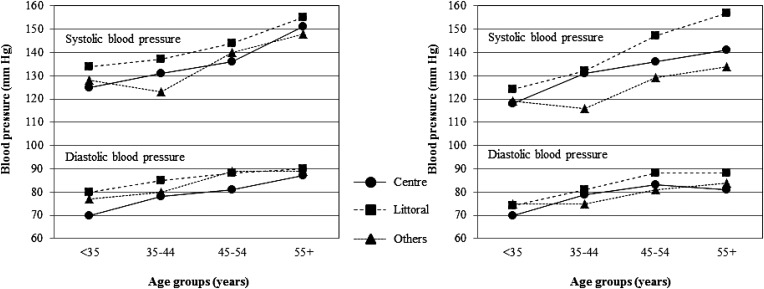
In all, 2120 participants (1003 women) were included. Among them, 1007 (prevalence rate 47.5%) had hypertension, including 319 (awareness rate 31.7%) who were aware of their status. The prevalence of hypertension increased with age overall and by sex and region. Among aware hypertensive participants, 191 (treatment rate 59.9%) were on regular BP-lowering medication, and among those treated, 47 (controlled rate 24.6%) were at target BP levels (ie, systolic (and diastolic) BP<140 (90) mm Hg). In multivariable logistic regression analysis, male gender, advanced age, parental history of hypertension, diabetes mellitus, elevated waist and elevated body mass index (BMI) were the significant predictors of hypertension. Likewise, male gender, high BMI and physical inactivity were associated with poor control.
High prevalence of hypertension with low awareness, treatment and control were found in this urban population; these findings are significant and alarming with consideration to the various improvements in the access to healthcare and the continuing efforts to educate communities over the last few decades.
高血压已被确认为非洲的一个主要公共卫生问题,但其对疾病负担的具体影响仍未完全明确。我们报告了喀麦隆主要城市成年人中高血压的患病率、决定因素、检测率、治疗率和控制率。
横断面研究。
喀麦隆主要城市基于社区的多中心研究。
参与者是来自中部、滨海、西北和西部地区的自选择城市居民,他们于2011年5月17日参加了通过大众媒体宣传的筛查活动。主要和次要结局指标:高血压定义为收缩压(和/或舒张压)≥140(90)mmHg,或正在服用降压药物。
共纳入2120名参与者(1003名女性)。其中,1007人(患病率47.5%)患有高血压,其中319人(知晓率31.7%)知晓自己的病情。高血压患病率总体上随年龄增加而上升,且存在性别和地区差异。在知晓自己患有高血压的参与者中,191人(治疗率59.9%)正在规律服用降压药物,在接受治疗的患者中,47人(控制率24.6%)血压达到目标水平(即收缩压(和舒张压)<140(90)mmHg)。多变量逻辑回归分析显示,男性、高龄、高血压家族史、糖尿病、腰围增加和体重指数(BMI)升高是高血压的显著预测因素。同样,男性、高BMI和缺乏身体活动与控制不佳有关。
在这一城市人群中发现高血压患病率高,但知晓率、治疗率和控制率低;考虑到过去几十年在医疗保健可及性方面的各种改善以及持续开展的社区教育工作,这些发现意义重大且令人担忧。