Adaramoye Oluwatosin A, Nwosu Ifeanyi O, Farombi Ebenezer O
Department of Biochemistry, Drug Metabolism and Toxicology Research Laboratories, College of Medicine, University of Ibadan, Ibadan, Nigeria.
Pharmacognosy Res. 2012 Jul;4(3):127-33. doi: 10.4103/0974-8490.99071.
Kolaviron (KV) (biflavonoid from Garcinia kola) and extract of Curcuma longa (CL) are frequently used in folk medicine for treatment of hypertension. One of their mechanisms of action is to enhance antioxidant properties in animals. N(G)- nitro- l- arginine methyl- ester (L- NAME) is L- arginine analogue, which by binding to Nitric Oxide Synthase (NOS) may induce hypertension partly due to increase in tissues oxidative stress.
To investigate the effect of L- NAME on some biochemical indices and the possible protective effect of KV or CL.
Four groups consisting of 6 rats each were used. One group served as control, second group received L- NAME (40 mg/kg/day). Third and fourth groups were treated with KV and CL, respectively and also received L- NAME. KV and CL were given at a dose of 200 mg/kg/day.
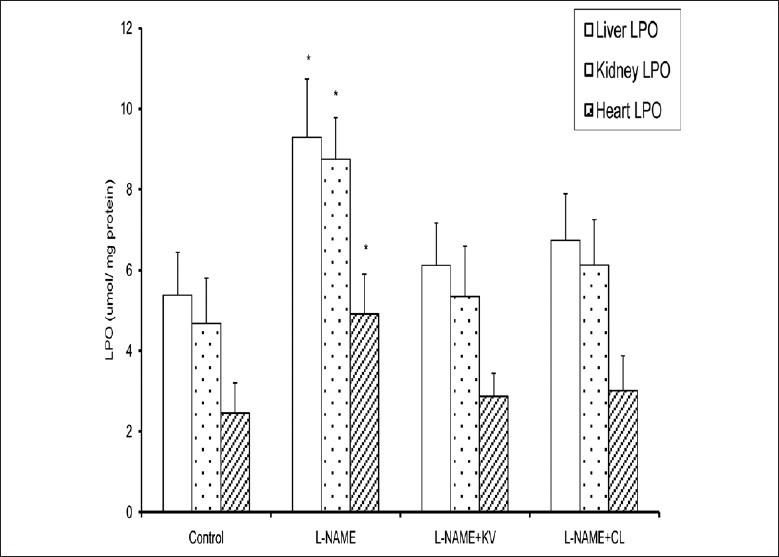
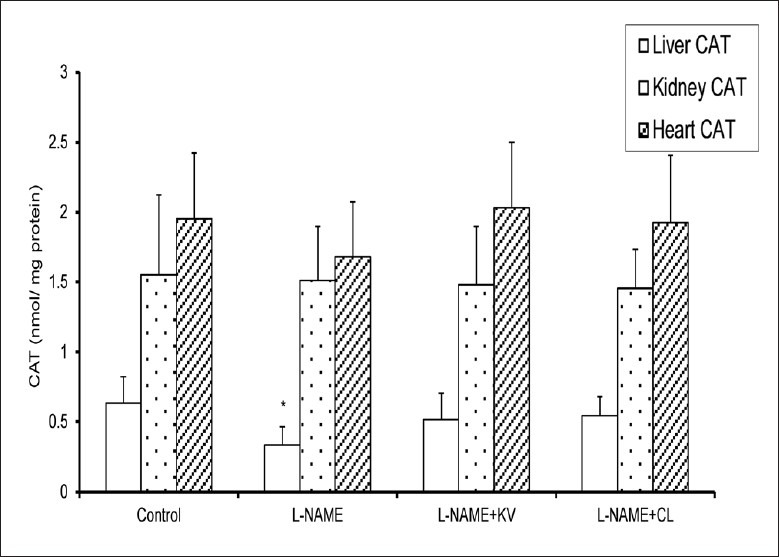
L- NAME caused a significant (P <0.05) increase in the levels of serum urea, creatine kinase and alanine aminotransferase relative to controls. L- NAME treated rats had markedly decreased hepatic catalase (CAT), superoxide dismutase (SOD), glutathione- S- transferase (GST) and reduced glutathione (GSH) levels. Precisely, L- NAME decreased CAT, SOD, GST and GSH by 48, 52, 76 and 40%, respectively. L- NAME intoxication significantly decreased (P <0.05) renal GSH and SOD levels. Also, L- NAME caused a significant (P <0.05) induction of lipid peroxidation (LPO) in the animals. Administration of KV or CL with L- NAME caused significant (P <0.05) inhibition of LPO and augments tissue antioxidant indices.
These results confirm the adverse effect of L- NAME on biochemical indices and, the ability of kolaviron or Curcuma longa to ameliorate the alterations.
可乐维隆(KV)(一种来自可乐果的双黄酮)和姜黄提取物(CL)常用于民间医学治疗高血压。它们的作用机制之一是增强动物的抗氧化特性。N(G)-硝基-L-精氨酸甲酯(L-NAME)是L-精氨酸类似物,通过与一氧化氮合酶(NOS)结合,可能部分由于组织氧化应激增加而诱发高血压。
研究L-NAME对一些生化指标的影响以及KV或CL可能的保护作用。
使用四组,每组6只大鼠。一组作为对照组,第二组接受L-NAME(40mg/kg/天)。第三组和第四组分别用KV和CL处理,并且也接受L-NAME。KV和CL的给药剂量为200mg/kg/天。
与对照组相比,L-NAME导致血清尿素、肌酸激酶和丙氨酸转氨酶水平显著(P<0.05)升高。接受L-NAME治疗的大鼠肝脏过氧化氢酶(CAT)、超氧化物歧化酶(SOD)、谷胱甘肽-S-转移酶(GST)和还原型谷胱甘肽(GSH)水平明显降低。具体而言,L-NAME使CAT、SOD、GST和GSH分别降低48%、52%、76%和40%。L-NAME中毒显著降低(P<0.05)肾脏GSH和SOD水平。此外,L-NAME导致动物体内脂质过氧化(LPO)显著(P<0.05)诱导。与L-NAME一起给予KV或CL导致LPO显著(P<0.05)抑制,并提高组织抗氧化指标。
这些结果证实了L-NAME对生化指标的不良影响,以及可乐维隆或姜黄改善这些改变的能力。