Faculty of Dentistry, University of Granada, Granada, Spain.
Med Oral Patol Oral Cir Bucal. 2013 Jan 1;18(1):e49-55. doi: 10.4317/medoral.18206.
Assessing the clinical effectiveness of a topical sialogogue on spray (malic acid, 1%) in the treatment of xerostomia induced by antihypertensive drugs.
This research has been carried out through a randomized double-blind clinical trial. 45 patients suffering from hypertensive drugs-induced xerostomia were divided into 2 groups: the first group (25 patients) received a topical sialogogue on spray (malic acid, 1%) whereas the second group (20 patients) received a placebo. Both of them were administered on demand for 2 weeks. Dry Mouth Questionnaire (DMQ) was used in order to evaluate xerostomia levels before and after product/placebo application. Unstimulated and stimulated salivary flows rates, before and after application, were measured. All the statistical analyses were performed by using SPSS software v17.0. Different DMQ scores at the earliest and final stage of the trial were analysed by using Mann-Whitney U test, whereas Student's T-test was used to analyse salivary flows. Critical p-value was established at p<0.05.
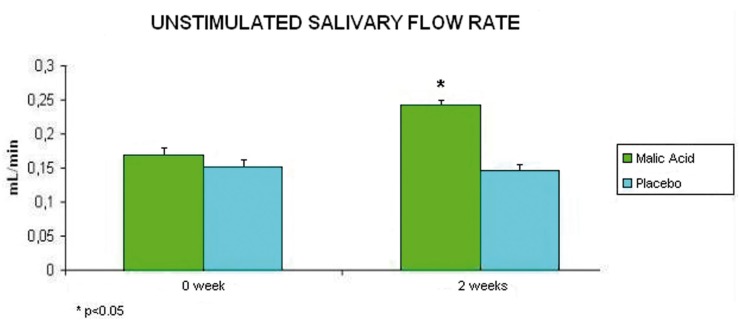
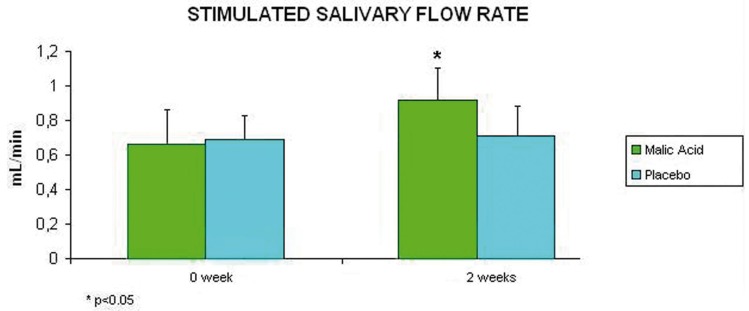
DMQ scores increased significantly (clinical recovery) from 1.21 to 3.36 points (p<0.05) after malic acid (1%) application whereas DMQ scores increased from 1.18 to 1.34 points (p>0.05) after placebo application. After two weeks of treatment with malic acid, unstimulated salivary flow increased from 0.17 to 0.242 mL/min whereas the stimulated one increased from 0.66 to 0.92 mL/min (p<0.05). After placebo application unstimulated flow ranged from 0.152 to 0.146 mL/min and stimulated flow increased from 0.67 to 0.70 mL/min (p>0.05).
Malic acid 1% spray improved antihypertensive-induced xerostomia and stimulated the production of saliva.
评估一种喷雾型局部唾液刺激剂(苹果酸,1%)治疗抗高血压药物引起的口干的临床疗效。
本研究采用随机双盲临床试验进行。45 名患有抗高血压药物引起的口干症的患者被分为两组:第一组(25 名患者)接受喷雾型局部唾液刺激剂(苹果酸,1%)治疗,第二组(20 名患者)接受安慰剂治疗。两组均按需使用,持续 2 周。使用口干问卷(DMQ)在产品/安慰剂使用前后评估口干程度。在使用前后测量非刺激性和刺激性唾液流量。所有统计分析均使用 SPSS 软件 v17.0 进行。使用 Mann-Whitney U 检验分析试验最早和最终阶段的不同 DMQ 评分,使用 Student's T 检验分析唾液流量。临界 p 值设定为 p<0.05。
使用苹果酸(1%)后,DMQ 评分从 1.21 分显著增加(临床恢复)至 3.36 分(p<0.05),而使用安慰剂后,DMQ 评分从 1.18 分增加至 1.34 分(p>0.05)。使用苹果酸治疗两周后,非刺激性唾液流量从 0.17 增加至 0.242 mL/min,而刺激性唾液流量从 0.66 增加至 0.92 mL/min(p<0.05)。使用安慰剂后,非刺激性流量范围为 0.152 至 0.146 mL/min,刺激性流量从 0.67 增加至 0.70 mL/min(p>0.05)。
1%苹果酸喷雾可改善抗高血压药物引起的口干,并刺激唾液分泌。