HAS, Saint Denis la Plaine, France.
BMJ Qual Saf. 2012 Sep;21(9):729-36. doi: 10.1136/bmjqs-2011-048710.
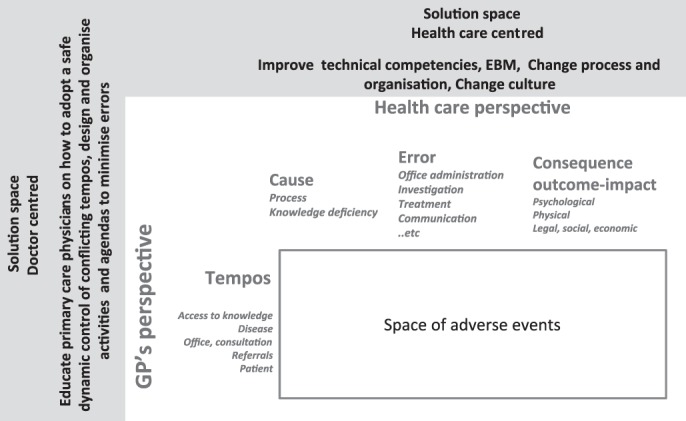
The role of time management in safe and efficient medicine is important but poorly incorporated into the taxonomies of error in primary care. This paper addresses the lack of time management, presenting a framework integrating five time scales termed 'Tempos' requiring parallel processing by GPs: the disease's tempo (unexpected rapid evolutions, slow reaction to treatment); the office's tempo (day-to-day agenda and interruptions); the patient's tempo (time to express symptoms, compliance, emotion); the system's tempo (time for appointments, exams, and feedback); and the time to access to knowledge. The art of medicine is to control all of these tempos in parallel and simultaneously.
Two qualified physicians reviewed a sample of 1046 malpractice claims from one liability insurer to determine whether a medical injury had occurred and, if so, whether it was due to one or more tempo-related problems. 623 of these reports were analysed in greater detail to identify the prevalence and characteristics of claims and related time management errors.
The percentages of contributing factors were as follows: disease tempo, 37.9%; office tempo, 13.2%; patient tempo, 13.8%; out-of-office coordination tempo, 22.6%; and GP's access to knowledge tempo, 33.2%.
Although not conceptualised in most error taxonomies, the disease and patient tempos are cornerstones in risk management in primary care. Traditional taxonomies describe events from an analytical perspective of care at the system level and offer opportunities to improve organisation, process, and evidence-based medicine. The suggested classification describes events in terms of (unsafe) dynamic control of parallel constraints from the carer's perspective, namely the GP, and offers improvement on how to self manage and coordinate different contradictory tempos and day-to-day activities. Further work is needed to test the validity and usefulness of this approach.
时间管理在安全高效的医疗中很重要,但在初级保健的错误分类中却没有得到很好的体现。本文针对时间管理方面的不足,提出了一个框架,将五个时间尺度整合为“Tempos”,这些时间尺度需要全科医生并行处理:疾病的节奏(意外的快速演变、对治疗的缓慢反应);诊所的节奏(日常议程和干扰);患者的节奏(表达症状、遵医嘱、情绪的时间);系统的节奏(预约、检查和反馈的时间);以及获取知识的时间。医学的艺术在于同时控制所有这些节奏。
两名合格的医生审查了一家责任保险公司的 1046 份医疗事故索赔样本,以确定是否发生了医疗伤害,如果发生了,是否是由于一个或多个与时间相关的问题。对其中 623 份报告进行了更详细的分析,以确定索赔的发生率和特征以及相关的时间管理错误。
促成因素的百分比如下:疾病节奏占 37.9%;诊所节奏占 13.2%;患者节奏占 13.8%;非办公协调节奏占 22.6%;全科医生获取知识的节奏占 33.2%。
尽管在大多数错误分类中没有概念化,但疾病和患者的节奏是初级保健风险管理的基石。传统的分类从系统层面上的护理分析角度描述事件,并为改善组织、流程和循证医学提供机会。建议的分类从护理人员(即全科医生)的角度,根据(不安全)并行约束的动态控制来描述事件,并提供了如何自我管理和协调不同矛盾的节奏和日常活动的改进方法。需要进一步的工作来测试这种方法的有效性和实用性。