Life and Health Sciences Research Institute (ICVS), School of Health Sciences, University of Minho, Braga, Portugal.
Oxid Med Cell Longev. 2012;2012:680304. doi: 10.1155/2012/680304. Epub 2012 Aug 9.
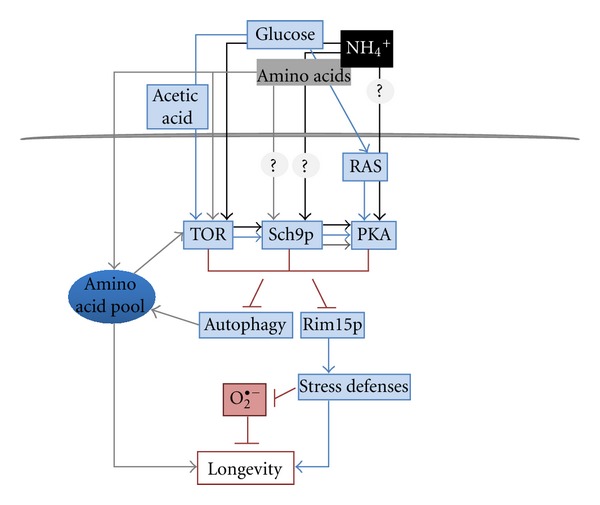
The manipulation of nutrient-signaling pathways in yeast has uncovered the impact of environmental growth conditions in longevity. Studies using calorie restriction show that reducing glucose concentration of the culture media is sufficient to increase replicative and chronological lifespan (CLS). Other components of the culture media and factors such as the products of fermentation have also been implicated in the regulation of CLS. Acidification of the culture media mainly due to acetic acid and other organic acids production negatively impacts CLS. Ethanol is another fermentative metabolite capable of inducing CLS reduction in aged cells by yet unknown mechanisms. Recently, ammonium was reported to induce cell death associated with shortening of CLS. This effect is correlated to the concentration of NH(4) (+) added to the culture medium and is particularly evident in cells starved for auxotrophy-complementing amino acids. Studies on the nutrient-signaling pathways regulating yeast aging had a significant impact on aging-related research, providing key insights into mechanisms that modulate aging and establishing the yeast as a powerful system to extend knowledge on longevity regulation in multicellular organisms.
酵母中营养信号通路的调控揭示了环境生长条件对寿命的影响。使用热量限制的研究表明,降低培养基中的葡萄糖浓度足以延长复制寿命和时序寿命(CLS)。培养基的其他成分和发酵产物等因素也与 CLS 的调节有关。培养基的酸化主要是由于乙酸和其他有机酸的产生,对 CLS 产生负面影响。乙醇是另一种发酵代谢产物,通过未知机制能够诱导衰老细胞 CLS 减少。最近,有报道称铵盐通过未知机制诱导与 CLS 缩短相关的细胞死亡。这种效应与添加到培养基中的 NH4 (+)浓度相关,在缺乏营养互补氨基酸的细胞中尤为明显。研究调控酵母衰老的营养信号通路对衰老相关研究产生了重大影响,为调节衰老的机制提供了重要见解,并使酵母成为一个强大的系统,以扩展对多细胞生物长寿调控的知识。