Life and Health Sciences Research Institute (ICVS), School of Health Sciences, University of Minho, Braga, Portugal.
Oxid Med Cell Longev. 2013;2013:161986. doi: 10.1155/2013/161986. Epub 2013 Aug 26.
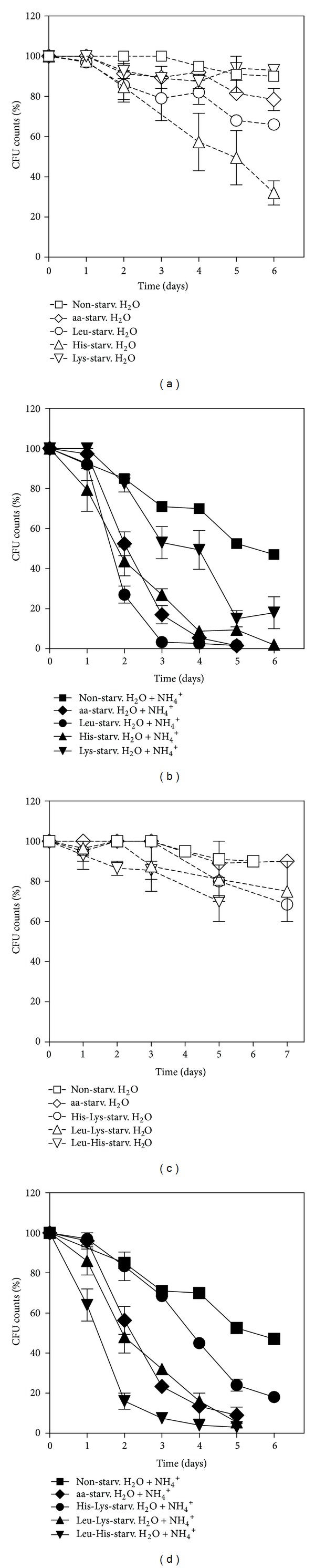
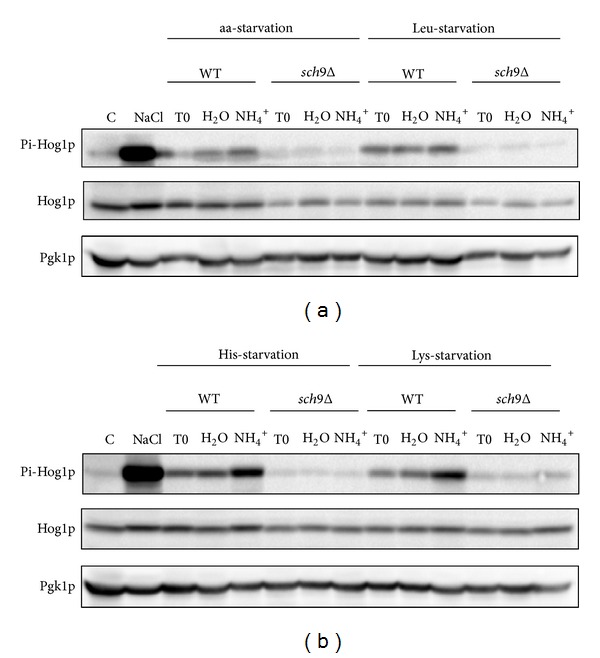
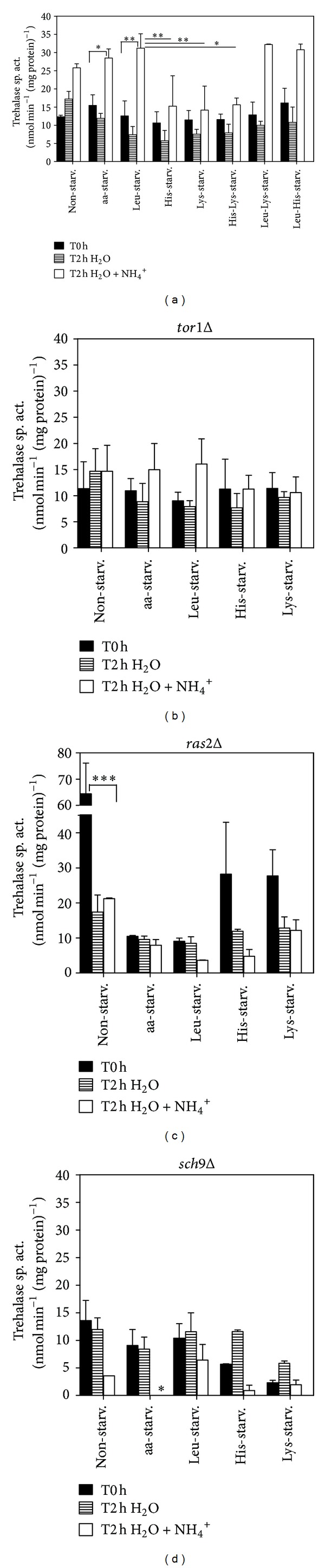
Ammonium (NH4(+)) leads to chronological life span (CLS) shortening in Saccharomyces cerevisiae BY4742 cells, particularly evident in cells starved for auxotrophy-complementing amino acids (leucine, lysine, and histidine) simultaneously. Here, we report that the effect of NH4(+) on aging yeast depends on the specific amino acid they are deprived of. Compared with no amino acid starvation, starvation for leucine alone or in combination with histidine resulted in the most pronounced NH4(+)-induced CLS shortening, whereas starvation for lysine, alone or in combination with histidine resulted in the least sensitivity to NH4(+). We also show that NH4(+)-induced CLS shortening is mainly mediated by Tor1p in cells starved for leucine or histidine but by Ras2p in cells starved for lysine, and in nonstarved cells. Sch9p protected cells from the effect of NH4(+) under all conditions tested (starved or nonstarved cells), which was associated with Sch9p-dependent Hog1p phosphorylation. Our data show that NH4(+) toxicity can be modulated through manipulation of the specific essential amino acid supplied to cells and of the conserved Ras2p, Tor1p, and Sch9p regulators, thus providing new clues to the development of environmental interventions for CLS extension and to the identification of new therapeutic targets for diseases associated with hyperammonemia.
氨(NH4(+)) 导致酿酒酵母 BY4742 细胞的时序寿命(CLS)缩短,尤其是在同时缺乏营养补充氨基酸(亮氨酸、赖氨酸和组氨酸)的情况下更为明显。在这里,我们报告说,NH4(+)对衰老酵母的影响取决于它们被剥夺的特定氨基酸。与没有氨基酸饥饿相比,单独饥饿亮氨酸或与组氨酸一起饥饿会导致最明显的 NH4(+)-诱导 CLS 缩短,而单独饥饿赖氨酸或与组氨酸一起饥饿对 NH4(+)的敏感性最低。我们还表明,NH4(+)-诱导的 CLS 缩短主要是由饥饿亮氨酸或组氨酸的细胞中的 Tor1p 介导的,但由饥饿赖氨酸的细胞中的 Ras2p 介导,并且在非饥饿细胞中也是如此。Sch9p 在所有测试条件下(饥饿或非饥饿细胞)都能保护细胞免受 NH4(+)的影响,这与 Sch9p 依赖性 Hog1p 磷酸化有关。我们的数据表明,通过操纵提供给细胞的特定必需氨基酸以及保守的 Ras2p、Tor1p 和 Sch9p 调节剂,可以调节 NH4(+)的毒性,从而为 CLS 延长的环境干预措施的发展提供了新的线索,并为与高氨血症相关的疾病确定新的治疗靶点提供了线索。