Indiana University School of Medicine, Indianapolis, IN 46202, USA.
Health Phys. 2012 Oct;103(4):356-66. doi: 10.1097/HP.0b013e3182666d6f.
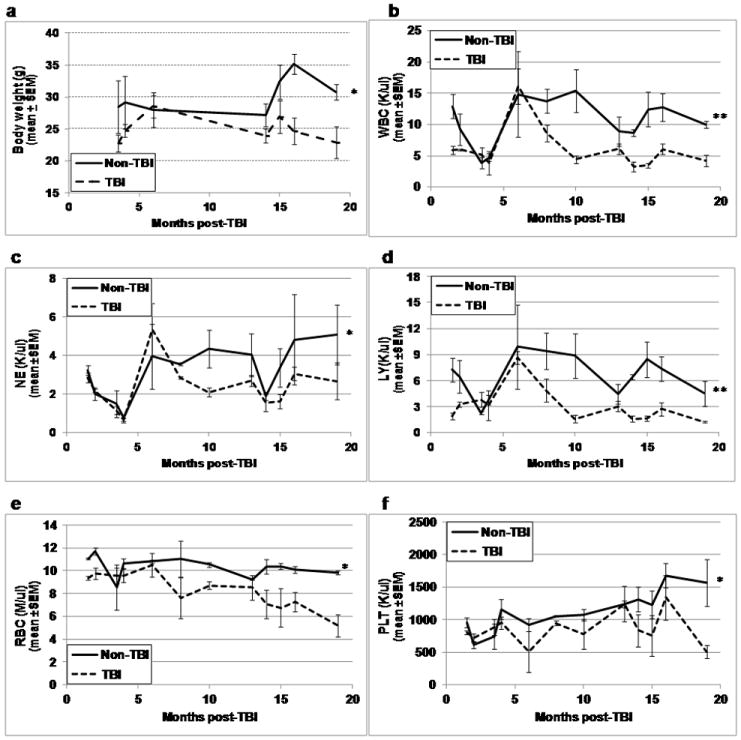
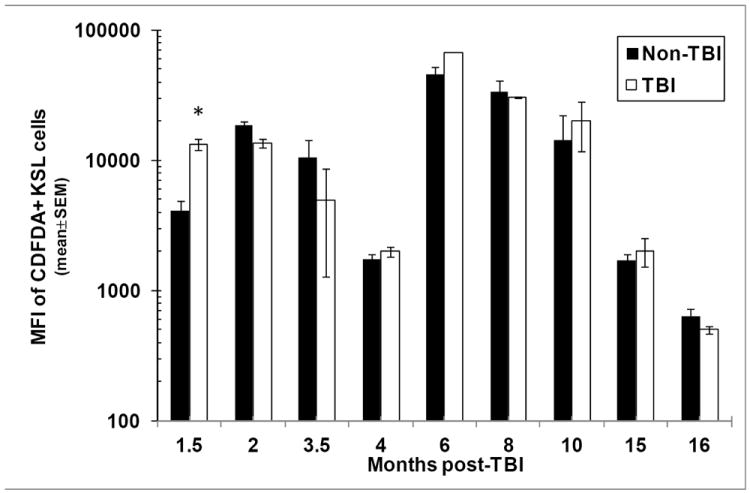
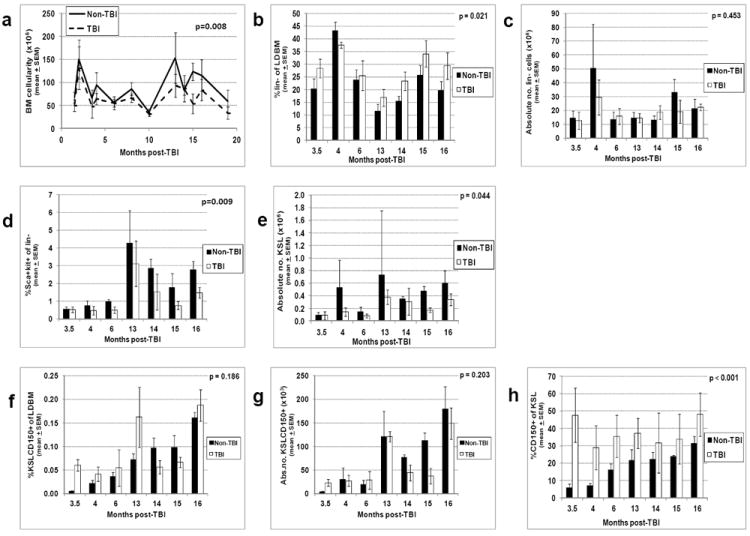
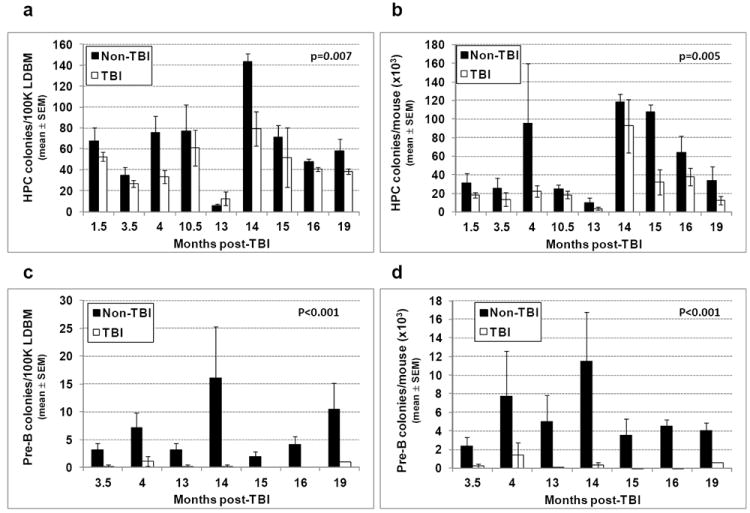
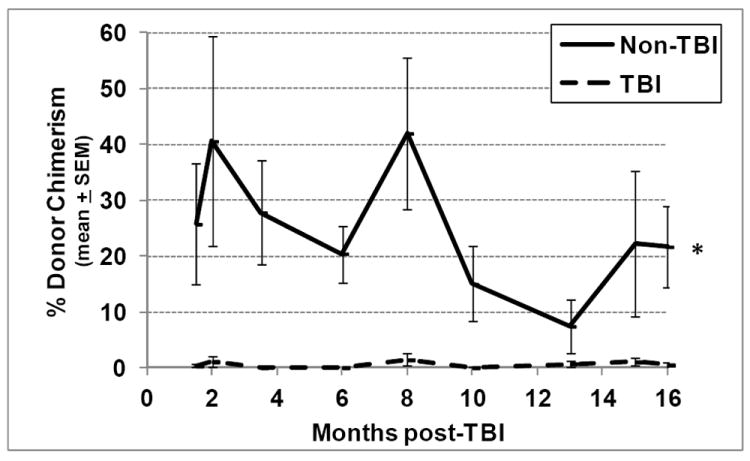
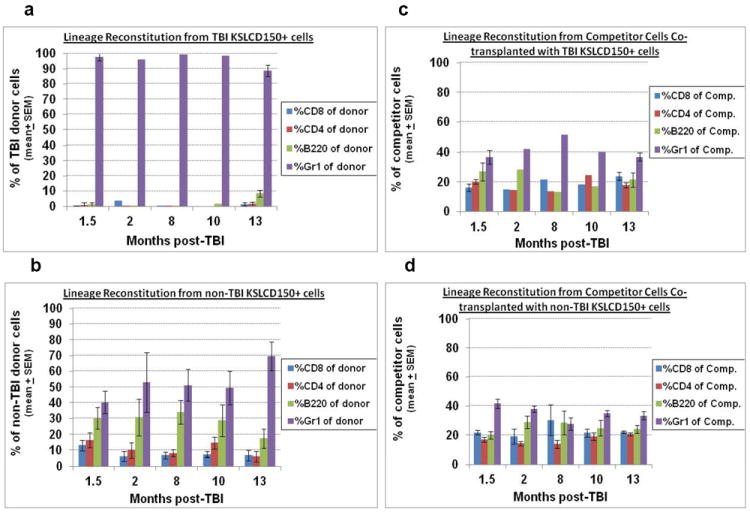
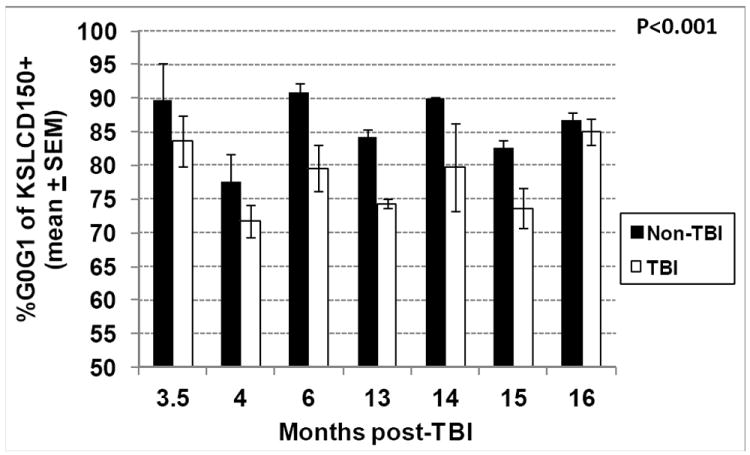
Residual bone marrow damage (RBMD) persists for years following exposure to radiation and is believed to be due to decreased self-renewal potential of radiation-damaged hematopoietic stem cells (HSC). Current literature has examined primarily sublethal doses of radiation and time points within a few months of exposure. In this study, the authors examined RBMD in mice surviving lethal doses of total body ionizing irradiation (TBI) in a murine model of the Hematopoietic Syndrome of the Acute Radiation Syndrome (H-ARS). Survivors were analyzed at various time points up to 19 mo post-TBI for hematopoietic function. The competitive bone marrow (BM) repopulating potential of 150 purified c-Kit+ Sca-1+ lineage- CD150+ cells (KSLCD150+) remained severely deficient throughout the study compared to KSLCD150+ cells from non-TBI age-matched controls. The minimal engraftment from these TBI HSCs is predominantly myeloid, with minimal production of lymphocytes both in vitro and in vivo. All classes of blood cells as well as BM cellularity were significantly decreased in TBI mice, especially at later time points as mice aged. Primitive BM hematopoietic cells (KSLCD150+) displayed significantly increased cell cycling in TBI mice at all time points, which may be a physiological attempt to maintain HSC numbers in the post-irradiation state. Taken together, these data suggest that the increased cycling among primitive hematopoietic cells in survivors of lethal radiation may contribute to long-term HSC exhaustion and subsequent RBMD, exacerbated by the added insult of aging at later time points.
残留骨髓损伤(RBMD)在暴露于辐射后持续多年,据信是由于辐射损伤的造血干细胞(HSC)自我更新潜力下降所致。目前的文献主要研究了亚致死剂量的辐射和暴露后几个月内的时间点。在这项研究中,作者在急性辐射综合征造血综合征(H-ARS)的小鼠模型中,研究了接受致死剂量全身电离照射(TBI)的小鼠中的 RBMD。幸存者在 TBI 后长达 19 个月的时间内,在各个时间点进行了造血功能分析。与非 TBI 年龄匹配对照的 KSLCD150+细胞相比,150 个纯化的 c-Kit+ Sca-1+谱系-CD150+细胞(KSLCD150+)的竞争骨髓(BM)再殖潜力在整个研究过程中仍然严重不足。这些来自 TBI HSCs 的最小植入物主要是骨髓细胞,无论是在体外还是体内,产生的淋巴细胞都很少。TBI 小鼠的所有类型的血细胞和 BM 细胞均显著减少,尤其是随着小鼠年龄的增长,后期时间点更为明显。原始 BM 造血细胞(KSLCD150+)在 TBI 小鼠中的细胞周期明显增加,这可能是在辐射后状态下维持 HSC 数量的生理尝试。综上所述,这些数据表明,致命辐射幸存者中原始造血细胞的细胞周期增加可能导致长期 HSC 衰竭和随后的 RBMD,并在后期因年龄增加而加重。