Los Angeles Biomedical Research Institute at Harbor-UCLA Medical Center, Torrance, California, USA.
Emerg Infect Dis. 2012 Sep;18(9):1414-21. doi: 10.3201/eid1809.111564.
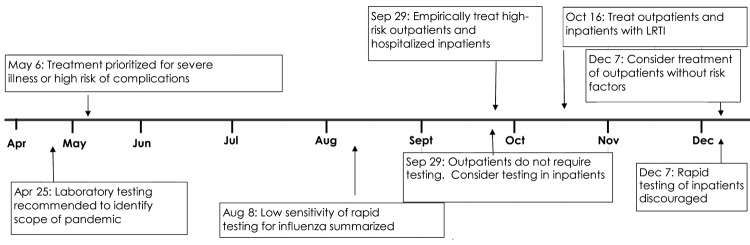
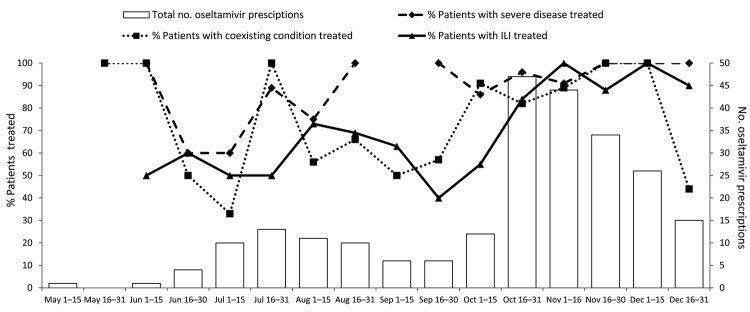
To assess adherence to real-time changes in guidelines for influenza diagnosis and use of oseltamivir during the 2009 influenza A(H1N1) pandemic, we reviewed medical records of patients with confirmed or suspected influenza-like illness (ILI) and those with no viral testing in a large Los Angeles (California, USA) hospital. Of 882 tested patients, 178 had results positive for influenza; 136 of the remaining patients received oseltamivir despite negative or no results. Oseltamivir use was consistent with national recommendations in >90%. Of inpatients, children were less likely than adults to have ILI at testing and to receive oseltamivir if ILI was found. Of outpatients, children were more likely to have positive test results; 20% tested did not have ILI or other influenza signs and symptoms. Twenty-five of 96 test-positive patients and 13 of 19 with lower respiratory tract disease were, inappropriately, not treated. Variations between practice and national recommendations could inform clinical education in future influenza seasons.
为了评估在 2009 年甲型 H1N1 流感大流行期间,对流感诊断指南实时变化和奥司他韦使用的依从性,我们对在一家大型洛杉矶(加利福尼亚州,美国)医院确诊或疑似流感样疾病(ILI)的患者和未进行病毒检测的患者的病历进行了回顾。在 882 名接受检测的患者中,有 178 名结果呈流感阳性;其余 136 名患者尽管结果为阴性或未检测,仍接受了奥司他韦治疗。奥司他韦的使用与全国建议一致,超过 90%。在住院患者中,与成年人相比,儿童在检测时发生 ILI 的可能性较小,如果发现 ILI,则接受奥司他韦治疗的可能性也较小。在门诊患者中,儿童更有可能检测结果呈阳性;20%的检测者没有 ILI 或其他流感症状和体征。在 96 名检测阳性的患者中,有 25 名和在 19 名患有下呼吸道疾病的患者未得到适当治疗。未来流感季节,可根据临床实践和国家建议之间的差异,开展临床教育。