University Hospital of Copenhagen, Herlev Hospital, Copenhagen, Denmark.
Thromb J. 2012 Aug 30;10(1):17. doi: 10.1186/1477-9560-10-17.
Computer-assistance and self-monitoring lower the cost and may improve the quality of anticoagulation therapy. The main purpose of this clinical investigation was to use computer-assisted oral anticoagulant therapy to improve the time to reach and the time spent within the therapeutic target range compared to traditional oral anticoagulant therapy by physicians.
54 patients were randomized equally into 3 groups. Patients in two groups used CoaguChek® systems to measure international normalized ratio (INR) values and had dosages of anticoagulation treatment calculated in a computer system by an algorithm specific to each group. The third group received traditional anticoagulation treatment by physicians. The obtained INR values were compared regarding the time to reach, and the time spent within, the therapeutic target range, corresponding to INR values from 2 to 3.
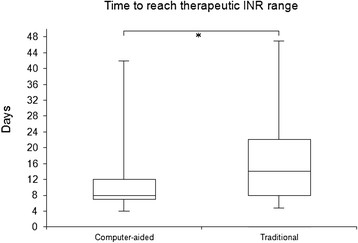
Patients randomized to computer-assisted anticoagulation and the CoaguChek® system reached the therapeutic target range after 8 days compared to 14 days by prescriptions from physicians (p = 0.04). Time spent in the therapeutic target range did not differ between groups. The median INR value measured throughout the study from all patients by CoaguChek® at 2.5 (2.42-2.62) was lower than measured by a hospital-based Clinical and Biochemical Laboratory at 2.6 (2.45-2.76), (p = 0.02).
The therapeutic target range was reached faster by the use of computer-assisted anticoagulation treatment than prescribed by physicians, and the total time spent within the therapeutic target range was similar. Thus computer-assisted oral anticoagulant therapy may reduce the cost of anticoagulation therapy without lowering the quality. INR values measured by CoaguChek® were reliable compared to measurements by a clinical and biochemical laboratory.
计算机辅助和自我监测可以降低成本,并可能提高抗凝治疗的质量。本临床研究的主要目的是使用计算机辅助口服抗凝治疗,与传统的医生口服抗凝治疗相比,提高达到治疗目标范围的时间和在治疗目标范围内花费的时间。
54 名患者被随机平均分为 3 组。两组患者使用 CoaguChek®系统测量国际标准化比值(INR)值,并通过特定于每组的算法在计算机系统中计算抗凝治疗剂量。第三组患者接受传统的医生抗凝治疗。比较各组获得的 INR 值,以达到治疗目标范围的时间和 INR 值为 2 至 3 时的时间。
随机接受计算机辅助抗凝治疗和 CoaguChek®系统的患者在 8 天内达到治疗目标范围,而医生处方的患者则在 14 天内达到(p=0.04)。两组患者在治疗目标范围内的时间没有差异。所有患者通过 CoaguChek®测量的研究期间的中位数 INR 值为 2.5(2.42-2.62),低于医院临床和生化实验室测量的 2.6(2.45-2.76)(p=0.02)。
与医生处方相比,使用计算机辅助抗凝治疗更快地达到治疗目标范围,并且在治疗目标范围内花费的总时间相似。因此,计算机辅助口服抗凝治疗可以降低抗凝治疗的成本,而不会降低质量。与临床和生化实验室的测量值相比,CoaguChek®测量的 INR 值是可靠的。