Balance Disorders Laboratory, Departments of Neurology and Behavioral Neuroscience, Oregon Health and Science University, 505 NW 185th Ave., Beaverton, OR 97006, USA.
Exp Brain Res. 2012 Oct;222(4):455-70. doi: 10.1007/s00221-012-3232-3. Epub 2012 Aug 31.
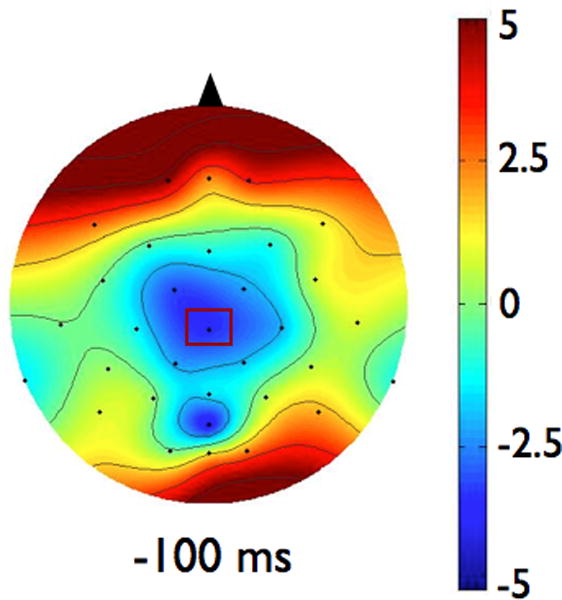
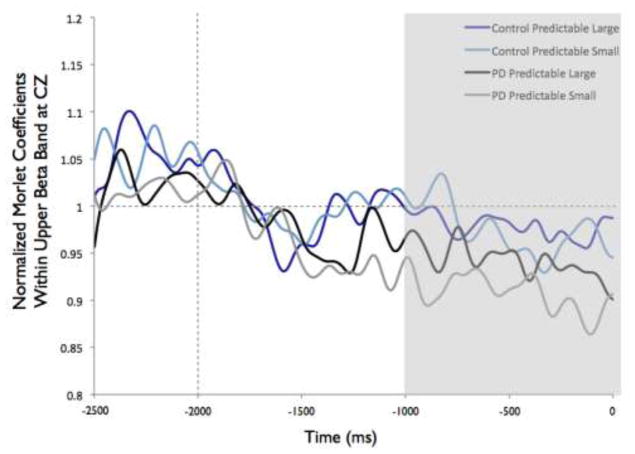
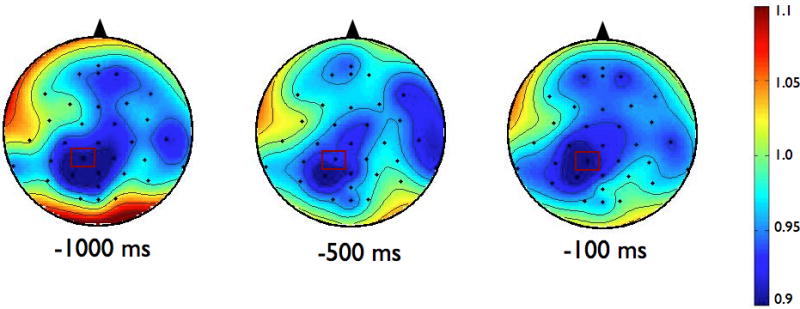
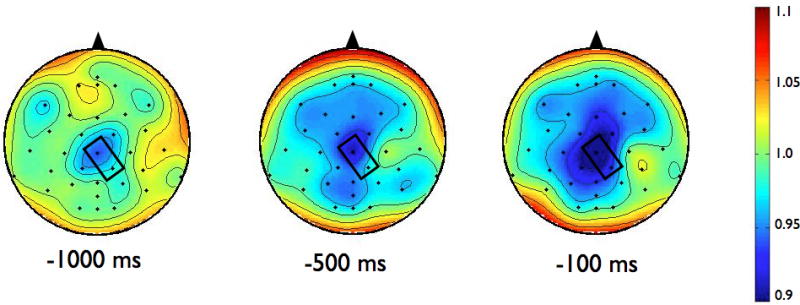
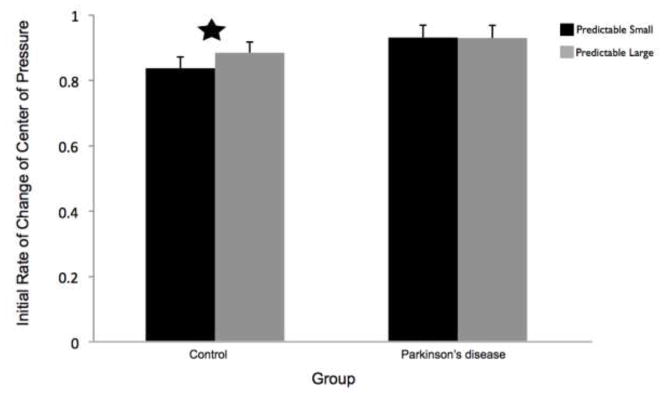
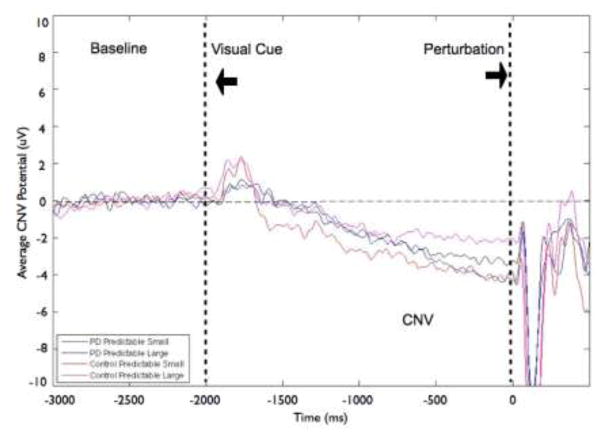
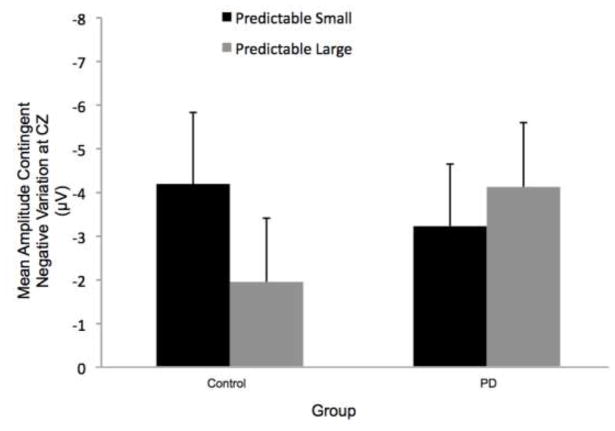
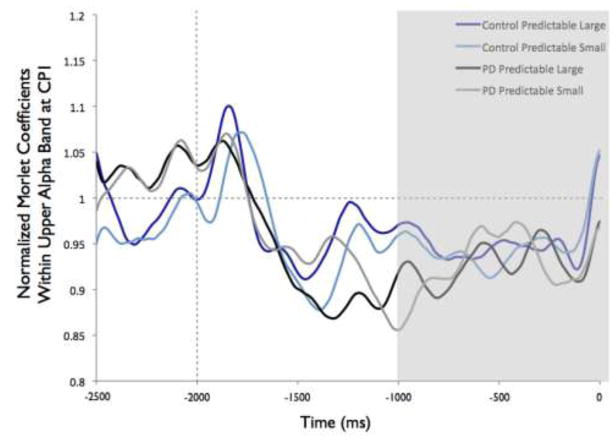
The goal of this study was to identify whether impaired cortical preparation may relate to impaired scaling of postural responses of people with Parkinson's disease (PD). We hypothesized that impaired scaling of postural responses in participants with PD would be associated with impaired set-dependent cortical activity in preparation for perturbations of predictable magnitudes. Participants performed postural responses to backward surface translations. We examined the effects of perturbation magnitude (predictable small vs. predictable large) and predictability of magnitude (predictable vs. unpredictable-in-magnitude) on postural responses (center-of-pressure (CoP) displacements) and on preparatory electroencephalographic (EEG) measures of contingent negative variation (CNV) and alpha and beta event-related desynchronization (ERD). Our results showed that unpredictability of perturbation magnitude, but not the magnitude of the perturbation itself, was associated with increased CNV amplitude at the CZ electrode in both groups. While control participants scaled their postural responses to the predicted magnitude of the perturbation, their condition-related changes in CoP displacements were not correlated with condition-related changes in EEG preparatory activity (CNV or ERD). In contrast, participants with PD did not scale their postural responses to the predicted magnitude of the perturbation, but they did demonstrate greater beta ERD in the condition of predictably small-magnitude perturbations and greater beta ERD than the control participants at the CZ electrode. In addition, increased beta ERD in PD was associated with decreased adaptability of postural responses, suggesting that preparatory cortical activity may have a more direct influence on postural response scaling for people with PD than for control participants.
本研究旨在确定皮质准备不足是否与帕金森病(PD)患者的姿势反应缩放能力受损有关。我们假设 PD 患者的姿势反应缩放能力受损与可预测幅度的干扰下依赖设定的皮质活动受损有关。参与者进行了向后表面平移的姿势反应。我们考察了干扰幅度(可预测小幅度与可预测大幅度)和幅度可预测性(可预测与幅度不可预测)对姿势反应(压力中心(CoP)位移)和预备性脑电图(EEG)的 contingent negative variation(CNV)和 alpha 及 beta 事件相关去同步化(ERD)的影响。结果表明,在两组中,不可预测的干扰幅度而非干扰幅度本身与 Cz 电极处的 CNV 振幅增加有关。尽管对照组根据预期的干扰幅度调整了姿势反应,但 CoP 位移的条件相关变化与 EEG 预备活动(CNV 或 ERD)的条件相关变化无关。相比之下,PD 患者并未根据预期的干扰幅度调整姿势反应,但在可预测小幅度干扰的条件下,他们表现出更大的 beta ERD,且 Cz 电极处的 beta ERD 大于对照组。此外,PD 患者的 beta ERD 增加与姿势反应适应性降低有关,这表明预备皮质活动对 PD 患者的姿势反应缩放可能比对照组有更直接的影响。