UCD Obstetrics and Gynaecology, School of Medicine and Medical Science, University College Dublin, National Maternity Hospital, Dublin, Ireland.
BMJ. 2012 Aug 30;345:e5605. doi: 10.1136/bmj.e5605.
To determine if a low glycaemic index diet in pregnancy could reduce the incidence of macrosomia in an at risk group.
Randomised controlled trial.
Maternity hospital in Dublin, Ireland.
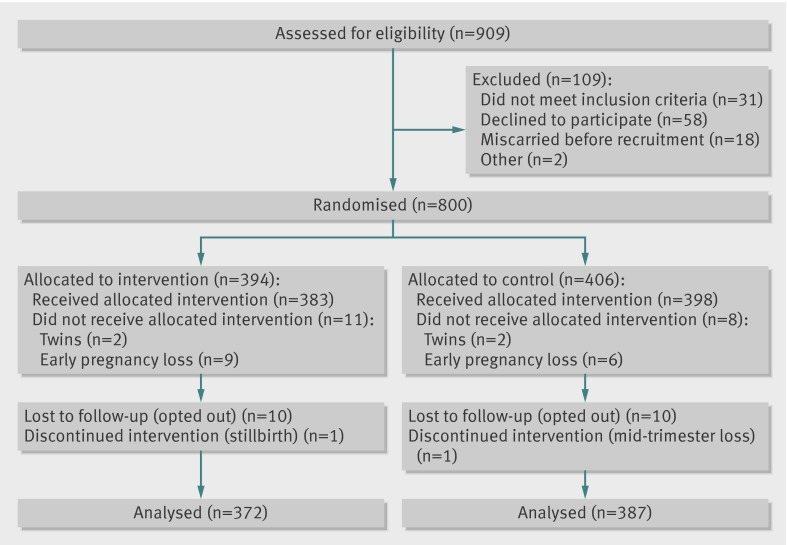
800 women without diabetes, all in their second pregnancy between January 2007 to January 2011, having previously delivered an infant weighing greater than 4 kg.
Women were randomised to receive no dietary intervention or start on a low glycaemic index diet from early pregnancy.
The primary outcome measure was difference in birth weight. The secondary outcome measure was difference in gestational weight gain.
No significant difference was seen between the two groups in absolute birth weight, birthweight centile, or ponderal index. Significantly less gestational weight gain occurred in women in the intervention arm (12.2 v 13.7 kg; mean difference -1.3, 95% confidence interval -2.4 to -0.2; P=0.01). The rate of glucose intolerance was also lower in the intervention arm: 21% (67/320) compared with 28% (100/352) of controls had a fasting glucose of 5.1 mmol/L or greater or a 1 hour glucose challenge test result of greater than 7.8 mmol/L (P=0.02).
A low glycaemic index diet in pregnancy did not reduce the incidence of large for gestational age infants in a group at risk of fetal macrosomia. It did, however, have a significant positive effect on gestational weight gain and maternal glucose intolerance.
Current Controlled Trials ISRCTN54392969.
探讨孕期低血糖生成指数饮食是否能降低高危人群中巨大儿的发生率。
随机对照试验。
爱尔兰都柏林的一家妇产医院。
800 名无糖尿病的孕妇,均于 2007 年 1 月至 2011 年 1 月期间进入第二次妊娠,此前分娩的婴儿体重均大于 4kg。
将这些孕妇随机分为两组,一组不进行饮食干预,另一组从妊娠早期开始采用低血糖生成指数饮食。
主要结局指标为出生体重的差异。次要结局指标为妊娠体重增加的差异。
两组之间的绝对出生体重、体重百分位或体重指数均无显著差异。干预组的妊娠体重增加显著减少(12.2 比 13.7kg;平均差异-1.3,95%置信区间-2.4 至-0.2;P=0.01)。干预组的葡萄糖耐量异常发生率也较低:21%(67/320)的孕妇空腹血糖≥5.1mmol/L,或 1 小时葡萄糖耐量试验结果>7.8mmol/L,而对照组的这一比例为 28%(100/352)(P=0.02)。
在高危胎儿巨大儿的孕妇中,孕期低血糖生成指数饮食并不能降低巨大儿的发生率。然而,它对妊娠体重增加和孕妇的葡萄糖耐量异常有显著的积极影响。
当前对照试验 ISRCTN54392969。