Brien Holden Vision Institute, The University of New South Wales, Barker St., Sydney, NSW 2052, Australia.
Indian J Ophthalmol. 2012 Sep-Oct;60(5):387-95. doi: 10.4103/0301-4738.100532.
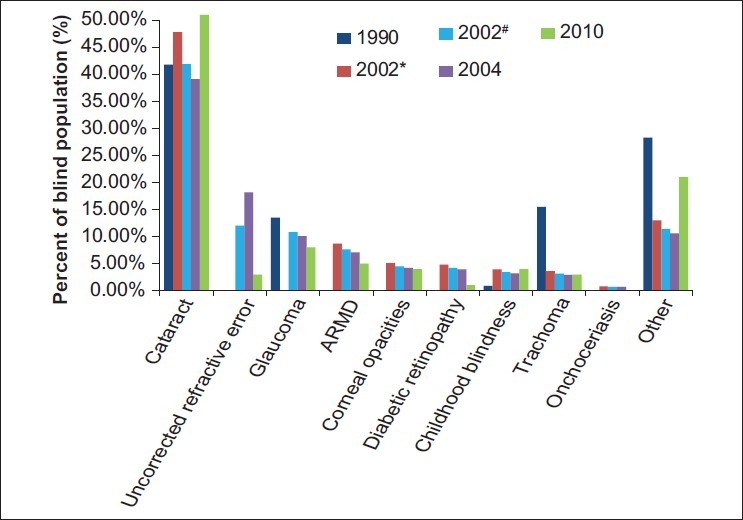
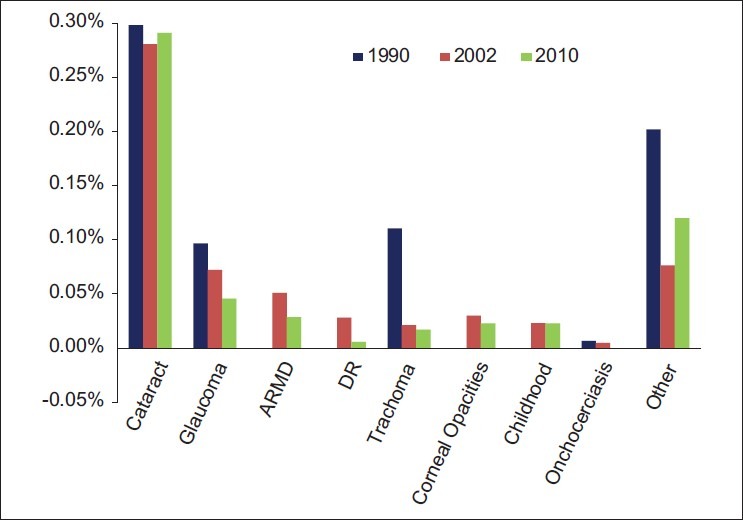
The objective of this review is to discuss the available data on the prevalence and causes of global blindness, and some of the associated trends and limitations seen. A literature search was conducted using the terms "global AND blindness" and "global AND vision AND impairment", resulting in seven appropriate articles for this review. Since 1990 the estimate of global prevalence of blindness has gradually decreased when considering the best corrected visual acuity definition: 0.71% in 1990, 0.59% in 2002, and 0.55% in 2010, corresponding to a 0.73% reduction per year over the 2002-2010 period. Significant limitations were found in the comparability between the global estimates in prevalence or causes of blindness or visual impairment. These limitations arise from various factors such as uncertainties about the true cause of the impairment, the use of different definitions and methods, and the absence of data from a number of geographical areas, leading to various extrapolation methods, which in turn seriously limit comparability. Seminal to this discussion on limitations in the comparability of studies and data, is that blindness has historically been defined using best corrected visual acuity.
本次综述的目的在于讨论全球失明的流行率和病因的现有数据,并探讨一些相关的趋势和局限性。通过使用“全球与失明”和“全球与视力与损伤”等术语进行文献检索,共检索到七篇适合本综述的文章。自 1990 年以来,考虑到最佳矫正视力的定义,全球失明流行率的估计逐渐下降:1990 年为 0.71%,2002 年为 0.59%,2010 年为 0.55%,相当于 2002-2010 年间每年下降 0.73%。在全球失明或视力损伤的流行率或病因的估计中,发现了明显的局限性。这些局限性源于多种因素,如对损伤的真正原因的不确定性、使用不同的定义和方法,以及一些地理区域缺乏数据,导致了各种外推方法,进而严重限制了可比性。本讨论的一个重要方面是研究和数据的可比性存在局限性,这是因为历史上失明一直是使用最佳矫正视力来定义的。