Department of Pathology, Leiden University Medical Center, PO Box 9600, 2300 RC, Leiden, The Netherlands.
J Transl Med. 2012 Sep 4;10:184. doi: 10.1186/1479-5876-10-184.
Cervical cancer is the third most common cancer in women worldwide. The most common histopathological subtype is cervical squamous cell carcinoma (SCC, 75-80%), followed by adenocarcinoma (AC) and adenosquamous carcinoma (ASC; together 15-20%). Rising incidence rates of AC have been observed relative and absolute to SCC and evidence is accumulating that cervical AC is a distinct clinical entity. Cervical SCC, ASC, and AC are caused by a persistent infection with high-risk human papillomavirus (HPV) and failed control of the immune system plays a pivotal role in the carcinogenesis of all three histopathological subtypes. Human leukocyte antigen E (HLA-E), a non-classical HLA class Ib molecule, plays an important role in immune surveillance and immune escape of virally infected cells. In this study we investigated HLA-E expression in three well-defined cohorts of cervical AC, ASC, and SCC patients, and determined whether HLA-E expression was associated with histopathological parameters and patient survival.
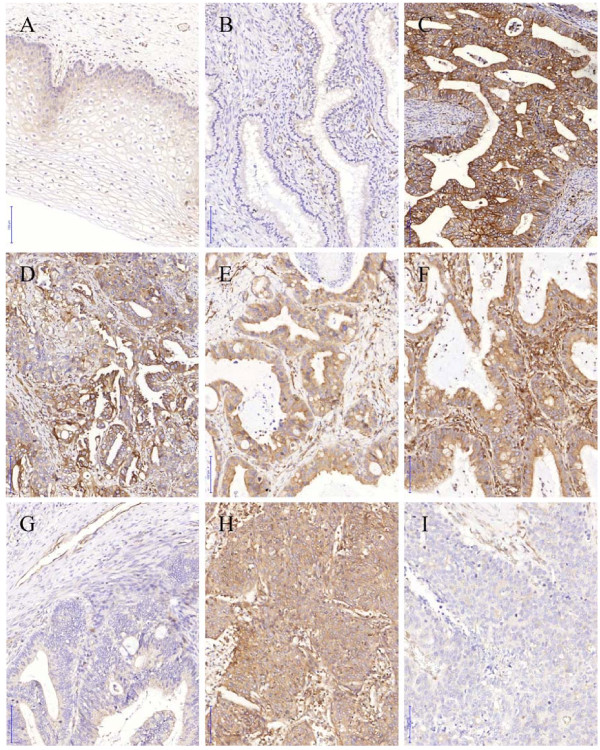
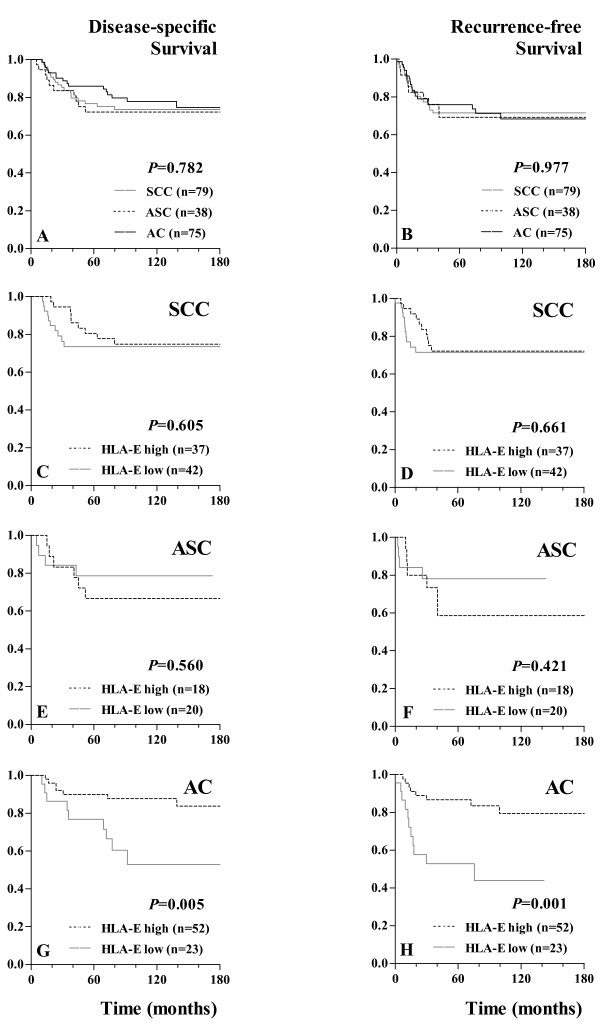
HLA-E expression was assessed by immunohistochemistry on formalin-fixed, paraffin-embedded tissue sections of 79 SCC, 38 ASC, and 75 AC patients. All patients included were International Federation of Gynaecology and Obstetrics stage I-II and underwent radical hysterectomy with lymphadenectomy as primary treatment. Significant differences between the histopathological subgroups were detected for age distribution, HPV positivity, HPV type distribution, tumour size, tumour infiltration depth, lymph-vascular space invasion, and adjuvant radiotherapy. High expression of HLA-E was found in 107/192 (56%) cervical carcinomas, with significantly more overexpression in cervical AC compared to SCC and ASC (37/79 SCC, 18/38 ASC, and 52/75 AC; P = 0.010). High HLA-E expression in cervical AC was associated with favourable long term disease-specific and recurrence-free survival (P = 0.005 and P = 0.001, respectively).
High expression of HLA-E occurred in the majority of all histopathological subtypes of cervical cancer; especially in cervical AC. High HLA-E expression in cervical AC was associated with improved patient survival. This study also highlights the importance of careful evaluation of cervical carcinomas to distinguish histopathological subtypes. In the future, insight into the biological behaviour and distinct molecular carcinogenetic processes of the AC, ASC, and SCC subtypes may contribute to the development of more tumour-specific treatment strategies.
宫颈癌是全世界女性中第三常见的癌症。最常见的组织病理学亚型是宫颈鳞状细胞癌(SCC,75-80%),其次是腺癌(AC)和腺鳞癌(ASC;共占 15-20%)。与 SCC 相比,AC 的发病率呈相对和绝对上升趋势,越来越多的证据表明宫颈 AC 是一种独特的临床实体。宫颈 SCC、ASC 和 AC 是由高危型人乳头瘤病毒(HPV)持续感染引起的,免疫系统的失控在所有三种组织病理学亚型的癌变中起着关键作用。人类白细胞抗原 E(HLA-E)是一种非经典的 HLA Ⅰ类分子,在病毒感染细胞的免疫监视和免疫逃逸中发挥重要作用。在这项研究中,我们调查了三个明确定义的宫颈 AC、ASC 和 SCC 患者队列中 HLA-E 的表达情况,并确定了 HLA-E 表达是否与组织病理学参数和患者生存相关。
通过免疫组织化学方法检测了 79 例 SCC、38 例 ASC 和 75 例 AC 患者福尔马林固定、石蜡包埋组织切片中的 HLA-E 表达。所有纳入的患者均为国际妇产科联合会(FIGO)分期 I-II 期,接受根治性子宫切除术和淋巴结切除术作为主要治疗方法。在年龄分布、HPV 阳性、HPV 型分布、肿瘤大小、肿瘤浸润深度、淋巴血管空间侵犯和辅助放疗方面,在组织病理学亚组之间检测到显著差异。在 192 例宫颈癌中发现 HLA-E 高表达 107 例(56%),与 SCC 和 ASC 相比,宫颈 AC 中 HLA-E 的过表达更为显著(37/79 SCC、18/38 ASC 和 52/75 AC;P = 0.010)。宫颈 AC 中 HLA-E 的高表达与长期疾病特异性和无复发生存率的改善相关(P = 0.005 和 P = 0.001)。
HLA-E 的高表达发生在宫颈癌的所有组织病理学亚型中,尤其是在宫颈 AC 中。宫颈 AC 中 HLA-E 的高表达与患者生存改善相关。本研究还强调了仔细评估宫颈癌以区分组织病理学亚型的重要性。在未来,对 AC、ASC 和 SCC 亚型的生物学行为和独特的分子致癌过程的深入了解,可能有助于开发更具肿瘤特异性的治疗策略。