Cancer Bioimmunotherapy Unit, Centro di Riferimento Oncologico, Istituto di Ricovero e Cura a Carattere Scientifico, Aviano, Italy.
J Transl Med. 2012 Sep 5;10:185. doi: 10.1186/1479-5876-10-185.
The clinical course of cutaneous melanoma (CM) can differ significantly for patients with identical stages of disease, defined clinico-pathologically, and no molecular markers differentiate patients with such a diverse prognosis. This study aimed to define the prognostic value of whole genome DNA methylation profiles in stage III CM.
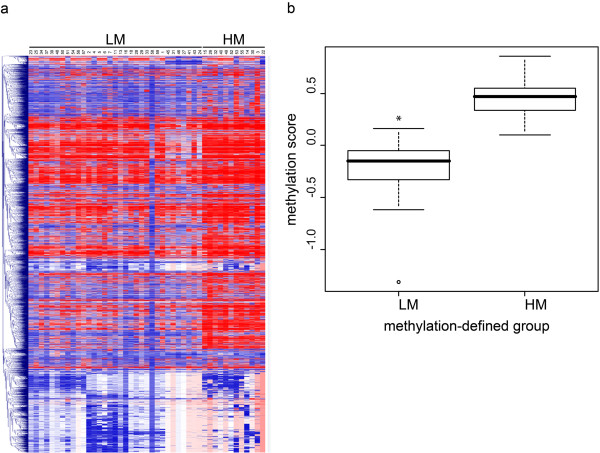
Genome-wide methylation profiles were evaluated by the Illumina Human Methylation 27 BeadChip assay in short-term neoplastic cell cultures from 45 stage IIIC CM patients. Unsupervised K-means partitioning clustering was exploited to sort patients into 2 groups based on their methylation profiles. Methylation patterns related to the discovered groups were determined using the nearest shrunken centroid classification algorithm. The impact of genome-wide methylation patterns on overall survival (OS) was assessed using Cox regression and Kaplan-Meier analyses.
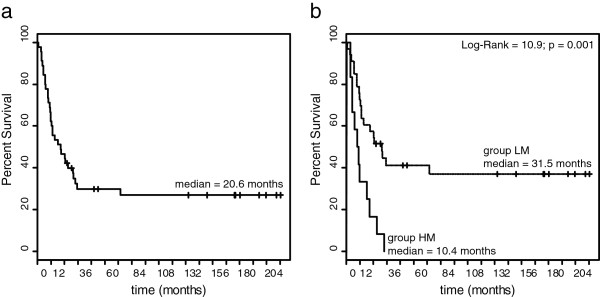
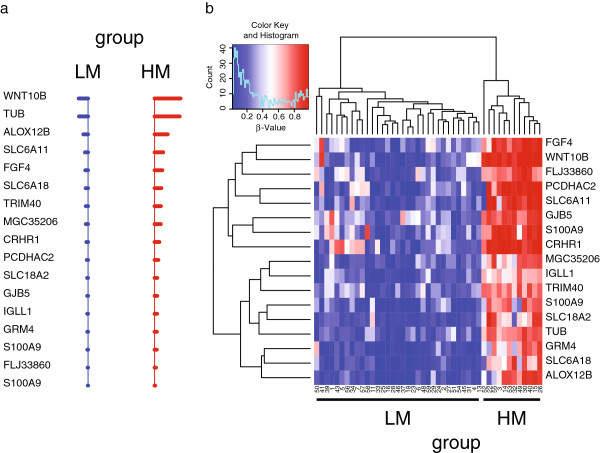
Unsupervised K-means partitioning by whole genome methylation profiles identified classes with significantly different OS in stage IIIC CM patients. Patients with a "favorable" methylation profile had increased OS (P = 0.001, log-rank = 10.2) by Kaplan-Meier analysis. Median OS of stage IIIC patients with a "favorable" vs. "unfavorable" methylation profile were 31.5 and 10.4 months, respectively. The 5 year OS for stage IIIC patients with a "favorable" methylation profile was 41.2% as compared to 0% for patients with an "unfavorable" methylation profile. Among the variables examined by multivariate Cox regression analysis, classification defined by methylation profile was the only predictor of OS (Hazard Ratio = 2.41, for "unfavorable" methylation profile; 95% Confidence Interval: 1.02-5.70; P = 0.045). A 17 gene methylation signature able to correctly assign prognosis (overall error rate = 0) in stage IIIC patients on the basis of distinct methylation-defined groups was also identified.
A discrete whole-genome methylation signature has been identified as molecular marker of prognosis for stage IIIC CM patients. Its use in daily practice is foreseeable, and promises to refine the comprehensive clinical management of stage III CM patients.
临床病程皮肤黑色素瘤(CM)可以显著不同的患者具有相同阶段的疾病,定义 clinico 病理,并没有分子标记区分具有这种不同预后的患者。本研究旨在确定全基因组 DNA 甲基化谱在 III 期 CM 的预后价值。
基因组广泛的甲基化谱通过 Illumina Human Methylation 27 BeadChip assay 在 45 例 IIIC 期 CM 患者的短期肿瘤细胞培养物中进行评估。利用无监督 K-均值分区聚类方法根据其甲基化谱将患者分为 2 组。使用最近收缩质心分类算法确定与发现的组相关的甲基化模式。使用 Cox 回归和 Kaplan-Meier 分析评估全基因组甲基化模式对总生存(OS)的影响。
通过全基因组甲基化谱的无监督 K-均值分区将 IIIC 期 CM 患者分为具有显著不同 OS 的类别。具有“有利”甲基化谱的患者具有增加的 OS(P=0.001,对数秩=10.2)通过 Kaplan-Meier 分析。具有“有利”与“不利”甲基化谱的 IIIC 期患者的中位 OS 分别为 31.5 和 10.4 个月。具有“有利”甲基化谱的 IIIC 期患者的 5 年 OS 为 41.2%,而具有“不利”甲基化谱的患者为 0%。在多变量 Cox 回归分析中检查的变量中,通过甲基化谱定义的分类是 OS 的唯一预测因子(危险比=2.41,对于“不利”甲基化谱;95%置信区间:1.02-5.70;P=0.045)。还确定了一个 17 个基因甲基化特征,能够根据不同的甲基化定义组正确分配 IIIC 期患者的预后(总体错误率=0)。
已经确定了离散的全基因组甲基化特征作为 IIIC 期 CM 患者预后的分子标志物。它在日常实践中的使用是可以预见的,并有望完善 III 期 CM 患者的综合临床管理。