Bloomberg School of Public Health, Johns Hopkins University, Baltimore, Maryland, United States of America.
PLoS Med. 2012;9(8):e1001298. doi: 10.1371/journal.pmed.1001298. Epub 2012 Aug 28.
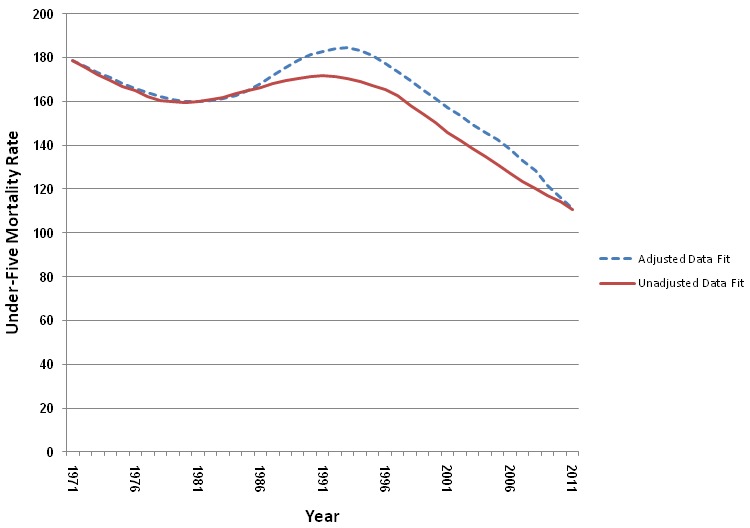
In most low- and middle-income countries, child mortality is estimated from data provided by mothers concerning the survival of their children using methods that assume no correlation between the mortality risks of the mothers and those of their children. This assumption is not valid for populations with generalized HIV epidemics, however, and in this review, we show how the United Nations Inter-agency Group for Child Mortality Estimation (UN IGME) uses a cohort component projection model to correct for AIDS-related biases in the data used to estimate trends in under-five mortality. In this model, births in a given year are identified as occurring to HIV-positive or HIV-negative mothers, the lives of the infants and mothers are projected forward using survivorship probabilities to estimate survivors at the time of a given survey, and the extent to which excess mortality of children goes unreported because of the deaths of HIV-infected mothers prior to the survey is calculated. Estimates from the survey for past periods can then be adjusted for the estimated bias. The extent of the AIDS-related bias depends crucially on the dynamics of the HIV epidemic, on the length of time before the survey that the estimates are made for, and on the underlying non-AIDS child mortality. This simple methodology (which does not take into account the use of effective antiretroviral interventions) gives results qualitatively similar to those of other studies.
在大多数中低收入国家,儿童死亡率是根据母亲提供的有关其子女存活情况的数据估计的,这些数据采用的方法假设母亲和子女的死亡率之间没有相关性。然而,对于普遍存在艾滋病毒流行的人群来说,这种假设是不成立的。在本综述中,我们展示了联合国儿童死亡率估计机构间小组(UN IGME)如何使用队列成分预测模型来纠正用于估计五岁以下儿童死亡率趋势的数据中与艾滋病相关的偏差。在该模型中,当年的出生被确定为来自 HIV 阳性或 HIV 阴性母亲,使用生存率来预测婴儿和母亲的生命,并计算由于调查前感染 HIV 的母亲死亡而导致儿童超额死亡未被报告的程度。然后,可以根据估计的偏差调整过去时期的调查估计值。与艾滋病相关的偏差程度取决于 HIV 流行的动态、用于估计的调查前时间长度以及潜在的非艾滋病儿童死亡率。这种简单的方法(未考虑使用有效的抗逆转录病毒干预措施)得出的结果与其他研究的结果定性相似。