Goldsmiths, University of London, London, United Kingdom.
PLoS One. 2012;7(8):e43101. doi: 10.1371/journal.pone.0043101. Epub 2012 Aug 28.
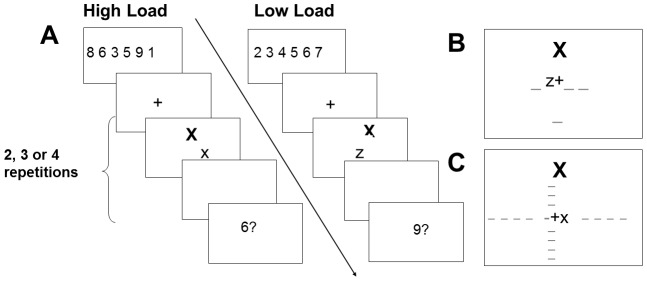
Working memory (WM) is imperative for effective selective attention. Distractibility is greater under conditions of high (vs. low) concurrent working memory load (WML), and in individuals with low (vs. high) working memory capacity (WMC). In the current experiments, we recorded the flanker task performance of individuals with high and low WMC during low and high WML, to investigate the combined effect of WML and WMC on selective attention.
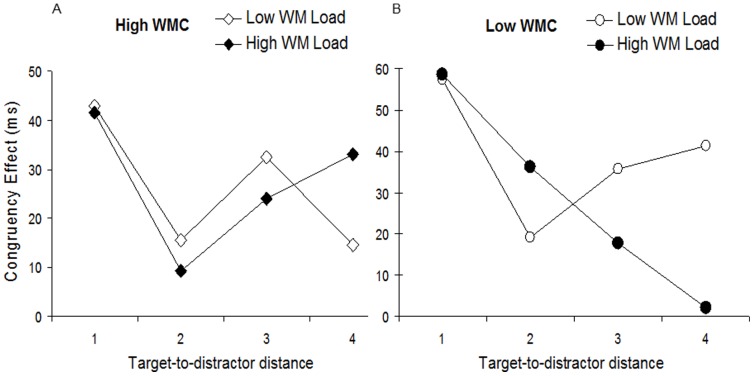
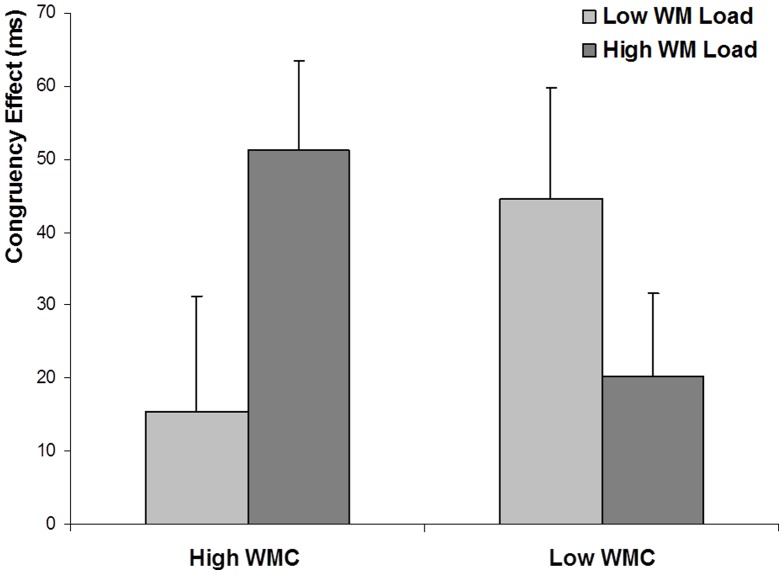
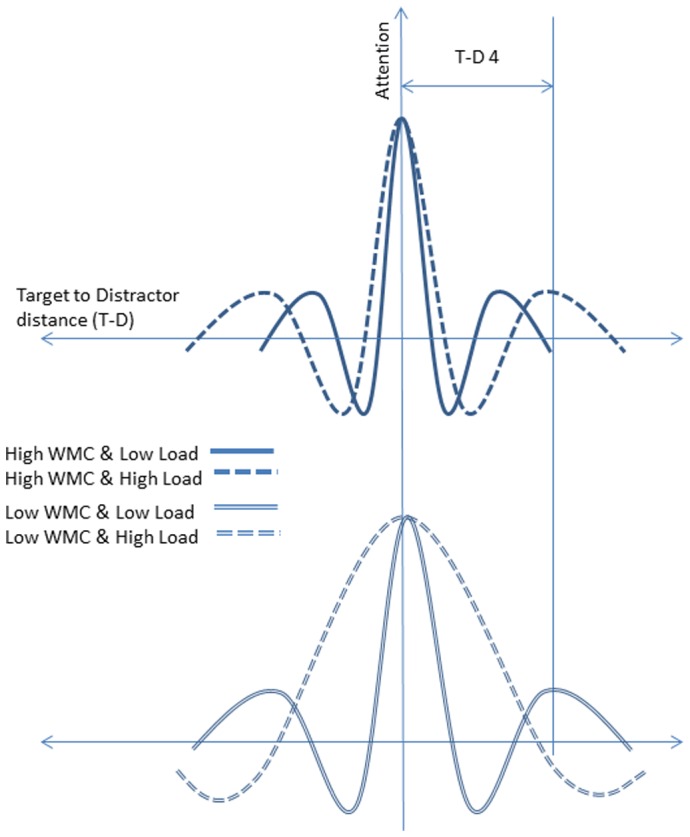
METHODOLOGY/PRINCIPAL FINDINGS: In Experiment 1, distractibility from a distractor at a fixed distance from the target was greater when either WML was high or WMC was low, but surprisingly smaller when both WML was high and WMC low. Thus we observed an inverted-U relationship between reductions in WM resources and distractibility. In Experiment 2, we mapped the distribution of spatial attention as a function of WMC and WML, by recording distractibility across several target-to-distractor distances. The pattern of distractor effects across the target-to-distractor distances demonstrated that the distribution of the attentional window becomes dispersed as WM resources are limited. The attentional window was more spread out under high compared to low WML, and for low compared to high WMC individuals, and even more so when the two factors co-occurred (i.e., under high WML in low WMC individuals). The inverted-U pattern of distractibility effects in Experiment 1, replicated in Experiment 2, can thus be explained by differences in the spread of the attentional window as a function of WM resource availability.
CONCLUSIONS/SIGNIFICANCE: The current findings show that limitations in WM resources, due to either WML or individual differences in WMC, affect the spatial distribution of attention. The difference in attentional constraining between high and low WMC individuals demonstrated in the current experiments helps characterise the nature of previously established associations between WMC and controlled attention.
工作记忆(WM)对有效选择性注意至关重要。在高(低)并发工作记忆负荷(WML)和低(高)工作记忆容量(WMC)个体中,分心度更高。在当前的实验中,我们记录了高 WMC 和低 WMC 个体在低 WML 和高 WML 下进行 Flanker 任务时的表现,以研究 WML 和 WMC 对选择性注意的综合影响。
方法/主要发现:在实验 1 中,当 WML 高或 WMC 低时,来自与目标固定距离的分心物的分心度更大,但当 WML 和 WMC 都高时,分心度却更小。因此,我们观察到 WM 资源减少与分心度之间的倒 U 关系。在实验 2 中,我们通过记录几个目标到分心物距离上的分心度,来绘制 WM 资源和 WMC 的空间注意力分布。跨目标到分心物距离的分心效应模式表明,注意力窗口的分布随着 WM 资源的限制而变得分散。与低 WML 相比,高 WML 下注意力窗口更为分散,与高 WMC 个体相比,低 WMC 个体注意力窗口更为分散,当这两个因素同时出现时(即低 WMC 个体的高 WML 下)更为分散。实验 1 中分心效应的倒 U 模式在实验 2 中得到了复制,因此可以解释为注意力窗口的分散程度随 WM 资源可用性的变化而变化。
结论/意义:当前的发现表明,由于 WML 或 WMC 的个体差异导致的 WM 资源限制,会影响注意力的空间分布。当前实验中高 WMC 和低 WMC 个体之间注意力约束的差异有助于描述 WMC 和受控注意力之间先前建立的关联的本质。