Fort Lauderdale Research and Education Center, University of Florida/IFAS, Davie, Florida, United States of America.
PLoS One. 2012;7(8):e43865. doi: 10.1371/journal.pone.0043865. Epub 2012 Aug 28.
The molecular operational taxonomic unit (MOTU) has recently been applied to microbial and microscopic animal biodiversity surveys. However, in many cases, some of the MOTUs cannot be definitively tied to any of the taxonomic groups in current databases. To surmount these limitations, the concept of "reverse taxonomy" has been proposed, i.e. to primarily list the MOTUs with morphological information, and then identify and/or describe them at genus/species level using subsamples or by re-isolating the target organisms. Nevertheless, the application of "reverse taxonomy" has not been sufficiently evaluated. Therefore, the practical applicability of "reverse taxonomy" is tested using termite-associated nematodes as a model system for phoretic/parasitic organisms which have high habitat specificity and a potential handle (their termite host species) for re-isolation attempts.
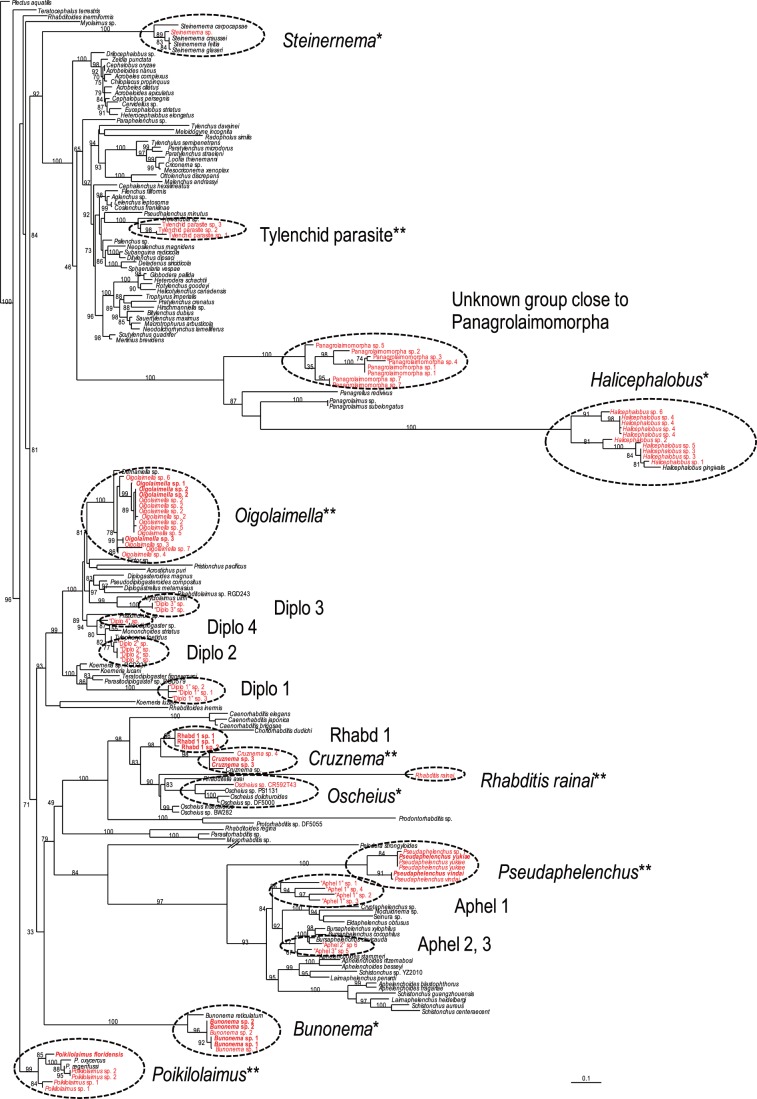
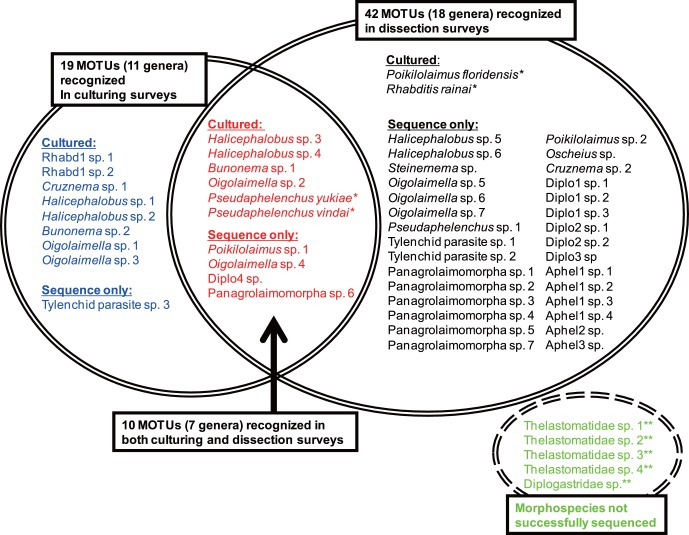
Forty-eight species (from 298 colonies) of termites collected from the American tropics and subtropics were examined for their nematode associates using the reverse taxonomy method and culturing attempts (morphological identification and further sequencing efforts). The survey yielded 51 sequence types ( = MOTUs) belonging to 19 tentatively identified genera. Within these, four were identified based on molecular data with preliminary morphological observation, and an additional seven were identified or characterized from successful culturing, leaving eight genera unidentified.
That 1/3 of the genera were not successfully identified suggests deficiencies in the depth of available sequences in the database and biological characters, i.e. usually isolated as phoretic/parasitic stages which are not available for morphological identification, and too many undiscovered lineages of nematodes. Although there still is the issue of culturability of nematodes, culturing attempts could help to make reverse taxonomy methods more effective. However, expansion of the database, i.e., production of more DNA barcodes tied to biological information by finding and characterizing additional new and known lineages, is necessary for analyzing functional diversity.
分子操作分类单元 (MOTU) 最近已被应用于微生物和微小动物生物多样性调查。然而,在许多情况下,一些 MOTU 无法明确归入当前数据库中的任何分类群。为了克服这些限制,提出了“反向分类学”的概念,即主要列出具有形态信息的 MOTU,然后使用亚样本或重新分离目标生物来鉴定和/或描述属/种水平的 MOTU。然而,“反向分类学”的应用尚未得到充分评估。因此,以白蚁相关线虫作为模型系统来测试“反向分类学”的实际适用性,因为这些线虫具有高度的栖息地特异性和重新分离的潜在手段(它们的白蚁宿主物种)。
使用反向分类学方法和培养尝试(形态鉴定和进一步测序工作),对来自美国热带和亚热带的 48 种(来自 298 个群体)白蚁进行了线虫相关研究。该调查产生了 51 个序列类型(= MOTU),属于 19 个暂定鉴定的属。在这些属中,有 4 个是根据分子数据和初步形态观察鉴定的,另外 7 个是从成功培养中鉴定或描述的,还有 8 个属未鉴定。
有 1/3 的属无法成功鉴定,这表明数据库中可用序列和生物特征存在缺陷,即通常作为寄生/寄生阶段分离,无法进行形态鉴定,并且线虫的未发现谱系过多。尽管仍然存在线虫可培养性的问题,但培养尝试可以帮助使反向分类学方法更加有效。然而,为了分析功能多样性,有必要扩展数据库,即通过发现和描述更多新的和已知的谱系,增加与生物信息相关的 DNA 条形码。