Microbioloy Department, Biomedical Research Institute-University Hospital, A Coruña, Spain.
PLoS One. 2012;7(8):e44105. doi: 10.1371/journal.pone.0044105. Epub 2012 Aug 29.
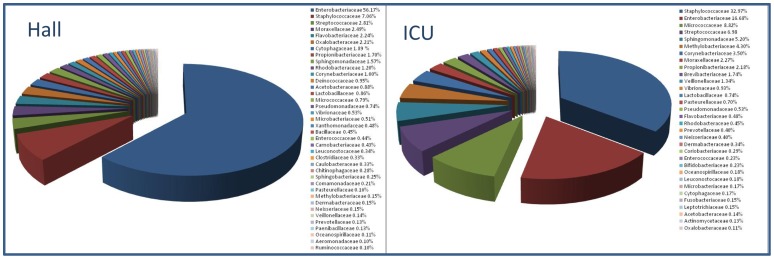
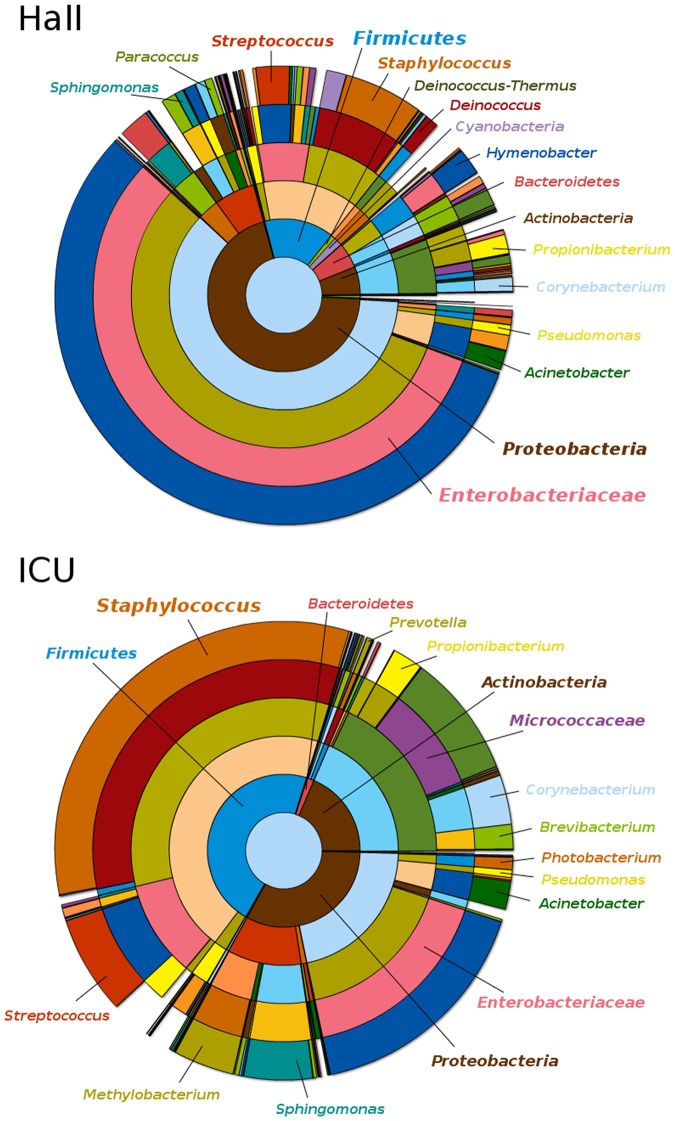
Understanding microbial populations in hospital environments is crucial for improving human health. Hospital-acquired infections are an increasing problem in intensive care units (ICU). In this work we present an exploration of bacterial diversity at inanimate surfaces of the ICU wards of the University Hospital A Coruña (Spain), as an example of confined hospital environment subjected to selective pressure, taking the entrance hall of the hospital, an open and crowded environment, as reference. Surface swab samples were collected from both locations and recovered DNA used as template to amplify a hypervariable region of the bacterial 16S rRNA gene. Sequencing of the amplicons was performed at the Roche 454 Sequencing Center using GS-FLX Titanium procedures. Reads were pre-processed and clustered into OTUs (operational taxonomic units), which were further classified. A total of 16 canonical bacterial phyla were detected in both locations. Members of the phyla Firmicutes (mainly Staphylococcus and Streptococcus) and Actinobacteria (mainly Micrococcaceae, Corynebacteriaceae and Brevibacteriaceae) were over-represented in the ICU with respect to the Hall. The phyllum Proteobacteria was also well represented in the ICU, mainly by members of the families Enterobacteriaceae, Methylobacteriaceae and Sphingomonadaceae. In the Hall sample, the phyla Proteobacteria, Bacteroidetes, Deinococcus-Thermus and Cyanobacteria were over-represented with respect to the ICU. Over-representation of Proteobacteria was mainly due to the high abundance of Enterobacteriaceae members. The presented results demonstrate that bacterial diversity differs at the ICU and entrance hall locations. Reduced diversity detected at ICU, relative to the entrance hall, can be explained by its confined character and by the existence of antimicrobial selective pressure. This is the first study using deep sequencing techniques made in hospital wards showing substantial hospital microbial diversity.
了解医院环境中的微生物种群对于改善人类健康至关重要。医院获得性感染是重症监护病房(ICU)日益严重的问题。在这项工作中,我们探索了西班牙阿科鲁尼亚大学医院(University Hospital A Coruña) ICU 病房的非生物表面的细菌多样性,作为受到选择性压力的受限医院环境的一个例子,以医院的入口大厅为参照,这是一个开放且拥挤的环境。从这两个地方采集表面拭子样本,并回收 DNA 作为模板,扩增细菌 16S rRNA 基因的高变区。使用 Roche 454 测序中心的 GS-FLX Titanium 程序对扩增子进行测序。对读取序列进行预处理,并将其聚类为操作分类单元(OTUs),然后对其进行分类。在这两个地方都检测到了 16 个典型的细菌门。厚壁菌门(主要是葡萄球菌属和链球菌属)和放线菌门(主要是微球菌科、棒状杆菌科和短杆菌科)的成员在 ICU 中相对于大厅过度表达。在 ICU 中也很好地代表了变形菌门,主要由肠杆菌科、甲基杆菌科和鞘脂单胞菌科的成员组成。在大厅样本中,相对于 ICU,变形菌门、拟杆菌门、Deinococcus-Thermus 和蓝藻门的成员过度表达。变形菌门的过度表达主要是由于肠杆菌科成员的高丰度。所呈现的结果表明,ICU 和入口大厅的细菌多样性存在差异。与大厅相比,在 ICU 检测到的多样性减少,可以用其封闭的特性和存在的抗菌选择性压力来解释。这是首次使用深度测序技术在医院病房进行的研究,显示了大量的医院微生物多样性。