College of Mechatronics and Automation, National University of Defense Technology, Changsha, Hunan, China.
PLoS One. 2012;7(8):e44530. doi: 10.1371/journal.pone.0044530. Epub 2012 Aug 30.
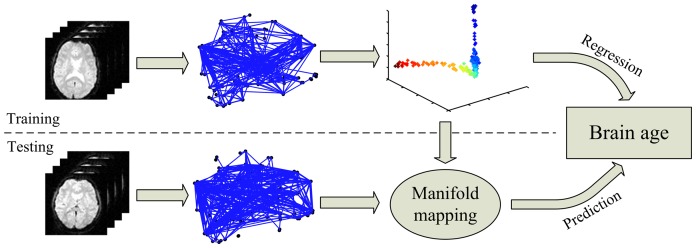
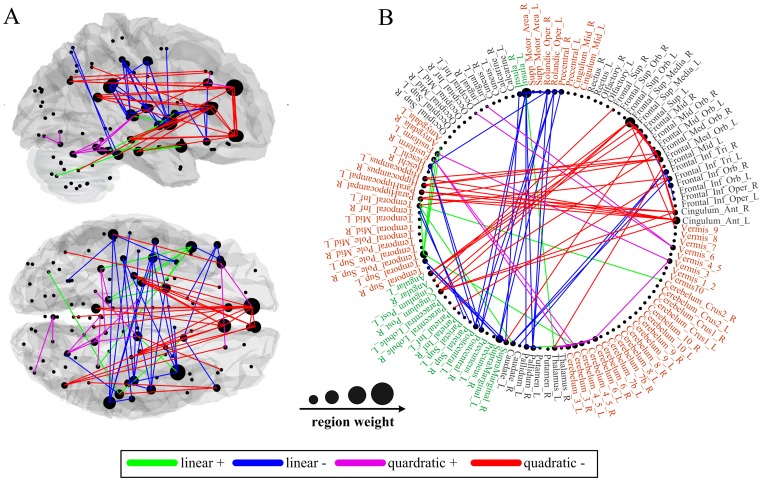
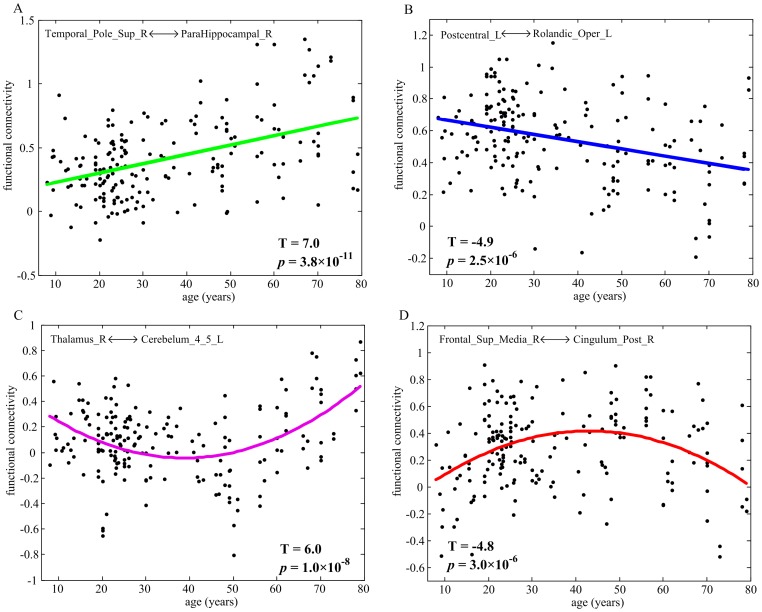
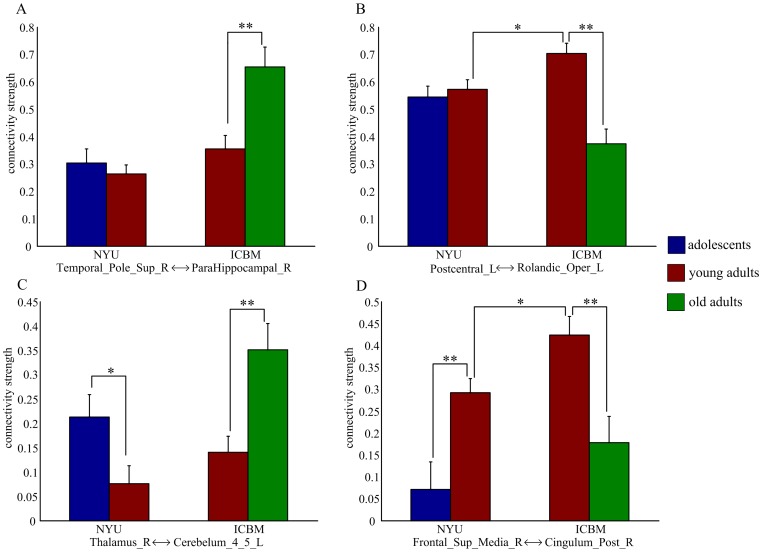
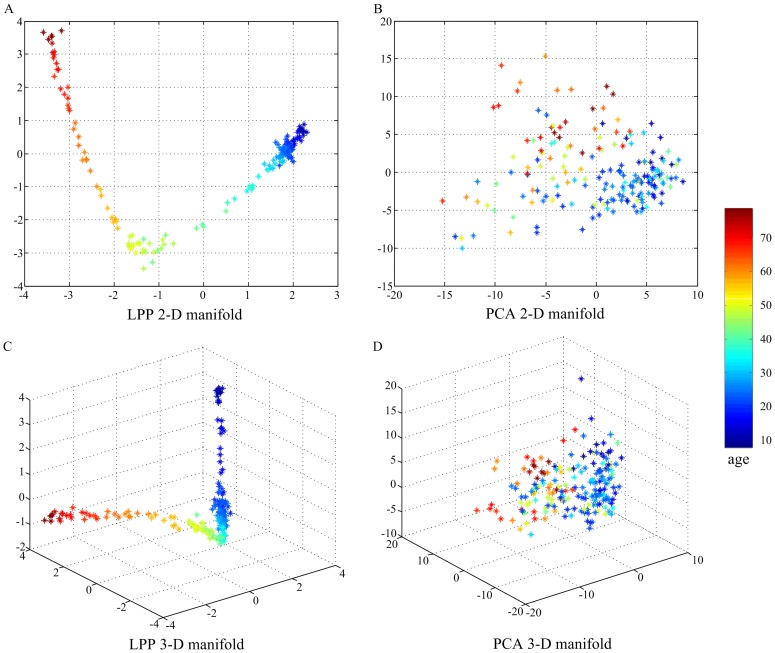
The development of large-scale functional brain networks is a complex, lifelong process that can be investigated using resting-state functional connectivity MRI (rs-fcMRI). In this study, we aimed to decode the developmental dynamics of the whole-brain functional network in seven decades (8-79 years) of the human lifespan. We first used parametric curve fitting to examine linear and nonlinear age effect on the resting human brain, and then combined manifold learning and support vector machine methods to predict individuals' "brain ages" from rs-fcMRI data. We found that age-related changes in interregional functional connectivity exhibited spatially and temporally specific patterns. During brain development from childhood to senescence, functional connections tended to linearly increase in the emotion system and decrease in the sensorimotor system; while quadratic trajectories were observed in functional connections related to higher-order cognitive functions. The complex patterns of age effect on the whole-brain functional network could be effectively represented by a low-dimensional, nonlinear manifold embedded in the functional connectivity space, which uncovered the inherent structure of brain maturation and aging. Regression of manifold coordinates with age further showed that the manifold representation extracted sufficient information from rs-fcMRI data to make prediction about individual brains' functional development levels. Our study not only gives insights into the neural substrates that underlie behavioral and cognitive changes over age, but also provides a possible way to quantitatively describe the typical and atypical developmental progression of human brain function using rs-fcMRI.
大规模功能大脑网络的发展是一个复杂的、终身的过程,可以使用静息态功能连接磁共振成像(rs-fcMRI)来研究。在这项研究中,我们旨在解码人类寿命 70 年(8-79 岁)中整个大脑功能网络的发展动态。我们首先使用参数曲线拟合来研究线性和非线性年龄对静息人脑的影响,然后结合流形学习和支持向量机方法,从 rs-fcMRI 数据预测个体的“大脑年龄”。我们发现,区域间功能连接的年龄相关性变化表现出空间和时间上的特定模式。在从儿童期到老年期的大脑发育过程中,情绪系统的功能连接倾向于呈线性增加,而感觉运动系统的功能连接则呈下降趋势;而与高级认知功能相关的功能连接则呈现出二次轨迹。大脑功能网络的复杂年龄效应模式可以通过嵌入在功能连接空间中的低维非线性流形来有效表示,揭示了大脑成熟和衰老的内在结构。与年龄的流形坐标回归进一步表明,流形表示从 rs-fcMRI 数据中提取了足够的信息,以便对个体大脑的功能发展水平进行预测。我们的研究不仅深入了解了年龄相关行为和认知变化的神经基础,还为使用 rs-fcMRI 定量描述人类大脑功能的典型和非典型发育进程提供了一种可能的方法。