Committee on Neurobiology of Addictive Disorders, The Scripps Research Institute, La Jolla, California, USA.
PLoS One. 2012;7(8):e44652. doi: 10.1371/journal.pone.0044652. Epub 2012 Aug 31.
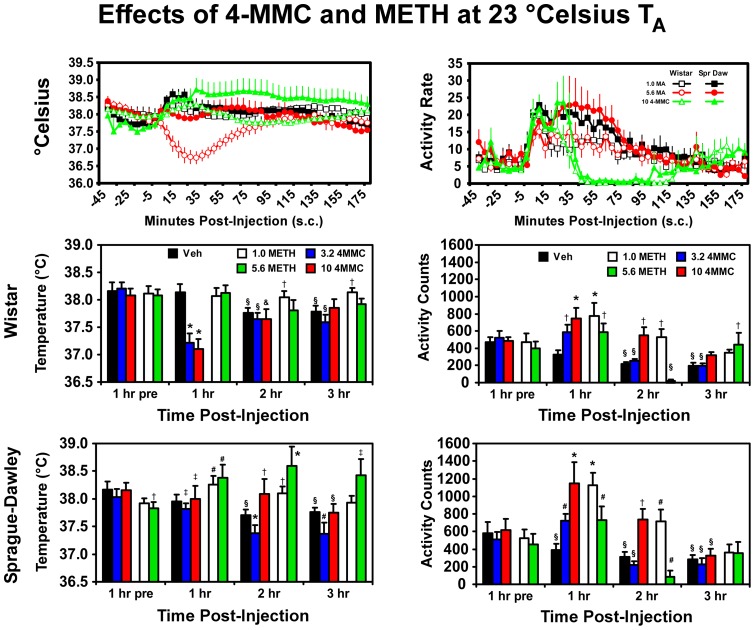
The drug 4-methylmethcathinone (4-MMC; aka, mephedrone, MMCAT, "plant food", "bath salts") is a recent addition to the list of popular recreational psychomotor-stimulant compounds. Relatively little information about this drug is available in the scientific literature, but popular media reports have driven recent drug control actions in the UK and several US States. Online user reports of subjective similarity to 3,4-methylenedioxymethamphetamine (MDMA, "Ecstasy") prompted the current investigation of the thermoregulatory and locomotor effects of 4-MMC. Male Wistar and Sprague-Dawley rats were monitored after subcutaneous administration of 4-MMC (1-10 mg/kg ) using an implantable radiotelemetry system under conditions of low (23°C) and high (27°C) ambient temperature. A reliable reduction of body temperature was produced by 4-MMC in Wistar rats at 23°C or 27°C with only minimal effect in Sprague-Dawley rats. Increased locomotor activity was observed after 4-MMC administration in both strains with significantly more activity produced in the Sprague-Dawley strain. The 10 mg/kg s.c. dose evoked greater increase in extracellular serotonin, compared with dopamine, in the nucleus accumbens. Follow-up studies confirmed that the degree of locomotor stimulation produced by 10 mg/kg 4-MMC was nearly identical to that produced by 1 mg/kg d-methamphetamine in each strain. Furthermore, hypothermia produced by the serotonin 1(A/7) receptor agonist 8-hydroxy-N,N-dipropyl-2-aminotetralin (8-OH-DPAT) was similar in each strain. These results show that the cathinone analog 4-MMC exhibits thermoregulatory and locomotor properties that are distinct from those established for methamphetamine or MDMA in prior work, despite recent evidence of neuropharmacological similarity with MDMA.
4-甲基甲卡西酮(4-MMC;又名甲卡西酮、MMCAT、“植物食物”、“浴盐”)是最近新增的流行娱乐性精神兴奋剂化合物之一。关于这种药物的信息在科学文献中相对较少,但大众媒体的报道推动了英国和美国几个州最近的药物管制行动。在线用户报告称,其主观上与 3,4-亚甲二氧基甲基苯丙胺(MDMA,“摇头丸”)相似,这促使人们对 4-MMC 的体温调节和运动效应进行了当前的研究。雄性 Wistar 和 Sprague-Dawley 大鼠在低(23°C)和高(27°C)环境温度下,使用植入式无线电遥测系统,皮下给予 4-MMC(1-10 mg/kg)后,其体温和运动行为受到监测。4-MMC 在 Wistar 大鼠中,无论在 23°C 还是 27°C,都能可靠地降低体温,而在 Sprague-Dawley 大鼠中,这种作用最小。在两种大鼠中,给予 4-MMC 后都观察到运动活性增加,Sprague-Dawley 大鼠的运动活性增加更为明显。与多巴胺相比,10 mg/kg 的 4-MMC 皮下给药增加了伏隔核细胞外 5-羟色胺的含量。后续研究证实,10 mg/kg 4-MMC 引起的运动刺激程度与 1 mg/kg d-苯丙胺在每种大鼠中的刺激程度几乎相同。此外,5-羟色胺 1A/7 受体激动剂 8-羟基-N,N-二丙基-2-氨基四氢萘(8-OH-DPAT)引起的体温降低在每种大鼠中也相似。这些结果表明,该金刚烷类似物 4-MMC 表现出的体温调节和运动特性与之前工作中确立的苯丙胺或 MDMA 的特性不同,尽管最近有证据表明其与 MDMA 的神经药理学相似。