Henshaw Helen, Clark Daniel P A, Kang Sujin, Ferguson Melanie A
NIHR National Biomedical Research Unit in Hearing, School of Clinical Sciences, University of Nottingham, Nottingham, United Kingdom.
J Med Internet Res. 2012 Aug 24;14(4):e113. doi: 10.2196/jmir.2036.
The use of personal computers (PCs) and the Internet to provide health care information and interventions has increased substantially over the past decade. Yet the effectiveness of such an approach is highly dependent upon whether the target population has both access and the skill set required to use this technology. This is particularly relevant in the delivery of hearing health care because most people with hearing loss are over 50 years (average age for initial hearing aid fitting is 74 years). Although PC skill and Internet use by demographic factors have been examined previously, data do not currently exist that examine the effects of hearing difficulties on PC skill or Internet use in older adults.
To explore the effect that hearing difficulty has on PC skill and Internet use in an opportunistic sample of adults aged 50-74 years.
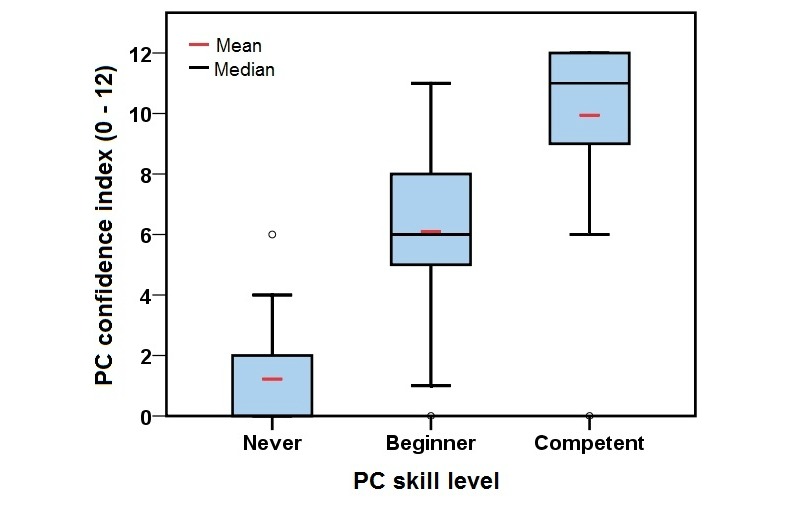
Postal questionnaires about hearing difficulty, PC skill, and Internet use (n=3629) were distributed to adults aged 50-74 years through three family physician practices in Nottingham, United Kingdom. A subsample of 84 respondents completed a second detailed questionnaire on confidence in using a keyboard, mouse, and track pad. Summed scores were termed the "PC confidence index." The PC confidence index was used to verify the PC skill categories in the postal questionnaire (ie, never used a computer, beginner, and competent).
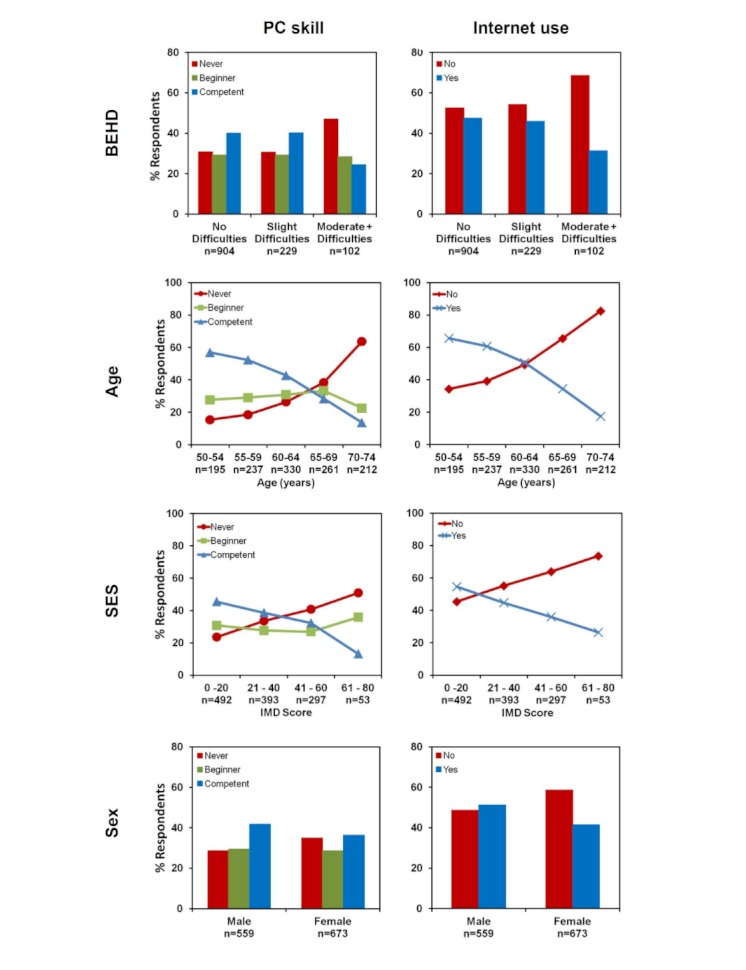
The postal questionnaire response rate was 36.78% (1298/3529) and 95.15% (1235/1298) of these contained complete information. There was a significant between-category difference for PC skill by PC confidence index (P<.001), thus verifying the three-category PC skill scale. PC and Internet use was greater in the younger respondents (50-62 years) than in the older respondents (63-74 years). The younger group's PC and Internet use was 81.0% and 60.9%, respectively; the older group's PC and Internet use was 54.0% and 29.8%, respectively. Those with slight hearing difficulties in the older group had significantly greater odds of PC use compared to those with no hearing difficulties (odds ratio [OR]=1.57, 95% confidence interval [CI] 1.06-2.30, P=.02). Those with moderate+ hearing difficulties had lower odds of PC use compared with those with no hearing difficulties, both overall (OR=0.58, 95% CI 0.39-0.87, P=.008) and in the younger group (OR=0.49, 95% CI 0.26-0.86, P=.008). Similar results were demonstrated for Internet use by age group (older: OR=1.57, 95% CI 0.99-2.47, P=.05; younger: OR=0.32, 95% CI 0.16-0.62, P=.001).
Hearing health care is of particular relevance to older adults because of the prevalence of age-related hearing loss. Our data show that older adults experiencing slight hearing difficulty have increased odds of greater PC skill and Internet use than those reporting no difficulty. These findings suggest that PC and Internet delivery of hearing screening, information, and intervention is feasible for people between 50-74 years who have hearing loss, but who would not typically present to an audiologist.
在过去十年中,使用个人电脑(PC)和互联网来提供医疗保健信息及干预措施的情况大幅增加。然而,这种方法的有效性高度依赖于目标人群是否具备使用该技术的条件和所需技能。这在听力保健的提供方面尤为重要,因为大多数听力损失患者年龄超过50岁(初次佩戴助听器的平均年龄为74岁)。尽管先前已根据人口统计学因素对PC技能和互联网使用情况进行过研究,但目前尚无数据探讨听力困难对老年人PC技能或互联网使用的影响。
在50 - 74岁成年人的机会性样本中,探讨听力困难对PC技能和互联网使用的影响。
通过英国诺丁汉的三家家庭医生诊所,向50 - 74岁的成年人发放了关于听力困难、PC技能和互联网使用情况的邮政问卷(n = 3629)。84名受访者的子样本完成了一份关于使用键盘、鼠标和触摸板信心的第二份详细问卷。汇总分数被称为“PC信心指数”。PC信心指数用于验证邮政问卷中的PC技能类别(即从未使用过电脑、初学者和熟练者)。
邮政问卷的回复率为36.78%(1298/3529),其中95.15%(1235/1298)包含完整信息。根据PC信心指数,PC技能在类别之间存在显著差异(P <.001),从而验证了三类PC技能量表。年轻受访者(50 - 62岁)的PC和互联网使用率高于年长受访者(63 - 74岁)。年轻组的PC和互联网使用率分别为81.0%和60.9%;年长组的PC和互联网使用率分别为54.0%和29.8%。与没有听力困难的人相比,年长组中轻度听力困难者使用PC的几率显著更高(优势比[OR] = 1.57,95%置信区间[CI] 1.06 - 2.30,P =.02)。与没有听力困难的人相比,总体上有中度及以上听力困难者使用PC的几率较低(OR = 0.58,95% CI 0.39 - 0.87,P =.008),在年轻组中也是如此(OR = 0.49,95% CI 0.26 - 0.86,P =.008)。按年龄组划分的互联网使用情况也显示出类似结果(年长组:OR = 1.57,95% CI 0.99 - 2.47,P =.05;年轻组:OR = 0.32,95% CI 0.16 - 0.62,P =.001)。
由于年龄相关性听力损失的普遍性,听力保健对老年人尤为重要。我们的数据表明,与报告无听力困难的老年人相比,有轻度听力困难的老年人具备更高PC技能和更多互联网使用的几率增加。这些发现表明,对于50 - 74岁有听力损失但通常不会去看听力专家的人群,通过PC和互联网进行听力筛查及提供信息和干预是可行的。