Akhtar Mohd Waseem, Sunico Carmen R, Nakamura Tomohiro, Lipton Stuart A
Del E. Webb Center for Neuroscience, Aging, and Stem Cell Research, Sanford-Burnham Medical Research Institute, 10901 North Torrey Pines Road, La Jolla, CA 92037, USA.
Int J Cell Biol. 2012;2012:463756. doi: 10.1155/2012/463756. Epub 2012 Aug 16.
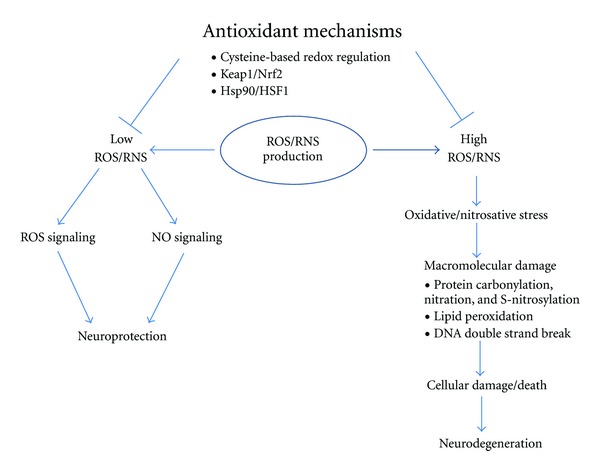
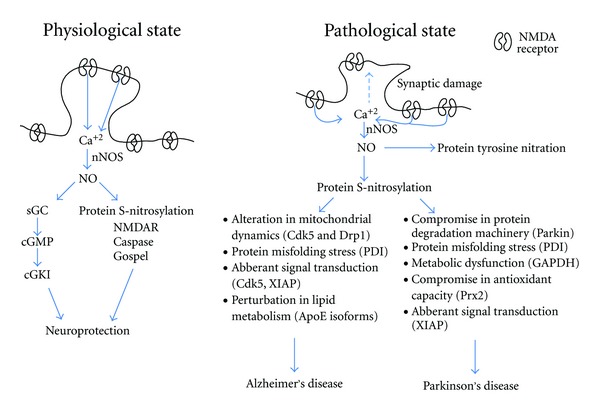
Debilitating neurodegenerative diseases, such as Alzheimer's disease (AD) and Parkinson's disease (PD), can be attributed to neuronal cell damage in specific brain regions. An important hallmark of these diseases is increased oxidative and nitrosative stress that occurs via overproduction of highly reactive free radicals known as reactive oxygen species (ROS) and reactive nitrogen species (RNS). These molecules are normally removed by cellular antioxidant systems. Under physiological conditions, ROS/RNS are present at low levels, mediating several neurotrophic and neuroprotective signaling pathways. In contrast, under pathological conditions, there is a pronounced increase in ROS/RNS generation, impairing normal neurological function. Nitric oxide (NO) is one such molecule that functions as a signaling agent under physiological conditions but causes nitrosative stress under pathological conditions due to its enhanced production. As first reported by our group and colleagues, the toxic effects of NO can be in part attributed to thiol S-nitrosylation, a posttranslational modification of cysteine residues on specific proteins. Here, we review several reports appearing over the past decade showing that S-nitrosylation of an increasing number of proteins compromises important cellular functions, including mitochondrial dynamics, endoplasmic reticulum (ER) protein folding, and signal transduction, thereby promoting synaptic damage, cell death, and neurodegeneration.
诸如阿尔茨海默病(AD)和帕金森病(PD)等使人衰弱的神经退行性疾病可归因于特定脑区的神经元细胞损伤。这些疾病的一个重要标志是氧化应激和亚硝化应激增加,这是通过产生称为活性氧(ROS)和活性氮(RNS)的高反应性自由基而发生的。这些分子通常由细胞抗氧化系统清除。在生理条件下,ROS/RNS以低水平存在,介导多种神经营养和神经保护信号通路。相反,在病理条件下,ROS/RNS的生成会显著增加,损害正常神经功能。一氧化氮(NO)就是这样一种分子,它在生理条件下起信号传导剂的作用,但在病理条件下由于其生成增加而导致亚硝化应激。正如我们小组和同事首次报道的那样,NO的毒性作用部分可归因于硫醇S-亚硝基化,这是特定蛋白质上半胱氨酸残基的一种翻译后修饰。在这里,我们综述了过去十年中出现的几篇报道,这些报道表明越来越多蛋白质的S-亚硝基化损害了重要的细胞功能,包括线粒体动力学、内质网(ER)蛋白折叠和信号转导,从而促进突触损伤、细胞死亡和神经退行性变。