Järhult Josef D
Section of Infectious Diseases, Department of Medical Sciences, Uppsala University, Uppsala, Sweden.
Infect Ecol Epidemiol. 2012;2. doi: 10.3402/iee.v2i0.18385. Epub 2012 Jun 21.
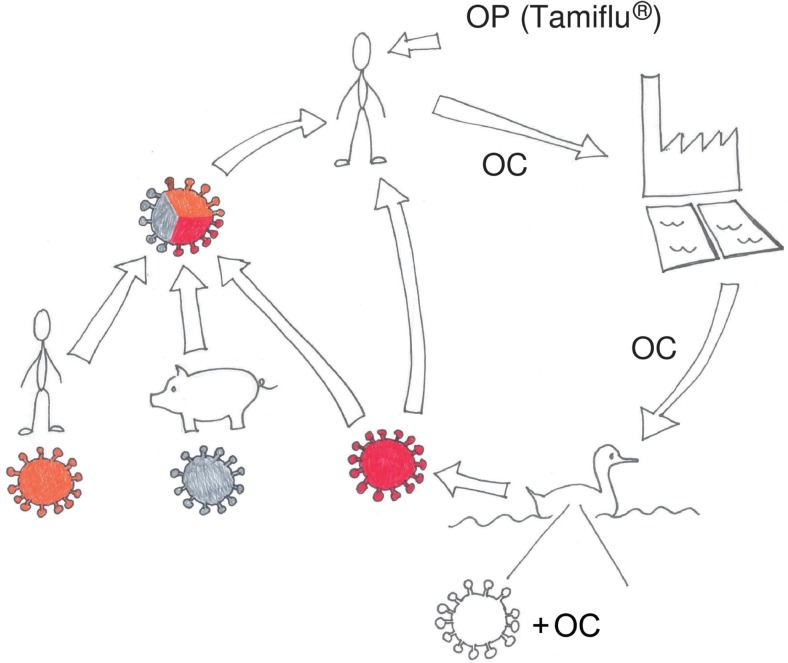
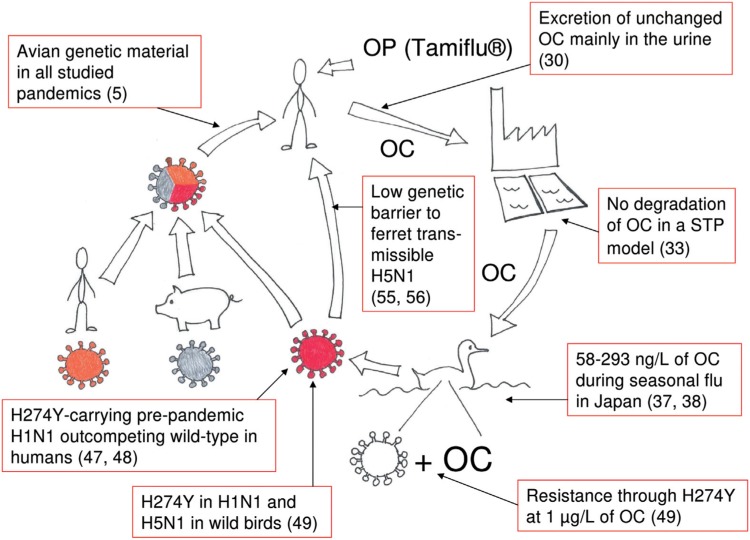
The antiviral drug oseltamivir (Tamiflu(®)) is a cornerstone in influenza pandemic preparedness plans worldwide. However, resistance to the drug is a growing concern. The active metabolite oseltamivir carboxylate (OC) is not degraded in surface water or sewage treatment plants and has been detected in river water during seasonal influenza outbreaks. The natural influenza reservoir, dabbling ducks, can thus be exposed to OC in aquatic environments. Environmental-like levels of OC induce resistance development in influenza A/H1N1 virus in mallards. There is a risk of resistance accumulation in influenza viruses circulating among wild birds when oseltamivir is used extensively. By reassortment or direct transmission, oseltamivir resistance can be transmitted to humans potentially causing a resistant pandemic or human-adapted highly-pathogenic avian influenza virus. There is a need for more research on resistance development in the natural influenza reservoir and for a prudent use of antivirals.
抗病毒药物奥司他韦(达菲®)是全球流感大流行防范计划的基石。然而,对该药物的耐药性问题日益受到关注。活性代谢产物奥司他韦羧酸盐(OC)在地表水或污水处理厂中不会降解,并且在季节性流感爆发期间已在河水中检测到。天然流感宿主——绿头鸭,因此可能在水生环境中接触到OC。环境水平的OC会诱导野鸭体内甲型H1N1流感病毒产生耐药性。当广泛使用奥司他韦时,野生鸟类中传播的流感病毒存在耐药性积累的风险。通过基因重配或直接传播,奥司他韦耐药性可能会传播给人类,从而有可能引发耐药性大流行或人源化高致病性禽流感病毒。有必要对天然流感宿主中的耐药性发展进行更多研究,并谨慎使用抗病毒药物。