Singer Andrew C, Järhult Josef D, Grabic Roman, Khan Ghazanfar A, Lindberg Richard H, Fedorova Ganna, Fick Jerker, Bowes Michael J, Olsen Björn, Söderström Hanna
Natural Environment Research Council, Centre for Ecology and Hydrology, Wallingford, United Kingdom.
Section of Infectious Diseases, Department of Medical Sciences, Uppsala University, Uppsala, Sweden.
PLoS One. 2014 Sep 25;9(9):e108621. doi: 10.1371/journal.pone.0108621. eCollection 2014.
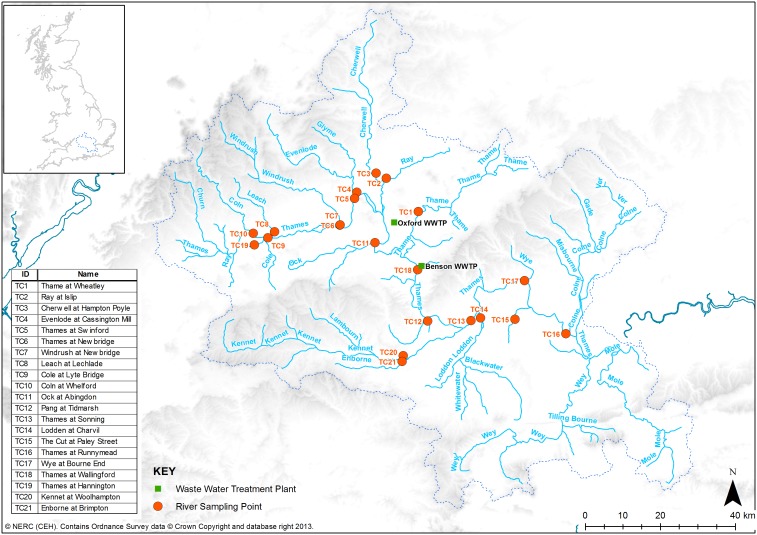
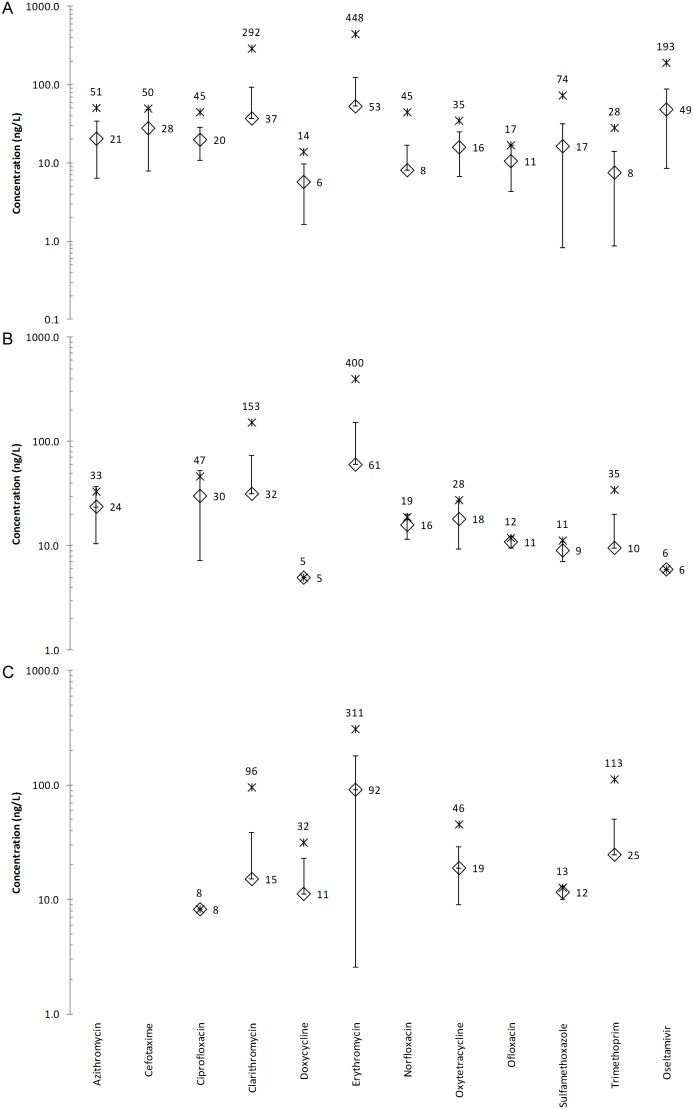
The concentration of eleven antibiotics (trimethoprim, oxytetracycline, ciprofloxacin, azithromycin, cefotaxime, doxycycline, sulfamethoxazole, erythromycin, clarithromycin, ofloxacin, norfloxacin), three decongestants (naphazoline, oxymetazoline, xylometazoline) and the antiviral drug oseltamivir's active metabolite, oseltamivir carboxylate (OC), were measured weekly at 21 locations within the River Thames catchment in England during the month of November 2009, the autumnal peak of the influenza A[H1N1]pdm09 pandemic. The aim was to quantify the pharmaceutical response to the pandemic and compare this to drug use during the late pandemic (March 2010) and the inter-pandemic periods (May 2011). A large and small wastewater treatment plant (WWTP) were sampled in November 2009 to understand the differential fate of the analytes in the two WWTPs prior to their entry in the receiving river and to estimate drug users using a wastewater epidemiology approach. Mean hourly OC concentrations in the small and large WWTP's influent were 208 and 350 ng/L (max, 2070 and 550 ng/L, respectively). Erythromycin was the most concentrated antibiotic measured in Benson and Oxford WWTPs influent (max=6,870 and 2,930 ng/L, respectively). Napthazoline and oxymetazoline were the most frequently detected and concentrated decongestant in the Benson WWTP influent (1650 and 67 ng/L) and effluent (696 and 307 ng/L), respectively, but were below detection in the Oxford WWTP. OC was found in 73% of November 2009's weekly river samples (max=193 ng/L), but only in 5% and 0% of the late- and inter-pandemic river samples, respectively. The mean river concentration of each antibiotic during the pandemic largely fell between 17-74 ng/L, with clarithromycin (max=292 ng/L) and erythromycin (max=448 ng/L) yielding the highest single measure. In general, the concentration and frequency of detecting antibiotics in the river increased during the pandemic. OC was uniquely well-suited for the wastewater epidemiology approach owing to its nature as a prodrug, recalcitrance and temporally- and spatially-resolved prescription statistics.
2009年11月,甲型H1N1流感大流行秋季高峰期间,在英格兰泰晤士河流域的21个地点每周测量11种抗生素(甲氧苄啶、土霉素、环丙沙星、阿奇霉素、头孢噻肟、强力霉素、磺胺甲恶唑、红霉素、克拉霉素、氧氟沙星、诺氟沙星)、3种减充血剂(萘甲唑啉、羟甲唑啉、赛洛唑啉)以及抗病毒药物奥司他韦的活性代谢物奥司他韦羧酸盐(OC)的浓度。目的是量化针对该大流行的药物反应,并将其与大流行后期(2010年3月)和大流行间期(2011年5月)的药物使用情况进行比较。2009年11月对一座大型和一座小型污水处理厂进行了采样,以了解两种污水处理厂中分析物在进入受纳河流之前的不同归宿,并采用污水流行病学方法估算药物使用者数量。小型和大型污水处理厂进水的OC平均每小时浓度分别为208和350纳克/升(最高分别为2070和550纳克/升)。红霉素是在本森和牛津污水处理厂进水处测量到的浓度最高的抗生素(最高分别为6870和2930纳克/升)。萘甲唑啉和羟甲唑啉分别是本森污水处理厂进水(1650和67纳克/升)和出水(696和307纳克/升)中检测到且浓度最高的减充血剂,但在牛津污水处理厂中未检出。在2009年11月的河流样本中,73%检测到OC(最高为193纳克/升),但在大流行后期和大流行间期的河流样本中,检出率分别仅为5%和0%。大流行期间,每种抗生素的河流平均浓度大多在17 - 74纳克/升之间,其中克拉霉素(最高为292纳克/升)和红霉素(最高为448纳克/升)的单次测量值最高。总体而言,大流行期间河流中抗生素的浓度和检出频率有所增加。由于OC作为前体药物的性质、难降解性以及在时间和空间上解析的处方统计数据,它特别适合采用污水流行病学方法。