Ecol Evol. 2012 Aug;2(8):2057-71. doi: 10.1002/ece3.316. Epub 2012 Jul 22.
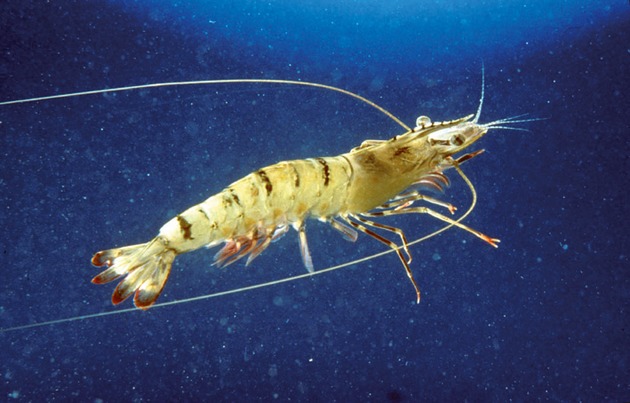
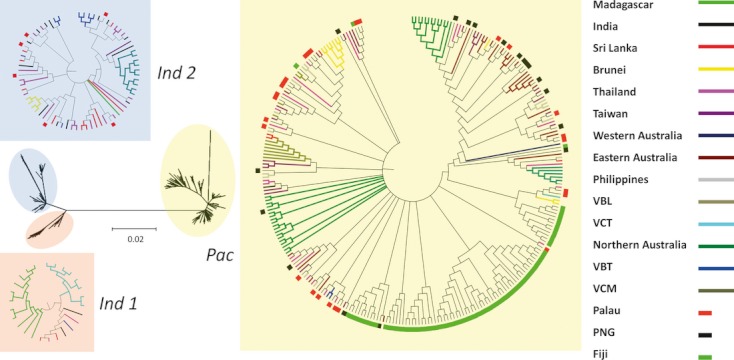
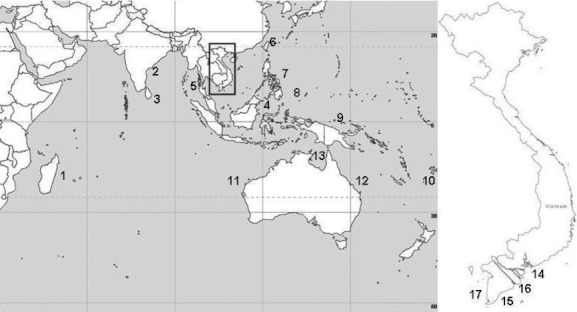
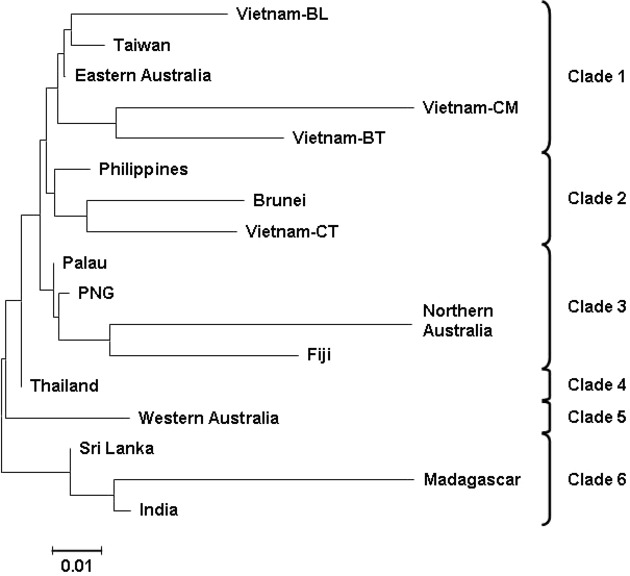
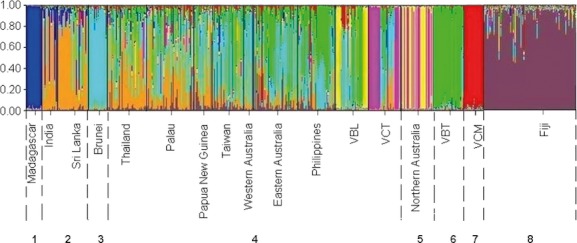
The Black Tiger shrimp (Penaeus monodon) has a natural distribution range from East Africa to the South Pacific Islands. Although previous studies of Indo-Pacific P. monodon have found populations from the Indian Ocean and Australasia to differ genetically, their relatedness to South Pacific shrimp remains unknown. To address this, polymorphisms at eight shared microsatellite loci and haplotypes in a 418-bp mtDNA-CR (control region) sequence were examined across 682 P. monodon from locations spread widely across its natural range, including the South Pacific islands of Fiji, Palau, and Papua New Guinea (PNG). Observed microsatellite heterozygosities of 0.82-0.91, allele richness of 6.85-9.69, and significant mtDNA-CR haplotype variation indicated high levels of genetic diversity among the South Pacific shrimp. Analysis of microsatellite genotypes using a Bayesian STRUCTURE method segregated Indo-Pacific P. monodon into eight distinct clades, with Palau and PNG shrimp clustering among others from Southeast Asia and eastern Australia, respectively, and Fiji shrimp clustering as a distinct group. Phylogenetic analyses of mtDNA-CR haplotypes delineated shrimp into three groupings, with shrimp from Fiji again being distinct by sharing no haplotypes with other populations. Depending on regional location, the genetic structures and substructures identified from the genotyping and mtDNA-CR haplotype phylogeny could be explained by Metapopulation and/or Member-Vagrant type evolutionary processes. Neutrality tests of mutation-drift equilibrium and estimation of the time since population expansion supported a hypothesis that South Pacific P. monodon were colonized from Southeast Asia and eastern Australia during the Pleistocene period over 60,000 years ago when land bridges were more expansive and linked these regions more closely.
黑虎虾(Penaeus monodon)的自然分布范围从东非到南太平洋岛屿。尽管先前对印度洋-太平洋地区 P. monodon 的研究发现,印度洋和澳大拉西亚的种群在遗传上存在差异,但它们与南太平洋虾的亲缘关系尚不清楚。为了解决这一问题,我们在广泛分布于其自然分布范围内的 682 只 P. monodon 中,检测了 8 个共享微卫星基因座的多态性和 418bp 的 mtDNA-CR(控制区)序列的单倍型。这些样本来自包括斐济、帕劳和巴布亚新几内亚(PNG)在内的南太平洋岛屿。观察到的微卫星杂合度为 0.82-0.91,等位基因丰富度为 6.85-9.69,以及显著的 mtDNA-CR 单倍型变异,表明南太平洋虾的遗传多样性水平很高。使用贝叶斯 STRUCTURE 方法对微卫星基因型进行分析,将印度洋-太平洋 P. monodon 分为 8 个不同的分支,帕劳和 PNG 的虾分别与东南亚和澳大利亚东部的其他虾聚类,而斐济的虾聚类为一个独特的群体。mtDNA-CR 单倍型的系统发育分析将虾分为三个群体,斐济的虾再次与其他种群没有共享的单倍型而显得与众不同。根据区域位置,从基因分型和 mtDNA-CR 单倍型系统发育中确定的遗传结构和亚结构可以用泛种群和/或成员-流浪者型进化过程来解释。突变-漂移平衡的中性检验和种群扩张时间的估计支持了这样一种假设,即南太平洋的 P. monodon 是在 6 万多年前的更新世时期从东南亚和澳大利亚东部殖民而来的,当时大陆桥更加广阔,使这些地区更加紧密地联系在一起。