Department of Global Health Systems and Development, Tulane University School of Public Health and Tropical Medicine, 1440 Canal Street, Suite 2200, New Orleans, LA 70112, USA.
Malar J. 2012 Sep 7;11:313. doi: 10.1186/1475-2875-11-313.
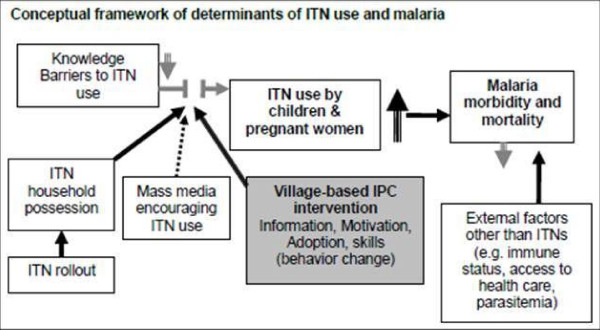
This paper presents results from an evaluation of the effect of a community health worker (CHW) -based, interpersonal communication campaign (IPC) for increasing insecticide-treated mosquito net (ITN) use among children in Luangwa District, Zambia, an area with near universal coverage of ITNs and moderate to low malaria parasite prevalence.
A quasi-experimental community randomized control trial was conducted from 2008 to 2010. CHWs were the unit of randomization. Cross-sectional data were collected from houses in both 2008 and 2010 using simple random sampling of a complete household enumeration of the district. A difference-in -differences approach was used to analyse the data.
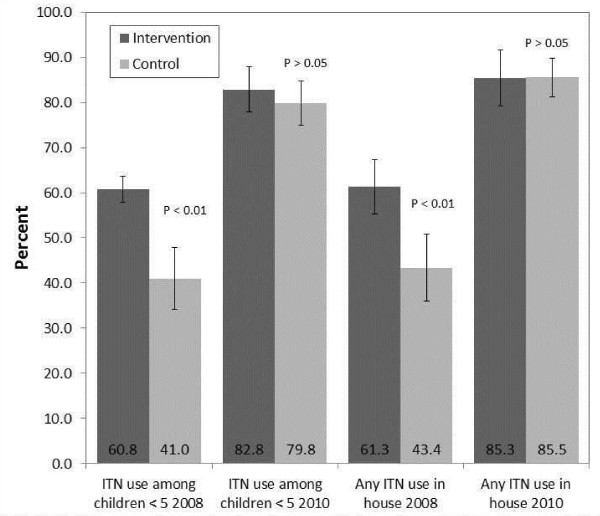
ITN use among children <5 years old in households with ≥1 ITN increased overall from 54% in 2008 to 81% in 2010 (χ(2) = 96.3, p <0.01); however, there was no difference in increase between the treatment and control arms in 2010 (p >0.05). ITN use also increased among children five to 14 years old from 37% in 2008 to 68% in 2010. There was no indication that the CHW-based intervention activities had a significant effect on increasing ITN use in this context, over and above what is already being done to disseminate information on the importance of using an ITN to prevent malaria infection.
ITN use increased dramatically in the district between 2008 and 2010. It is likely that IPC activities in general may have contributed to the observed increase in ITN use, as the increased observed in this study was far higher than the increase observed between 2008 and 2010 malaria indicator survey (MIS) estimates. Contamination across control communities, coupled with linear settlement patterns and subsequent behavioural norms related to communication in the area, likely contributed to the observed increase in net use and null effect in this study.
本文介绍了一项针对赞比亚卢安瓜地区社区卫生工作者(CHW)为基础的人际沟通活动(IPC)对增加儿童使用驱虫蚊帐(ITN)效果的评估结果。该地区已经几乎普及了 ITN,疟疾寄生虫流行率处于中低水平。
本研究采用了准实验社区随机对照试验,于 2008 年至 2010 年进行。以社区卫生工作者为单位进行随机分组。2008 年和 2010 年,采用简单随机抽样方法对整个地区的家庭进行完全户数普查,收集来自房屋的横截面数据。采用差值差异法对数据进行分析。
2008 年,拥有≥1 顶 ITN 的家庭中 5 岁以下儿童使用 ITN 的比例总体从 54%增加到 2010 年的 81%(χ(2) = 96.3,p <0.01);然而,2010 年治疗组和对照组之间的增加没有差异(p >0.05)。2008 年,5 至 14 岁儿童使用 ITN 的比例从 37%增加到 2010 年的 68%。没有迹象表明在这种情况下,基于 CHW 的干预活动在传播使用 ITN 预防疟疾感染的重要性信息方面有显著效果。
2008 年至 2010 年期间,该地区 ITN 使用量大幅增加。IPC 活动可能在增加 ITN 使用方面做出了贡献,因为观察到的增加幅度远高于疟疾指标调查(MIS)在 2008 年至 2010 年期间的估计。控制社区的交叉污染,加上线性定居模式以及该地区与沟通相关的后续行为规范,可能导致了观察到的网用增加和本研究中的无效效应。