Iowa City Veterans Affairs Health Care System, Iowa City, IA USA.
Antimicrob Resist Infect Control. 2012 Jan 26;1(1):5. doi: 10.1186/2047-2994-1-5.
Hospital-associated infections (HAIs) are associated with a considerable burden of disease and direct costs greater than $17 billion. The pathogens that cause the majority of serious HAIs are Enterococcus faecium, Staphylococcus aureus, Clostridium difficile, Klebsiella pneumoniae, Acinetobacter baumannii, Pseudomonas aeruginosa, and Enterobacter species, referred as ESCKAPE. We aimed to determine the amount of funding the National Institute of Health (NIH) National Institute of Allergy and Infectious Diseases (NIAID) allocates to research on antimicrobial resistant pathogens, particularly ESCKAPE pathogens.
The NIH Research Portfolio Online Reporting Tools (RePORT) database was used to identify NIAID antimicrobial resistance research grants funded in 2007-2009 using the terms "antibiotic resistance," "antimicrobial resistance," and "hospital-associated infection."
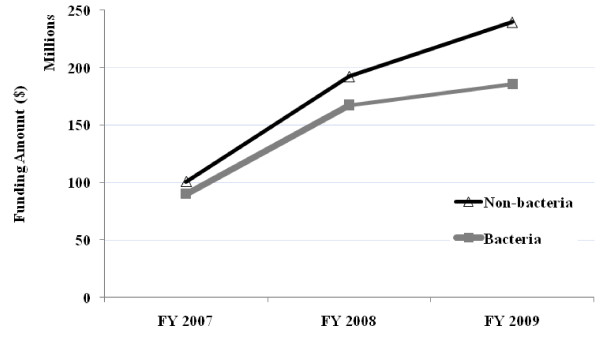
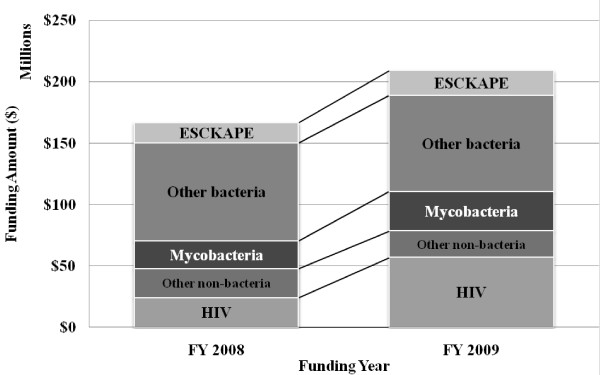
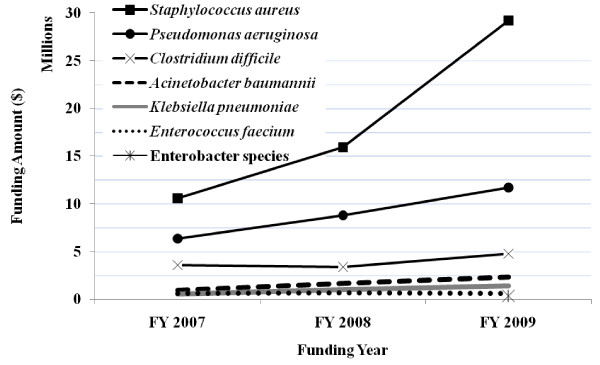
Funding for antimicrobial resistance grants has increased from 2007-2009. Antimicrobial resistance funding for bacterial pathogens has seen a smaller increase than non-bacterial pathogens. The total funding for all ESKCAPE pathogens was $ 22,005,943 in 2007, $ 30,810,153 in 2008 and $ 49,801,227 in 2009. S. aureus grants received $ 29,193,264 in FY2009, the highest funding amount of all the ESCKAPE pathogens. Based on 2009 funding data, approximately $1,565 of research money was spent per S. aureus related death and $750 of was spent per C. difficile related death.
Although the funding for ESCKAPE pathogens has increased from 2007 to 2009, funding levels for antimicrobial resistant bacteria-related grants is still lower than funding for antimicrobial resistant non-bacterial pathogens. Efforts may be needed to improve research funding for resistant-bacterial pathogens, particularly as their clinical burden increases.
医院相关感染(HAI)会导致严重疾病并带来直接超过 170 亿美元的经济负担。引起大多数严重 HAI 的病原体是屎肠球菌、金黄色葡萄球菌、艰难梭菌、肺炎克雷伯菌、鲍曼不动杆菌、铜绿假单胞菌和肠杆菌属,统称 ESKAPE。我们旨在确定美国国立卫生研究院(NIH)过敏和传染病研究所(NIAID)分配给抗微生物药物耐药病原体研究的资金数额,特别是 ESKAPE 病原体。
利用“抗生素耐药性”、“抗微生物药物耐药性”和“医院相关感染”等术语,通过 NIH 研究组合在线报告工具(RePORT)数据库确定 2007-2009 年 NIAID 抗微生物药物耐药性研究资助金。
抗微生物药物耐药性资助金从 2007-2009 年逐渐增加。细菌病原体的抗微生物药物耐药性资助金增加幅度小于非细菌病原体。2007 年所有 ESKCAPE 病原体的总资金为 22005943 美元,2008 年为 30810153 美元,2009 年为 49801227 美元。2009 年金黄色葡萄球菌资助金获得 29193264 美元,是 ESKAPE 病原体中最高的资助金额。根据 2009 年的资金数据,每例与金黄色葡萄球菌相关的死亡大约花费 1565 美元的研究资金,每例与艰难梭菌相关的死亡大约花费 750 美元的研究资金。
尽管 ESKAPE 病原体的资金从 2007 年到 2009 年有所增加,但抗微生物药物耐药细菌相关资助金的水平仍然低于抗微生物药物耐药非细菌病原体的水平。可能需要努力提高抗耐药细菌病原体的研究资金,特别是随着它们的临床负担增加。