Department of Bioengineering, Stanford University, Stanford, California, USA.
Nat Methods. 2012 Oct;9(10):1005-12. doi: 10.1038/nmeth.2171. Epub 2012 Sep 9.
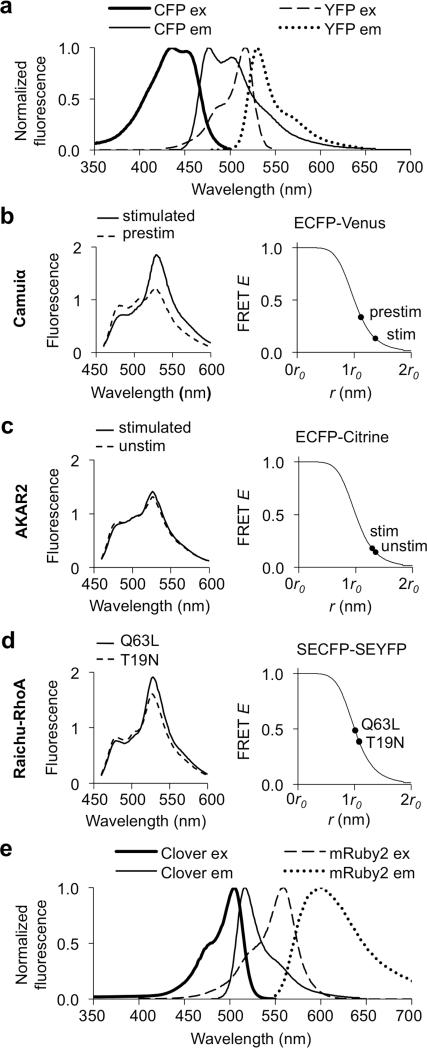
A variety of genetically encoded reporters use changes in fluorescence (or Förster) resonance energy transfer (FRET) to report on biochemical processes in living cells. The standard genetically encoded FRET pair consists of CFPs and YFPs, but many CFP-YFP reporters suffer from low FRET dynamic range, phototoxicity from the CFP excitation light and complex photokinetic events such as reversible photobleaching and photoconversion. We engineered two fluorescent proteins, Clover and mRuby2, which are the brightest green and red fluorescent proteins to date and have the highest Förster radius of any ratiometric FRET pair yet described. Replacement of CFP and YFP with these two proteins in reporters of kinase activity, small GTPase activity and transmembrane voltage significantly improves photostability, FRET dynamic range and emission ratio changes. These improvements enhance detection of transient biochemical events such as neuronal action-potential firing and RhoA activation in growth cones.
多种遗传编码报告器利用荧光(或Förster)共振能量转移(FRET)的变化来报告活细胞中的生化过程。标准的遗传编码 FRET 对由 CFPs 和 YFPs 组成,但许多 CFP-YFP 报告器的 FRET 动态范围较低,CFP 激发光的光毒性以及复杂的光动力学事件,如可逆光漂白和光转化。我们设计了两种荧光蛋白,Clover 和 mRuby2,它们是迄今为止最亮的绿色和红色荧光蛋白,并且具有任何比率 FRET 对中迄今为止描述的最高 Förster 半径。在激酶活性、小 GTPase 活性和跨膜电压的报告器中用这两种蛋白质替代 CFP 和 YFP,显著提高了光稳定性、FRET 动态范围和发射比变化。这些改进增强了对神经元动作电位发射和生长锥中 RhoA 激活等短暂生化事件的检测。