UMR7156 Université de Strasbourg/CNRS, Génétique Moléculaire, Génomique, Microbiologie, Strasbourg, France.
Biol Direct. 2012 Sep 10;7:28. doi: 10.1186/1745-6150-7-28.
Acid Mine Drainages (AMDs) are extreme environments characterized by very acid conditions and heavy metal contaminations. In these ecosystems, the bacterial diversity is considered to be low. Previous culture-independent approaches performed in the AMD of Carnoulès (France) confirmed this low species richness. However, very little is known about the cultured bacteria in this ecosystem. The aims of the study were firstly to apply novel culture methods in order to access to the largest cultured bacterial diversity, and secondly to better define the robustness of the community for 3 important functions: As(III) oxidation, cellulose degradation and cobalamine biosynthesis.
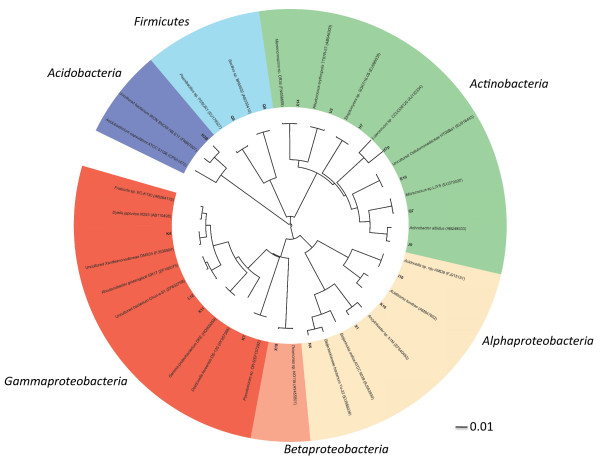
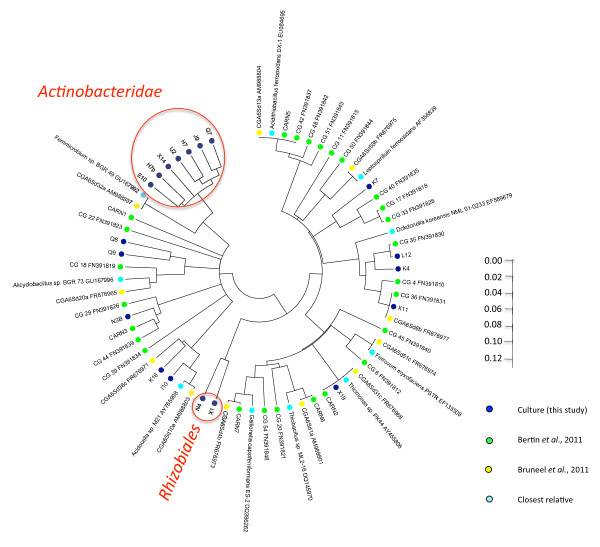
Despite the oligotrophic and acidic conditions found in AMDs, the newly designed media covered a large range of nutrient concentrations and a pH range from 3.5 to 9.8, in order to target also non-acidophilic bacteria. These approaches generated 49 isolates representing 19 genera belonging to 4 different phyla. Importantly, overall diversity gained 16 extra genera never detected in Carnoulès. Among the 19 genera, 3 were previously uncultured, one of them being novel in databases. This strategy increased the overall diversity in the Carnoulès sediment by 70% when compared with previous culture-independent approaches, as specific phylogenetic groups (e.g. the subclass Actinobacteridae or the order Rhizobiales) were only detected by culture. Cobalamin auxotrophy, cellulose degradation and As(III)-oxidation are 3 crucial functions in this ecosystem, and a previous meta- and proteo-genomic work attributed each function to only one taxon. Here, we demonstrate that other members of this community can also assume these functions, thus increasing the overall community robustness.
This work highlights that bacterial diversity in AMDs is much higher than previously envisaged, thus pointing out that the AMD system is functionally more robust than expected. The isolated bacteria may be part of the rare biosphere which remained previously undetected due to molecular biases. No matter their current ecological relevance, the exploration of the full diversity remains crucial to decipher the function and dynamic of any community. This work also underlines the importance to associate culture-dependent and -independent approaches to gain an integrative view of the community function.
酸性矿山排水(AMD)是一种极端环境,其特点是酸度非常高且重金属污染严重。在这些生态系统中,细菌多样性被认为较低。此前在法国卡尔努勒斯(Carnoulès)的 AMD 中进行的非培养依赖性方法证实了这种低物种丰富度。然而,对于该生态系统中培养的细菌知之甚少。本研究的目的首先是应用新的培养方法来获取最大的培养细菌多样性,其次是更好地定义 3 种重要功能的群落稳健性:As(III)氧化、纤维素降解和钴胺素生物合成。
尽管在 AMD 中发现了贫营养和酸性条件,但新设计的培养基涵盖了广泛的营养浓度范围和 pH 值范围,从 3.5 到 9.8,以便也针对非嗜酸细菌。这些方法产生了 49 个代表 19 个属的分离株,属于 4 个不同的门。重要的是,与之前在卡尔努勒斯从未检测到的相比,总共增加了 16 个新的属。在 19 个属中,有 3 个以前未培养过,其中一个在数据库中是新的。与之前的非培养依赖性方法相比,该策略将卡尔努勒斯沉积物中的总体多样性提高了 70%,因为特定的系统发育群(例如,类放线菌亚纲或根瘤菌目)仅通过培养检测到。钴胺素营养缺陷、纤维素降解和 As(III)氧化是该生态系统中的 3 个关键功能,之前的元基因组和蛋白质组学工作将每个功能归因于一个分类群。在这里,我们证明了该群落的其他成员也可以承担这些功能,从而提高了整体群落的稳健性。
这项工作强调了 AMD 中的细菌多样性远高于先前预期,从而表明 AMD 系统的功能比预期的更为稳健。这些分离的细菌可能是由于分子偏见而以前未被检测到的稀有生物界的一部分。无论它们目前的生态相关性如何,探索完整的多样性仍然是揭示任何群落功能和动态的关键。这项工作还强调了将依赖培养和非依赖培养的方法相结合以获得群落功能综合视图的重要性。