International Centre for Circulatory Health, National Heart and Lung Institute, Imperial College London, London, UK.
Diabetes Care. 2013 Feb;36(2):383-93. doi: 10.2337/dc12-0544. Epub 2012 Sep 10.
To determine the extent of, and reasons for, ethnic differences in type 2 diabetes incidence in the U.K.
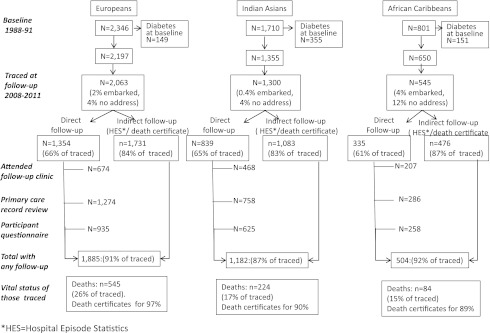
Population-based triethnic cohort. Participants were without diabetes, aged 40-69 at baseline (1989-1991), and followed-up for 20 years. Baseline measurements included fasting and postglucose bloods, anthropometry, and lifestyle questionnaire. Incident diabetes was identified from medical records and participant recall. Ethnic differences in diabetes incidence were examined using competing risks regression.
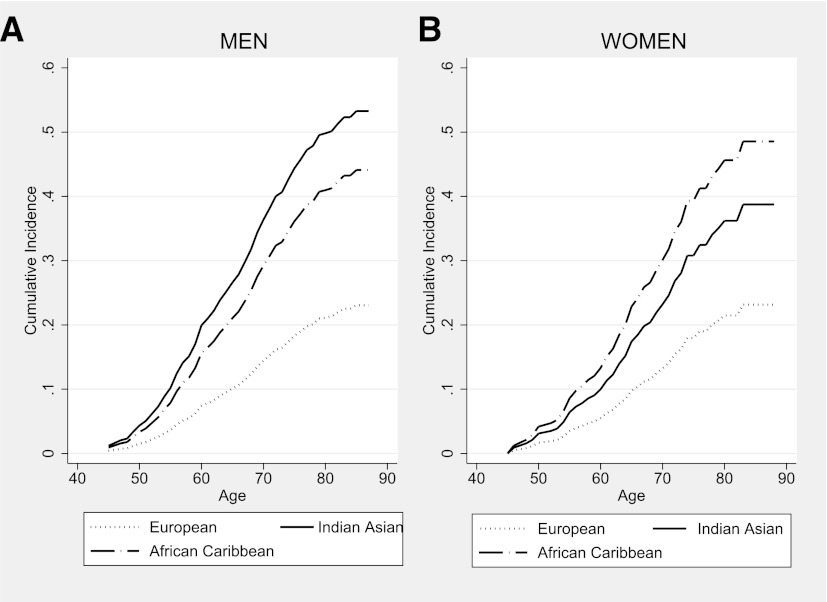
Incident diabetes was identified in 196 of 1,354 (14%) Europeans, 282 of 839 (34%) Indian Asians, and 100 of 335 (30%) African Caribbeans. All Indian Asians and African Caribbeans were first-generation migrants. Compared with Europeans, age-adjusted subhazard ratios (SHRs [95% CI]) for men and women, respectively, were 2.88 (95%, 2.36-3.53; P < 0.001) and 1.91 (1.18-3.10; P = 0.008) in Indian Asians, and 2.23 (1.64-3.03; P < 0.001) and 2.51 (1.63-3.87; P < 0.001) in African Caribbeans. Differences in baseline insulin resistance and truncal obesity largely attenuated the ethnic minority excess in women (adjusted SHRs: Indian Asians 0.77 [0.49-1.42]; P = 0.3; African Caribbeans 1.48 [0.89-2.45]; P = 0.13), but not in men (adjusted SHRs: Indian Asians 1.98 [1.52-2.58]; P < 0.001 and African Caribbeans, 2.05 [1.46-2.89; P < 0.001]).
Insulin resistance and truncal obesity account for the twofold excess incidence of diabetes in Indian Asian and African Caribbean women, but not men. Explanations for the excess diabetes risk in ethnic minority men remains unclear. Further study requires more precise measures of conventional risk factors and identification of novel risk factors.
确定英国 2 型糖尿病发病率在不同民族间的差异程度和原因。
基于人群的三民族队列。参与者在基线时(1989-1991 年)无糖尿病,年龄 40-69 岁,并随访 20 年。基线测量包括空腹和餐后血糖、人体测量学和生活方式问卷。通过医疗记录和参与者回忆确定糖尿病的发病情况。使用竞争风险回归分析糖尿病发病率的民族差异。
在 1354 名欧洲人中,有 196 名(14%)发生了糖尿病;在 839 名印度亚裔中,有 282 名(34%)发生了糖尿病;在 335 名非洲加勒比裔中,有 100 名(30%)发生了糖尿病。所有印度亚裔和非洲加勒比裔都是第一代移民。调整年龄后的男性和女性亚危险比(95%CI)分别为 2.88(95%,2.36-3.53;P<0.001)和 1.91(1.18-3.10;P=0.008)在印度亚裔中,2.23(1.64-3.03;P<0.001)和 2.51(1.63-3.87;P<0.001)在非洲加勒比裔中。基线胰岛素抵抗和躯干肥胖的差异在很大程度上减轻了女性中少数民族的糖尿病发病过度(调整后的亚危险比:印度亚裔 0.77(0.49-1.42);P=0.3;非洲加勒比裔 1.48(0.89-2.45);P=0.13),但对男性没有影响(调整后的亚危险比:印度亚裔 1.98(1.52-2.58);P<0.001和非洲加勒比裔 2.05(1.46-2.89;P<0.001))。
胰岛素抵抗和躯干肥胖导致印度亚裔和非洲加勒比裔女性的糖尿病发病率增加一倍,但对男性没有影响。少数族裔男性糖尿病风险增加的原因尚不清楚。需要进一步研究,以获得更精确的传统危险因素指标,并确定新的危险因素。