Eastwood Sophie V, Tillin Therese, Dehbi Hakim-Moulay, Wright Andrew, Forouhi Nita G, Godsland Ian, Whincup Peter, Sattar Naveed, Hughes Alun D, Chaturvedi Nishi
Institute of Cardiovascular Science, University College London, UK.
Obesity (Silver Spring). 2015 Mar;23(3):699-706. doi: 10.1002/oby.20997. Epub 2015 Feb 3.
To examine ethnic differences in ectopic fat and associations with incident diabetes.
In a UK cohort study, 1338 Europeans, 838 South Asians, and 330 African Caribbeans living in London were aged 40-69 years at baseline. Baseline assessment included blood tests, anthropometry, and questionnaires. Anthropometry-based prediction equations estimated baseline visceral adipose tissue (VAT). Incident diabetes was ascertained from record review, self-report, or oral glucose tolerance testing.
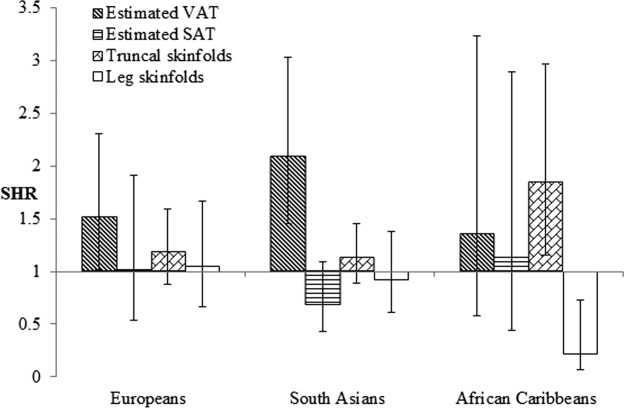
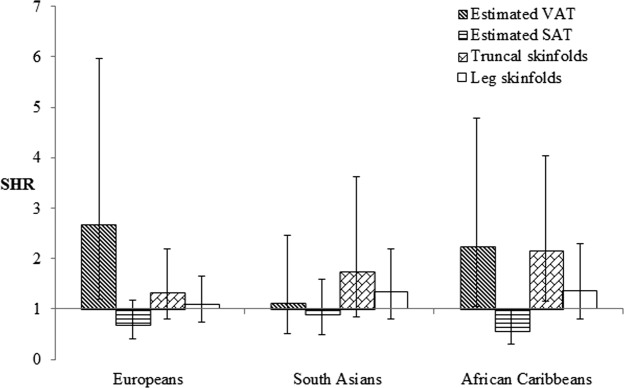
South Asians had more and African Caribbeans less estimated VAT than Europeans. Both ethnic minorities had larger truncal skinfolds than Europeans. In men, adjustment for risk factors (BMI, smoking, systolic blood pressure, and HDL-cholesterol) markedly attenuated the association between estimated VAT and diabetes in Europeans (standardized subhazard ratios [95% CI]: from 1.74 [1.49, 2.03] to 1.16 [0.77, 1.76]) and African Caribbeans (1.72 [1.26, 2.35] to 1.44 [0.69, 3.02]) but not South Asians (1.60 [1.38, 1.86] to 1.90 [1.37, 2.64]). In women, attenuation was observed only for South Asians (1.80 [1.01, 3.23] to 1.07 [0.49, 2.31]). Associations between truncal skinfolds and diabetes appeared less affected by multivariable adjustment in South Asians and African Caribbeans than Europeans (1.24 [0.97, 1.57] and 1.28 [0.89, 1.82] versus 1.02 [0.77, 1.36] in men; 1.91 [1.03, 3.56] and 1.42 [0.86, 2.34] versus 1.23 [0.74, 2.05] in women).
Differences in overall truncal fat, as well as VAT, may contribute to the excess of diabetes in South Asian and African Caribbean groups, particularly for women.
研究异位脂肪的种族差异及其与糖尿病发病的关联。
在一项英国队列研究中,1338名欧洲人、838名南亚人和330名非洲裔加勒比人居住在伦敦,基线年龄为40 - 69岁。基线评估包括血液检测、人体测量和问卷调查。基于人体测量的预测方程估算基线内脏脂肪组织(VAT)。通过记录审查、自我报告或口服葡萄糖耐量试验确定糖尿病发病情况。
与欧洲人相比,南亚人的估算VAT更多,而非洲裔加勒比人的估算VAT更少。两个少数族裔的躯干皮褶厚度均大于欧洲人。在男性中,调整风险因素(BMI、吸烟、收缩压和高密度脂蛋白胆固醇)后,欧洲人(标准化亚风险比[95%CI]:从1.74[1.49, 2.03]降至1.16[0.77, 1.76])和非洲裔加勒比人(1.72[1.26, 2.35]降至1.44[0.69, 3.02])中估算VAT与糖尿病之间的关联显著减弱,但南亚人(1.60[1.38, 1.86]至1.90[1.37, 2.64])未减弱。在女性中,仅南亚人出现关联减弱(1.80[1.01, 3.23]至1.07[0.49, 2.31])。与欧洲人相比,多变量调整对南亚人和非洲裔加勒比人躯干皮褶厚度与糖尿病之间关联的影响似乎较小(男性中分别为1.24[0.97, 1.57]和1.28[0.89, 1.82],而欧洲人为1.02[0.77, 1.36];女性中分别为1.91[1.03, 3.56]和1.42[0.86, 2.34],而欧洲人为1.23[0.74, 2.05])。
总体躯干脂肪以及VAT的差异可能导致南亚和非洲裔加勒比人群中糖尿病发病率过高,尤其是女性。