Jayasuriya Chathuraka T, Goldring Mary B, Terek Richard, Chen Qian
Arthritis Res Ther. 2012 Sep 11;14(5):R197. doi: 10.1186/ar4033.
Deletion or mutation of the gene encoding the cartilage extracellular matrix (ECM) protein matrilin-3 (MATN3) results in the early onset of osteoarthritis (OA), suggesting chondroprotective properties of MATN3. To understand the mechanisms underlying these properties, we determined the effects of MATN3 protein on the expression of several key anabolic and catabolic genes involved in chondrocyte homeostasis, and the dependence of such regulation on the anti-inflammatory cytokine: IL-1 receptor antagonist (IL-1Ra).
The effects of recombinant human (rh) MATN3 protein were examined in C28/I2 immortalized human chondrocytes, primary human chondrocytes (PHCs), and primary mouse chondrocytes (PMCs). Messenger RNA levels of IL-1Ra, COL2A1, ACAN, MMP-13, and ADAMTS-4 and -5 were determined using real-time RT-PCR. Knocking down IL-1Ra was achieved by siRNA gene silencing. IL-1Ra protein levels were quantified by ELISA and the Bio-Plex Suspension Array System. COL2A1 protein level was quantified using Western blot analysis. Statistic analysis was done using the two-tailed t-test or one-way ANOVA.
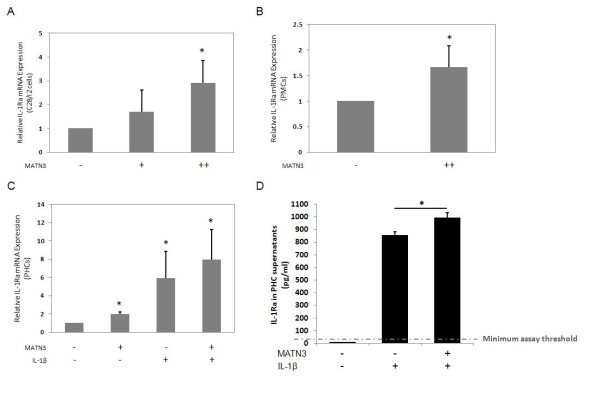
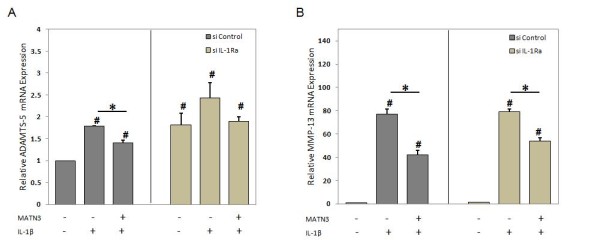
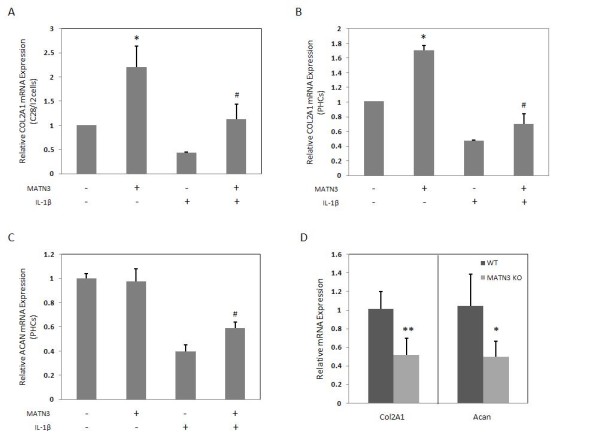
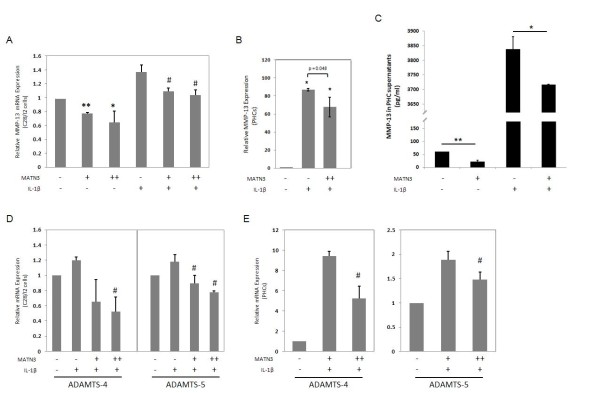
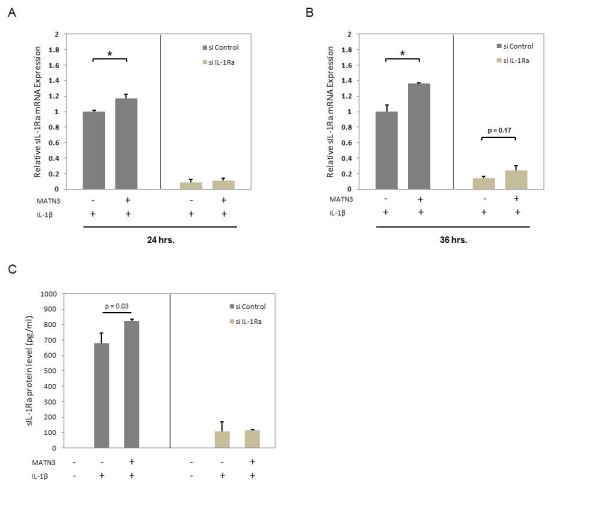
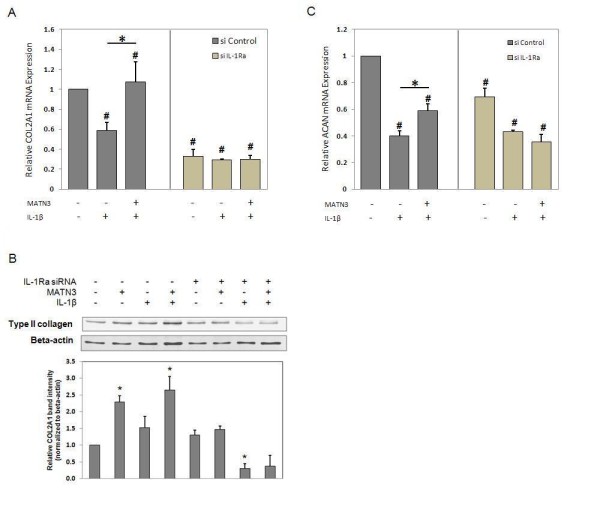
rhMATN3 protein induced gene expression of IL-1Ra in C28/I2 cells, PHCs, and PMCs in a dose- and time-dependent manner. Treatment of C28/I2 cells and PHCs with MATN3 protein stimulated gene expression of COL2A1 and ACAN. Conversely, mRNA levels of COL2A1 and ACAN were decreased in MATN3 KO mice. MATN3 protein treatment inhibited IL-1β-induced MMP-13, ADAMTS-4 and ADAMTS-5 in C28/I2 cells and PHCs. Knocking down IL-1Ra abolished the MATN3-mediated stimulation of COL2A1 and ACAN and inhibition of ADAMTS-5, but had no effect on MATN3 inhibition of MMP-13 mRNA.
Our findings point to a novel regulatory role of MATN3 in cartilage homeostasis due to its capacity to induce IL-1Ra, to upregulate gene expression of the major cartilage matrix components, and to downregulate the expression of OA-associated matrix-degrading proteinases in chondrocytes. The chondroprotective properties of endogenous MATN3 depend partly on its induction of IL-1Ra. Our findings raise a possibility to use rhMATN3 protein for anti-inflammatory and chondroprotective therapy.
编码软骨细胞外基质(ECM)蛋白matrilin-3(MATN3)的基因发生缺失或突变会导致骨关节炎(OA)的早期发病,这表明MATN3具有软骨保护特性。为了了解这些特性背后的机制,我们确定了MATN3蛋白对软骨细胞内稳态中几个关键合成代谢和分解代谢基因表达的影响,以及这种调节对抗炎细胞因子白细胞介素-1受体拮抗剂(IL-1Ra)的依赖性。
在C28/I2永生化人软骨细胞、原代人软骨细胞(PHCs)和原代小鼠软骨细胞(PMCs)中检测重组人(rh)MATN3蛋白的作用。使用实时逆转录聚合酶链反应(RT-PCR)测定IL-1Ra、COL2A1、ACAN、MMP-13以及ADAMTS-4和-5的信使核糖核酸(mRNA)水平。通过小干扰RNA(siRNA)基因沉默实现敲低IL-1Ra。采用酶联免疫吸附测定(ELISA)和生物芯片悬浮阵列系统对IL-1Ra蛋白水平进行定量。使用蛋白质免疫印迹分析对COL2A1蛋白水平进行定量。采用双侧t检验或单因素方差分析进行统计分析。
rhMATN3蛋白以剂量和时间依赖性方式诱导C28/I2细胞、PHCs和PMCs中IL-1Ra的基因表达。用MATN3蛋白处理C28/I2细胞和PHCs可刺激COL2A1和ACAN的基因表达。相反,MATN3基因敲除小鼠中COL2A1和ACAN的mRNA水平降低。MATN3蛋白处理可抑制IL-1β诱导的C28/I2细胞和PHCs中MMP-13、ADAMTS-4和ADAMTS-5的表达。敲低IL-1Ra消除了MATN介导的对COL2A1和ACAN的刺激以及对ADAMTS-5的抑制,但对MATN3对MMP-13 mRNA的抑制作用没有影响。
我们的研究结果表明MATN3在软骨内稳态中具有新的调节作用,因为它能够诱导IL-1Ra、上调主要软骨基质成分基因的表达,并下调软骨细胞中与OA相关的基质降解蛋白酶的表达。内源性MATN3的软骨保护特性部分取决于其对IL-1Ra的诱导作用。我们的研究结果提出了使用rhMATN3蛋白进行抗炎和软骨保护治疗的可能性。