Hall Jessica M F, Cruser Desanges, Podawiltz Alan, Mummert Diana I, Jones Harlan, Mummert Mark E
Department of Molecular Biology and Immunology, University of North Texas Health Science Center, Fort Worth, TX 76107, USA.
Dermatol Res Pract. 2012;2012:403908. doi: 10.1155/2012/403908. Epub 2012 Aug 30.
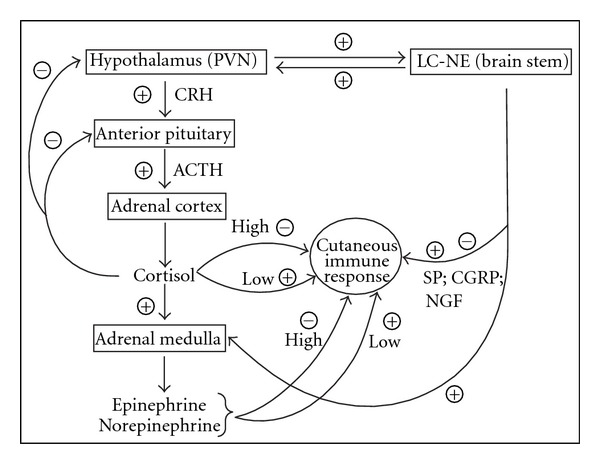
Psychological stress, an evolutionary adaptation to the fight-or-flight response, triggers a number of physiological responses that can be deleterious under some circumstances. Stress signals activate the hypothalamus-pituitary-adrenal (HPA) axis and the sympathetic nervous system. Elements derived from those systems (e.g., cortisol, catecholamines and neuropeptides) can impact the immune system and possible disease states. Skin provides a first line of defense against many environmental insults. A number of investigations have indicated that the skin is especially sensitive to psychological stress, and experimental evidence shows that the cutaneous innate and adaptive immune systems are affected by stressors. For example, psychological stress has been shown to reduce recovery time of the stratum corneum barrier after its removal (innate immunity) and alters antigen presentation by epidermal Langerhans cells (adaptive immunity). Moreover, psychological stress may trigger or exacerbate immune mediated dermatological disorders. Understanding how the activity of the psyche-nervous -immune system axis impinges on skin diseases may facilitate coordinated treatment strategies between dermatologists and psychiatrists. Herein, we will review the roles of the HPA axis and the sympathetic nervous system on the cutaneous immune response. We will selectively highlight how the interplay between psychological stress and the immune system affects atopic dermatitis and psoriasis.
心理应激是对战斗或逃跑反应的一种进化适应,它会引发许多生理反应,在某些情况下这些反应可能是有害的。应激信号会激活下丘脑 - 垂体 - 肾上腺(HPA)轴和交感神经系统。源自这些系统的成分(如皮质醇、儿茶酚胺和神经肽)会影响免疫系统及可能的疾病状态。皮肤是抵御许多环境侵害的第一道防线。多项研究表明,皮肤对心理应激特别敏感,实验证据显示皮肤的固有免疫和适应性免疫系统会受到应激源的影响。例如,心理应激已被证明会延长角质层屏障去除后的恢复时间(固有免疫),并改变表皮朗格汉斯细胞的抗原呈递(适应性免疫)。此外,心理应激可能引发或加剧免疫介导的皮肤病。了解心理 - 神经 - 免疫系统轴的活动如何影响皮肤病,可能有助于皮肤科医生和精神科医生制定协同治疗策略。在此,我们将综述HPA轴和交感神经系统在皮肤免疫反应中的作用。我们将有选择地重点介绍心理应激与免疫系统之间的相互作用如何影响特应性皮炎和银屑病。