Department of Dermatology and Venerology, Faculty of Medicine, Ludwik Rydygier Collegium Medicum in Bydgoszcz, Nicolaus Copernicus University in Torun, 85-094 Bydgoszcz, Poland.
Department of Clinical Neuropsychology, Collegium Medicum in Bydgoszcz, Nicolaus Copernicus University in Torun, 85-094 Bydgoszcz, Poland.
Int J Mol Sci. 2022 Jan 8;23(2):669. doi: 10.3390/ijms23020669.
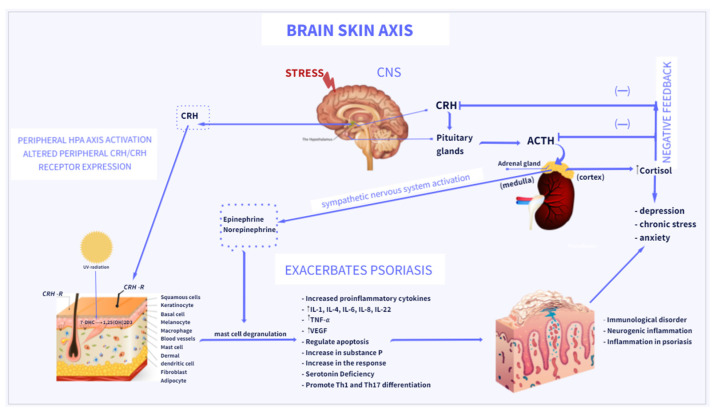
Psoriasis is a chronic inflammatory skin disease with systemic manifestation, in which psychological factors play an important role. The etiology of psoriasis is complex and multifactorial, including genetic background and environmental factors such as emotional or physical stress. Psychological stress may also play a role in exacerbation of psoriasis, by dysregulation of the hypothalamic-pituitary-adrenal (HPA) axis, sympathetic-adrenal-medullary axis, peripheral nervous system, and immune system. Skin cells also express various neuropeptides and hormones in response to stress, including the fully functional analog of the HPA axis. The deterioration of psoriatic lesions is accompanied by increased production of inflammatory mediators, which could contribute to the imbalance of neurotransmitters and the development of symptoms of depression and anxiety. Therefore, deregulation of the crosstalk between endocrine, paracrine, and autocrine stress signaling pathways contributes to clinical manifestations of psoriasis, which requires multidisciplinary approaches.
银屑病是一种慢性炎症性皮肤病,具有全身表现,其中心理因素起着重要作用。银屑病的病因复杂且多因素,包括遗传背景和情绪或身体应激等环境因素。心理应激也可能通过下丘脑-垂体-肾上腺 (HPA) 轴、交感神经-肾上腺髓质轴、外周神经系统和免疫系统的失调而加重银屑病,皮肤细胞也会对压力产生各种神经肽和激素作出反应,包括具有完整功能的 HPA 轴类似物。银屑病病变的恶化伴随着炎症介质的产生增加,这可能导致神经递质失衡和抑郁、焦虑症状的发展。因此,内分泌、旁分泌和自分泌应激信号通路的失调会导致银屑病的临床表现,这需要多学科的方法。