Cruz-Ortiz Nancy, Gonzalez Rodrigo J, Lindblade Kim A, Richards Frank O, Sauerbrey Mauricio, Zea-Flores Guillermo, Dominguez Alfredo, Oliva Orlando, Catú Eduardo, Rizzo Nidia
Centro de Estudios en Salud, Universidad del Valle de Guatemala (UVG), 18 avenida 11-95 Zona 15, Vista Hermosa III, Guatemala City, Guatemala.
J Parasitol Res. 2012;2012:638429. doi: 10.1155/2012/638429. Epub 2012 Aug 23.
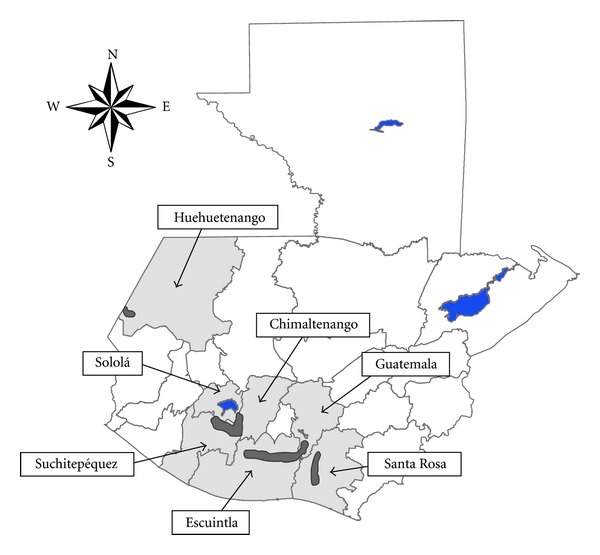
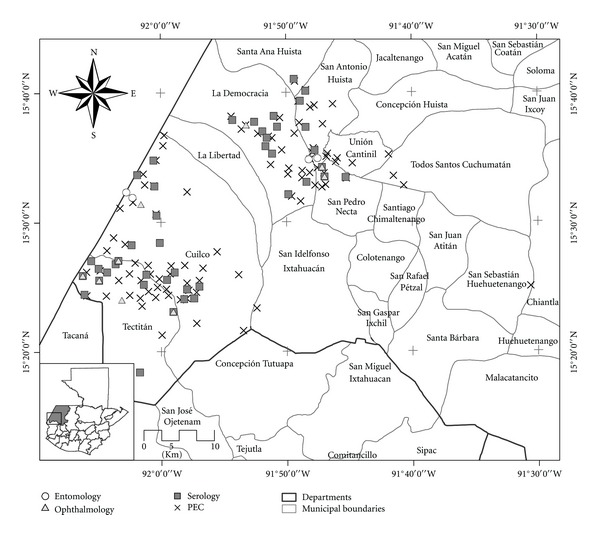
In Latin America, onchocerciasis is targeted for elimination by 2012 through twice-yearly mass treatment of the eligible population with ivermectin. In Guatemala, two of the four historical endemic foci have demonstrated elimination of transmission, following World Health Organization guidelines. Using established guidelines ophthalmological, serological, and entomological evaluations were conducted in 2007-8 to determine the transmission status of onchocerciasis in the Huehuetenango focus. The prevalence of Onchocerca volvulus microfilariae in the anterior segment of the eye in 365 residents was 0% (95% confidence interval [CI] 0-0.8%), the prevalence of infection of O. volvulus in Simulium ochraceum among 8252 flies collected between November 2007 and April 2008 was 0% (95% CI 0-0.02%), and the prevalence of antibodies to a recombinant O. volvulus antigen in 3118 school age children was 0% (95% CI 0-0.1%). These results showed transmission interruption; thus, in 2009 mass treatment was halted and posttreatment surveillance began. To verify for potential recrudescence an entomological evaluation (from December 2010 to April 2011) was conducted during the 2nd and 3rd year of posttreatment surveillance. A total of 4587 S. ochraceum were collected, and the prevalence of infection of O. volvulus was 0% (95% CI 0-0.04%). Transmission of onchocerciasis in the Huehuetenango focus has been eliminated.
在拉丁美洲,盘尾丝虫病的目标是到2012年通过每年两次用伊维菌素对符合条件的人群进行大规模治疗来实现消除。在危地马拉,按照世界卫生组织的指导方针,四个历史流行区中的两个已证明传播被阻断。2007年至2008年,依据既定指导方针进行了眼科、血清学和昆虫学评估,以确定韦韦特南戈流行区盘尾丝虫病的传播状况。365名居民眼前节中盘尾丝虫微丝蚴的患病率为0%(95%置信区间[CI] 0 - 0.8%),2007年11月至2008年4月间收集的8252只蚋中,旋盘尾丝虫的感染率为0%(95% CI 0 - 0.02%),3118名学龄儿童中针对重组盘尾丝虫抗原的抗体患病率为0%(95% CI 0 - 0.1%)。这些结果表明传播已被阻断;因此,2009年停止了大规模治疗并开始进行治疗后监测。为了核查是否可能复发,在治疗后监测的第2年和第3年期间(2010年12月至2011年4月)进行了昆虫学评估。总共收集了4587只赭色蚋,旋盘尾丝虫的感染率为0%(95% CI 0 - 0.04%)。韦韦特南戈流行区的盘尾丝虫病传播已被消除。