Priority Research Centre for Gender, Health and Ageing, University of Newcastle, University Drive, Callaghan, NSW, 2308, Australia.
BMC Public Health. 2012 Sep 13;12:777. doi: 10.1186/1471-2458-12-777.
In 2009, Australian alcohol guidelines for pregnancy changed from low to no alcohol intake. Previous research found a high proportion of pregnant Australian women drank during pregnancy; however, there has been limited investigation of whether pregnant women comply with 2009 alcohol guidelines. The purpose of this study was to provide an assessment of pregnant women's compliance with 2009 Australian alcohol guidelines and identify predictors of such compliance, including previous drinking behaviour.
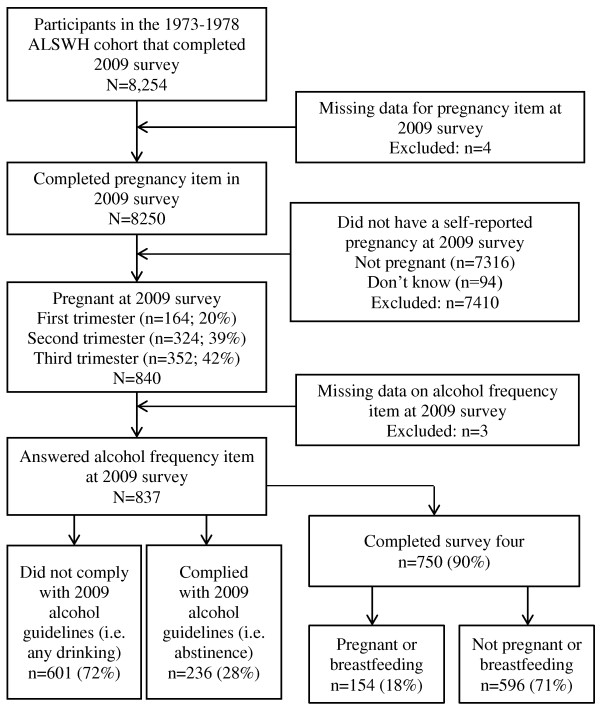
Cross-sectional analysis of prospective data from the 1973-1978 cohort of the Australian Longitudinal Study on Women's Health was conducted. Women aged 30-36 years who were pregnant at the 2009 survey and had data on alcohol use were included (n = 837). Compliance with 2009 alcohol guidelines for pregnancy was defined as no alcohol intake. Predictors of compliance were analysed using multivariate logistic regression, controlling for area of residence, in three separate models to account for multicollinearity between measures of previous alcohol intake (compliance with 2001 guidelines; frequency and quantity; bingeing). Private health insurance, household income, and illicit drug use were entered into all models and retained if significant.
72% of pregnant women did not comply with the 2009 alcohol guidelines and 82% of these women drank less than seven drinks per week, with no more than one or two drinks per drinking day. The odds of complying with abstinence increased by a factor of 3.48 (95% CI 2.39-5.05) for women who previously complied with the 2001 alcohol guidelines and decreased by a factor of 0.19 (95% CI 0.08-0.66) if household incomes were $36,400 or more. In other models the odds of complying were lower for women who consumed alcohol before pregnancy at least weekly (OR = 0.40, 95% CI 0.25-0.63) or binged (OR ≥ 0.18, 95% CI 0.10-0.31) and were higher for those who abstained (OR = 45.09; 95% CI 8.63-235.49) prior to pregnancy.
Most pregnant women did not comply with alcohol guidelines promoting abstinence. Prior alcohol behaviour was the strongest predictor of compliance during pregnancy, suggesting alcohol use should be addressed in women of child-bearing age. The study is limited by the relatively short timeframe between the official introduction of the 2009 guidelines and the date the surveys were sent out. Widespread dissemination of the guidelines may be necessary to help increase guideline compliance by pregnant women.
2009 年,澳大利亚的孕期饮酒指南由低摄入改为零摄入。先前的研究发现,相当一部分澳大利亚孕妇在孕期饮酒;然而,对于孕妇是否遵守 2009 年饮酒指南,我们知之甚少。本研究旨在评估孕妇遵守 2009 年澳大利亚饮酒指南的情况,并确定其遵守情况的预测因素,包括先前的饮酒行为。
对澳大利亚女性健康纵向研究 1973-1978 年队列的前瞻性数据进行了横断面分析。纳入在 2009 年调查时怀孕且有饮酒数据的年龄在 30-36 岁的女性(n=837)。遵守 2009 年孕期饮酒指南定义为不饮酒。使用多变量逻辑回归分析遵守情况的预测因素,在三个单独的模型中控制居住地、以前饮酒的衡量标准(遵守 2001 年指南;频率和数量;狂饮)之间的共线性,以评估遵守情况的预测因素。将私人医疗保险、家庭收入和非法药物使用纳入所有模型,并保留如果有统计学意义的因素。
72%的孕妇不遵守 2009 年饮酒指南,其中 82%的孕妇每周饮酒量少于 7 杯,且每天饮酒量不超过 1 或 2 杯。对于以前遵守 2001 年饮酒指南的女性,遵守禁欲的几率增加了 3.48 倍(95%CI 2.39-5.05),而如果家庭收入为 36400 澳元或以上,遵守的几率则降低了 0.19 倍(95%CI 0.08-0.66)。在其他模型中,与每周至少一次饮酒的孕妇相比(OR=0.40,95%CI 0.25-0.63)或狂饮的孕妇相比(OR≥0.18,95%CI 0.10-0.31),在怀孕前就已经戒酒的孕妇的遵守几率较低,而与怀孕前就已经戒酒的孕妇相比(OR=45.09;95%CI 8.63-235.49),遵守几率较高。
大多数孕妇不遵守促进戒酒的饮酒指南。以前的饮酒行为是怀孕期间遵守情况的最强预测因素,这表明应该在育龄妇女中解决饮酒问题。该研究的局限性在于 2009 年指南正式出台与调查寄出之间的时间相对较短。可能需要广泛传播指南,以帮助增加孕妇对指南的遵守。