Department of Clinical Sciences, Danderyd Hospital, Karolinska Institutet, Division of Obstetrics and Gynecology, Stockholm, Sweden.
Mol Pain. 2012 Sep 12;8:68. doi: 10.1186/1744-8069-8-68.
Provoked vestibulodynia (PVD) is a pain disorder localized in the vestibular mucosa. It is the most common cause of dyspareunia among young women and it is associated with general pain hypersensitivity and other chronic pain conditions. Polymorphism in the guanosine triphosphate cyclohydrolase (GCH1) gene has been found to influence general pain sensitivity and the risk of developing a longstanding pain condition. The aim of this study was to investigate GCH1-polymorphism in women with PVD and healthy controls, in correlation to pain sensitivity.
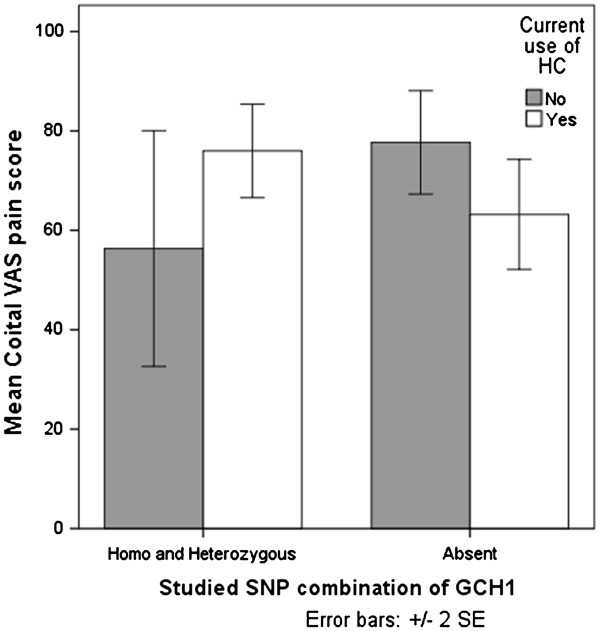
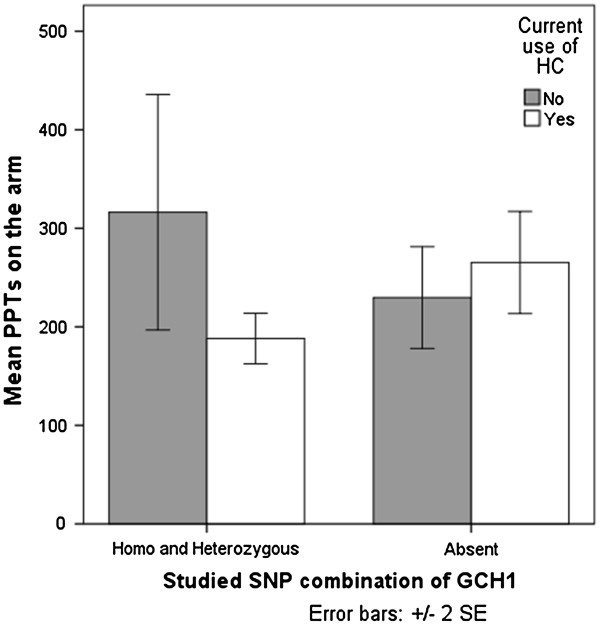
We found no correlation between the previously defined pain-protective GCH1-SNP combination and the diagnosis of PVD. Nor any correlation with pain sensitivity measured as pressure pain thresholds on the arm, leg and in the vestibule, coital pain scored on a visual analog scale and prevalence of other bodily pain conditions among women with PVD (n = 98) and healthy controls (n = 102). However, among patients with current treatment (n = 36), there was a significant interaction effect of GCH1-gene polymorphism and hormonal contraceptive (HC) therapy on coital pain (p = 0.04) as well as on pressure pain thresholds on the arm (p = 0.04). PVD patients carrying the specified SNP combination and using HCs had higher pain sensitivity compared to non-carriers. In non-HC-users, carriers had lower pain sensitivity.
The results of this study gave no support to the hypothesis that polymorphism in the GCH1-gene contributes to the etiology of PVD. However, among patients currently receiving treatment an interaction effect of the defined SNP combination and use of hormonal contraceptives on pain sensitivity was found. This finding offers a possible explanation to the clinically known fact that some PVD patients improve after cessation of hormonal contraceptives, indicating that PVD patients carrying the defined SNP combination of GCH1 would benefit from this intervention.
诱发性外阴痛(PVD)是一种局限于前庭黏膜的疼痛障碍。它是年轻女性性交困难最常见的原因,与一般疼痛敏感性和其他慢性疼痛状况有关。已发现鸟苷三磷酸环化水解酶(GCH1)基因的多态性会影响一般疼痛敏感性和发生长期疼痛状况的风险。本研究旨在调查患有 PVD 的女性和健康对照组中 GCH1 多态性与疼痛敏感性的关系。
我们没有发现先前定义的疼痛保护 GCH1-SNP 组合与 PVD 诊断之间存在相关性。也没有发现与手臂、腿部和前庭的压力疼痛阈值、视觉模拟评分上的性交疼痛以及 PVD 女性(n=98)和健康对照组(n=102)中其他身体疼痛状况的患病率之间存在相关性。然而,在当前接受治疗的患者(n=36)中,GCH1 基因多态性与激素避孕(HC)治疗对性交疼痛(p=0.04)以及手臂压力疼痛阈值(p=0.04)的交互作用有显著影响。携带特定 SNP 组合并使用 HCs 的 PVD 患者的疼痛敏感性高于非携带者。在非 HC 使用者中,携带者的疼痛敏感性较低。
本研究结果不支持 GCH1 基因多态性导致 PVD 病因的假设。然而,在当前接受治疗的患者中,发现定义的 SNP 组合与激素避孕药的使用对疼痛敏感性存在交互作用。这一发现为临床上已知的某些 PVD 患者在停止使用激素避孕药后病情改善的事实提供了可能的解释,表明携带 GCH1 定义 SNP 组合的 PVD 患者将从这种干预中受益。