Division on Substance Abuse, New York State Psychiatric Institute, Department of Psychiatry, College of Physicians and Surgeons of Columbia University, New York, NY 10032, USA.
J Pain. 2010 Apr;11(4):330-42. doi: 10.1016/j.jpain.2009.08.004. Epub 2009 Oct 22.
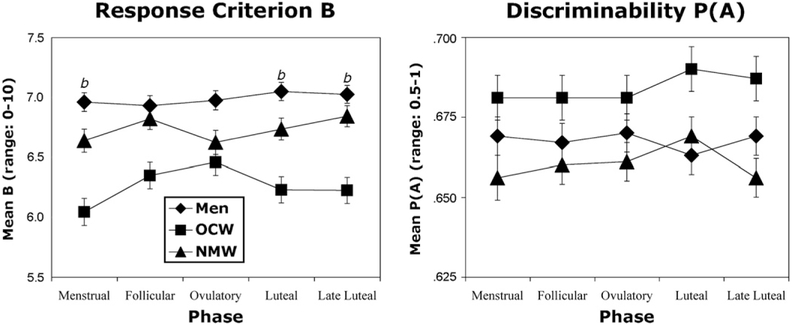
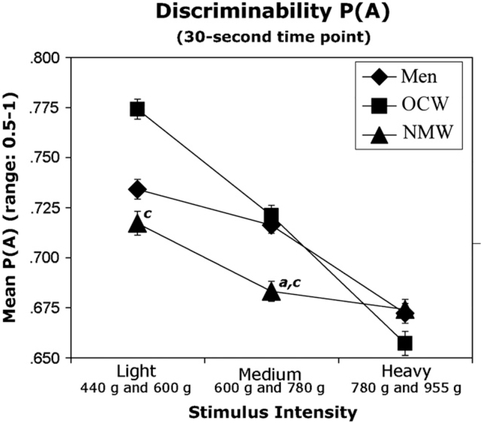
Previous studies have demonstrated that sex differences in pain responsivity can be detected using various models of experimentally induced pain. The present study employed the mechanical pressure test in order to examine potential differences in pain report among men, normally menstruating women (NMW), and women taking monophasic oral contraceptives (OCW). Testing occurred during 5 phases of the menstrual cycle (menstrual, follicular, ovulatory, luteal, and late luteal) and all participants completed 10 sessions (2 sessions per phase). Menstrual-cycle phase was estimated for OCW based on their first day of menses. Men were tested at time points that roughly corresponded to the intervals during which the different phases occurred in NMW. During the mechanical pressure test, 4 different weights were placed on the fingers, one at a time, and ratings of pain were recorded for 30 seconds. The statistical decision-making model and a forced-choice procedure were used to analyze the response data. Two variables, based on signal detection theory, were thus generated: P(A), a measure of sensory pain, and B, a measure of response bias. P(A) is believed to be a measure of pain sensitivity while B measures stoicism. NMW tended to report lower P(A) values, indicating reduced ability to discriminate among different stimulus intensities, during the menstrual and late luteal phases compared to the luteal phase. OCW reported lower B values, indicating less stoicism, during the menstrual compared to the follicular and ovulatory phases. Men tended to have significantly lower B values than OCW, but not NMW. These results demonstrate subtle menstrual-cycle effects in NMW and OCW. Sex differences were few, with more group differences and trends emerging between OCW and men, as opposed to men and NMW.
The lack of consistent differences between men and NMW underscores the subtle impact of sex and hormonal changes in pain report. In addition, the data obtained in NMW support the notion that changes in hormone levels during the menstrual cycle can lead to changes in pain responsivity as NMW had trends for better discrimination in menstrual phases when estradiol levels were highest.
先前的研究已经表明,通过各种实验性疼痛模型可以检测到疼痛反应中的性别差异。本研究采用机械压力测试来检查男性、正常月经女性(NMW)和服用单相口服避孕药(OCW)的女性在疼痛报告方面的潜在差异。测试在月经周期的 5 个阶段(月经期、卵泡期、排卵期、黄体期和黄体晚期)进行,所有参与者完成了 10 个阶段(每个阶段 2 个阶段)。根据 OCW 的月经第一天,估计 OCW 的月经周期阶段。男性的测试时间大致与 NMW 中不同阶段发生的时间间隔相对应。在机械压力测试中,一次将 4 个不同的重量放在手指上,记录 30 秒的疼痛评分。使用统计决策模型和强制选择程序分析响应数据。基于信号检测理论,生成了两个变量:P(A),一种感知疼痛的度量,和 B,一种反应偏差的度量。P(A)被认为是疼痛敏感性的度量,而 B 则衡量坚韧性。与黄体期相比,NMW 在月经期和黄体晚期倾向于报告较低的 P(A)值,这表明它们在区分不同刺激强度方面的能力降低。OCW 在月经期报告的 B 值较低,这表明与卵泡期和排卵期相比,OCW 的坚韧性较低。男性的 B 值明显低于 OCW,但与 NMW 无显著差异。这些结果表明 NMW 和 OCW 中存在微妙的月经周期效应。性别差异很少,OCW 和男性之间的组间差异和趋势比男性和 NMW 之间更为明显。
男性和 NMW 之间缺乏一致的差异强调了性和荷尔蒙变化对疼痛报告的微妙影响。此外,NMW 获得的数据支持这样一种观点,即月经周期中激素水平的变化会导致疼痛反应的变化,因为当雌激素水平最高时,NMW 在月经期的区分能力有上升趋势。