Saggar Manish, King Brandon G, Zanesco Anthony P, Maclean Katherine A, Aichele Stephen R, Jacobs Tonya L, Bridwell David A, Shaver Phillip R, Rosenberg Erika L, Sahdra Baljinder K, Ferrer Emilio, Tang Akaysha C, Mangun George R, Wallace B Alan, Miikkulainen Risto, Saron Clifford D
Department of Psychiatry and Behavioral Sciences, Stanford University Stanford, CA, USA.
Front Hum Neurosci. 2012 Sep 10;6:256. doi: 10.3389/fnhum.2012.00256. eCollection 2012.
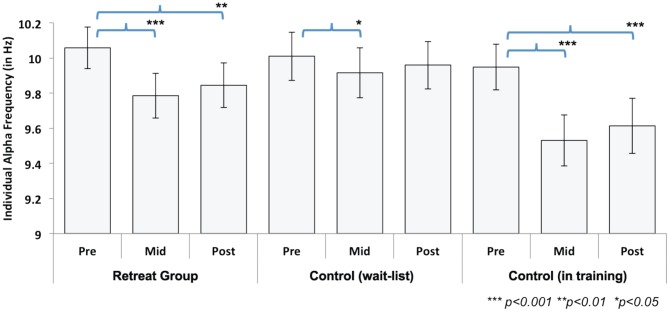
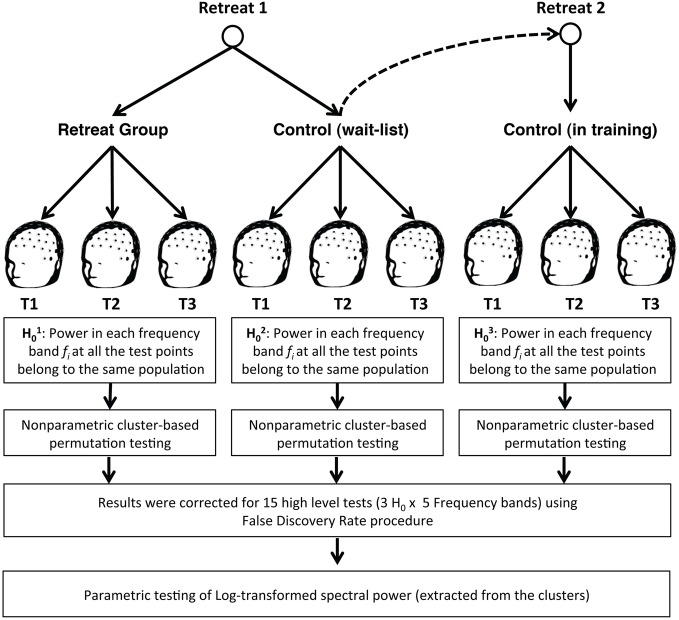
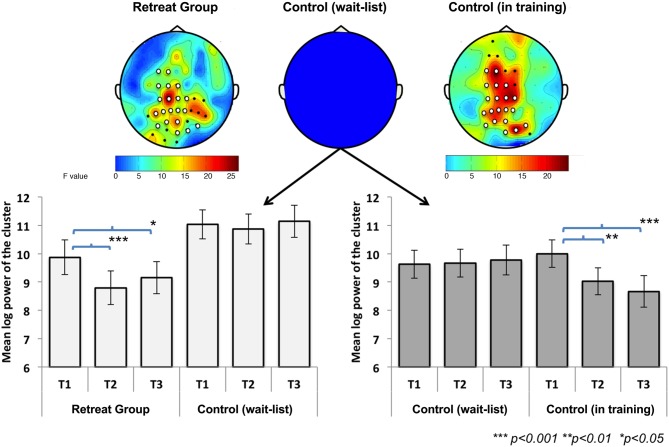
The capacity to focus one's attention for an extended period of time can be increased through training in contemplative practices. However, the cognitive processes engaged during meditation that support trait changes in cognition are not well characterized. We conducted a longitudinal wait-list controlled study of intensive meditation training. Retreat participants practiced focused attention (FA) meditation techniques for three months during an initial retreat. Wait-list participants later undertook formally identical training during a second retreat. Dense-array scalp-recorded electroencephalogram (EEG) data were collected during 6 min of mindfulness of breathing meditation at three assessment points during each retreat. Second-order blind source separation, along with a novel semi-automatic artifact removal tool (SMART), was used for data preprocessing. We observed replicable reductions in meditative state-related beta-band power bilaterally over anteriocentral and posterior scalp regions. In addition, individual alpha frequency (IAF) decreased across both retreats and in direct relation to the amount of meditative practice. These findings provide evidence for replicable longitudinal changes in brain oscillatory activity during meditation and increase our understanding of the cortical processes engaged during meditation that may support long-term improvements in cognition.
通过冥想练习训练,可以提高长时间集中注意力的能力。然而,冥想过程中支持认知特质变化的认知过程尚未得到很好的描述。我们进行了一项密集冥想训练的纵向候补名单对照研究。静修参与者在首次静修期间进行了为期三个月的专注注意力(FA)冥想技巧练习。候补名单上的参与者后来在第二次静修期间进行了形式上相同的训练。在每次静修的三个评估点,在6分钟的呼吸正念冥想期间收集密集阵列头皮记录的脑电图(EEG)数据。二阶盲源分离以及一种新型半自动伪迹去除工具(SMART)用于数据预处理。我们观察到双侧前中央和后头皮区域与冥想状态相关的β波段功率可重复降低。此外,个体阿尔法频率(IAF)在两次静修中均降低,且与冥想练习量直接相关。这些发现为冥想期间大脑振荡活动可重复的纵向变化提供了证据,并增进了我们对冥想期间可能支持认知长期改善的皮层过程的理解。