Cummins Denise Dellarosa, Cummins Robert C
Department of Psychology, University of Illinois at Urbana-Champaign Champaign, IL, USA.
Front Psychol. 2012 Sep 5;3:328. doi: 10.3389/fpsyg.2012.00328. eCollection 2012.
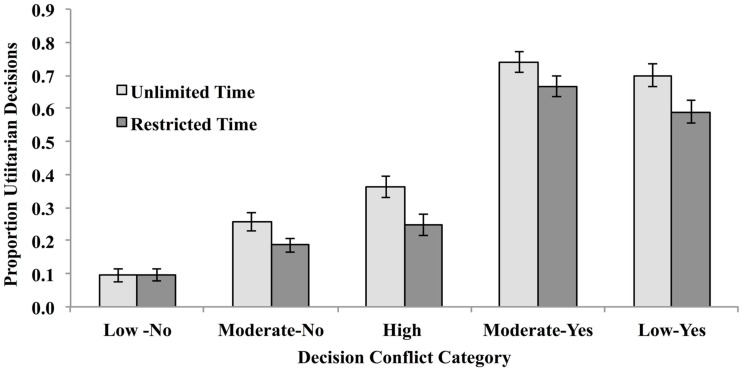
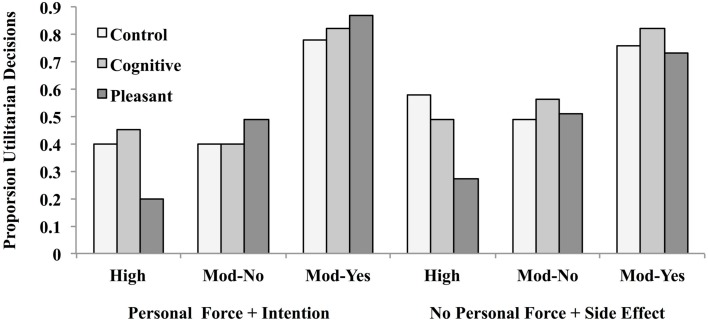
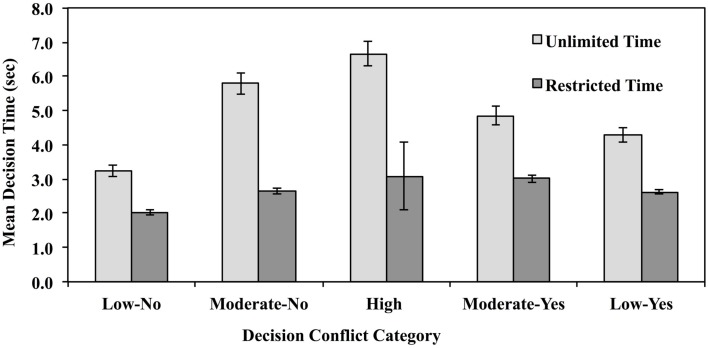
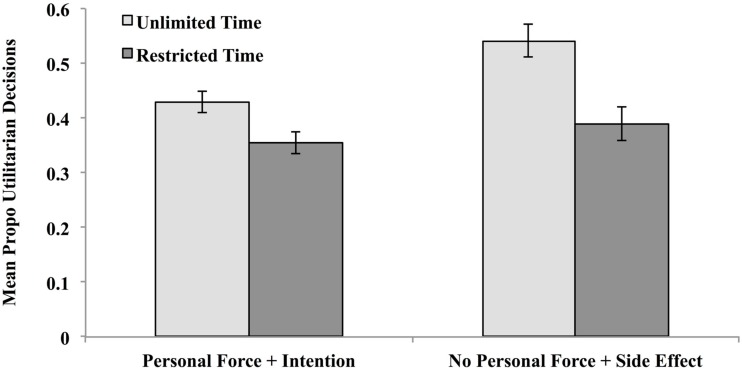
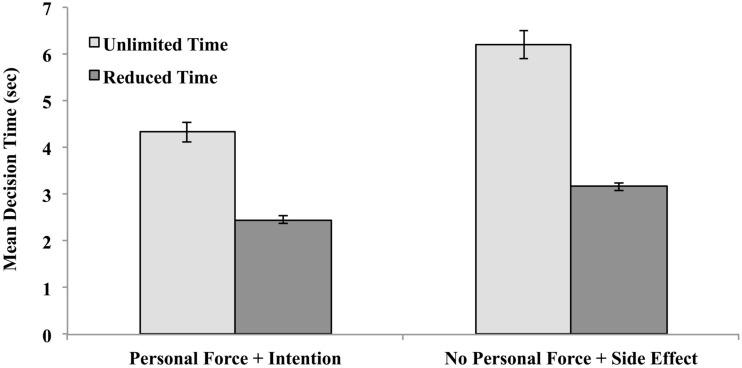
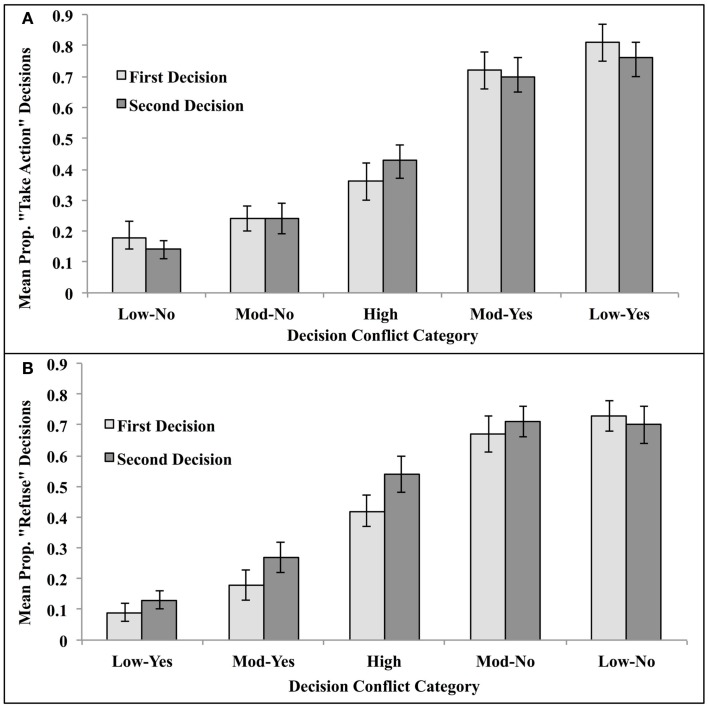
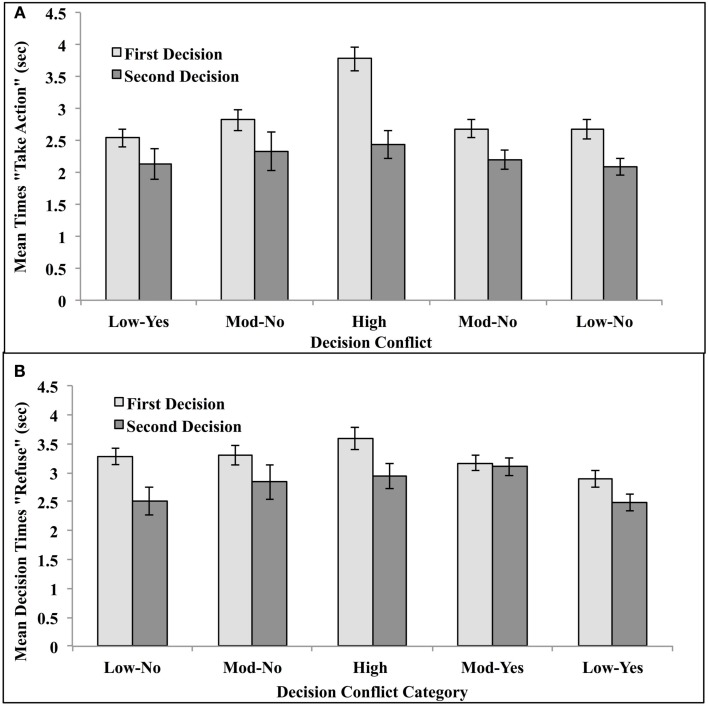
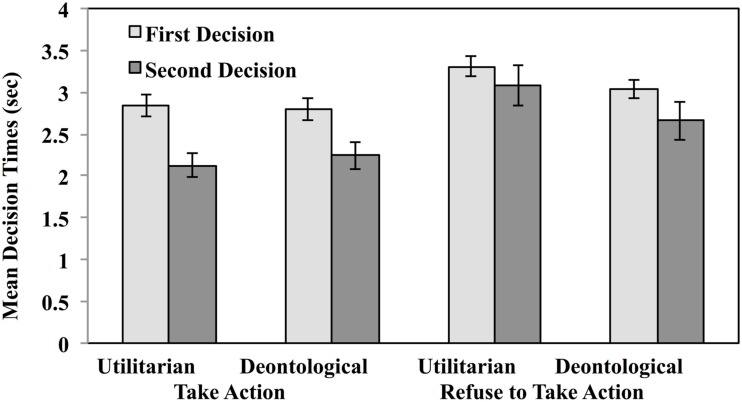
According to an influential dual-process model, a moral judgment is the outcome of a rapid, affect-laden process and a slower, deliberative process. If these outputs conflict, decision time is increased in order to resolve the conflict. Violations of deontological principles proscribing the use of personal force to inflict intentional harm are presumed to elicit negative affect which biases judgments early in the decision-making process. This model was tested in three experiments. Moral dilemmas were classified using (a) decision time and consensus as measures of system conflict and (b) the aforementioned deontological criteria. In Experiment 1, decision time was either unlimited or reduced. The dilemmas asked whether it was appropriate to take a morally questionable action to produce a "greater good" outcome. Limiting decision time reduced the proportion of utilitarian ("yes") decisions, but contrary to the model's predictions, (a) vignettes that involved more deontological violations logged faster decision times, and (b) violation of deontological principles was not predictive of decisional conflict profiles. Experiment 2 ruled out the possibility that time pressure simply makes people more like to say "no." Participants made a first decision under time constraints and a second decision under no time constraints. One group was asked whether it was appropriate to take the morally questionable action while a second group was asked whether it was appropriate to refuse to take the action. The results replicated that of Experiment 1 regardless of whether "yes" or "no" constituted a utilitarian decision. In Experiment 3, participants rated the pleasantness of positive visual stimuli prior to making a decision. Contrary to the model's predictions, the number of deontological decisions increased in the positive affect rating group compared to a group that engaged in a cognitive task or a control group that engaged in neither task. These results are consistent with the view that early moral judgments are influenced by affect. But they are inconsistent with the view that (a) violation of deontological principles are predictive of differences in early, affect-based judgment or that (b) engaging in tasks that are inconsistent with the negative emotional responses elicited by such violations diminishes their impact.
根据一个有影响力的双加工模型,道德判断是一个快速的、充满情感的过程和一个较慢的、深思熟虑的过程的结果。如果这些输出相互冲突,决策时间就会增加以解决冲突。禁止使用个人武力造成故意伤害的道义原则的违反被认为会引发负面影响,这种影响会在决策过程的早期对判断产生偏差。该模型在三个实验中得到了检验。道德困境是根据以下标准进行分类的:(a) 将决策时间和共识作为系统冲突的衡量指标,以及 (b) 上述道义标准。在实验1中,决策时间要么不受限制,要么缩短。这些困境询问采取道德上有问题的行动以产生“更大的善”的结果是否合适。缩短决策时间降低了功利主义(“是”)决策的比例,但与该模型的预测相反,(a) 涉及更多道义违反的情景记录的决策时间更快,并且 (b) 违反道义原则并不能预测决策冲突模式。实验2排除了时间压力只是使人们更倾向于说“不”的可能性。参与者在时间限制下做出第一个决定,在没有时间限制下做出第二个决定。一组被询问采取道德上有问题的行动是否合适,而另一组被询问拒绝采取该行动是否合适。无论“是”还是“否”构成功利主义决策,结果都重复了实验1的结果。在实验3中,参与者在做出决定之前对积极视觉刺激的愉悦程度进行评分。与进行认知任务的组或既不进行任何任务的控制组相比,与该模型的预测相反,在积极情感评分组中道义决策的数量增加了。这些结果与早期道德判断受情感影响的观点一致。但它们与以下观点不一致:(a) 违反道义原则可预测基于情感的早期判断的差异,或者 (b) 从事与此类违反行为引发的负面情绪反应不一致的任务会减少其影响。