Supercomputer Education and Research Centre, Indian Institute of Science, Bangalore, India.
PLoS One. 2012;7(9):e44419. doi: 10.1371/journal.pone.0044419. Epub 2012 Sep 4.
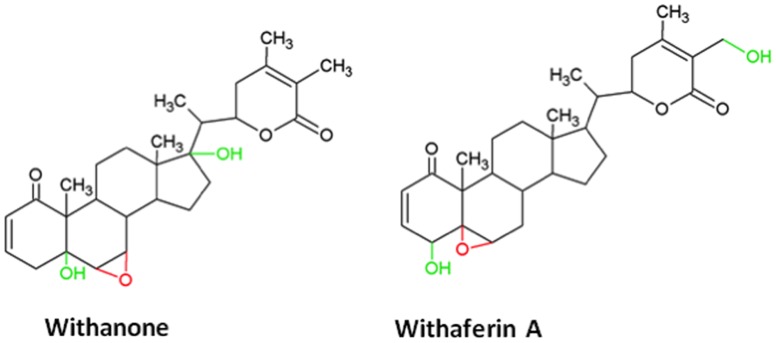
Withanolides are naturally occurring chemical compounds. They are secondary metabolites produced via oxidation of steroids and structurally consist of a steroid-backbone bound to a lactone or its derivatives. They are known to protect plants against herbivores and have medicinal value including anti-inflammation, anti-cancer, adaptogenic and anti-oxidant effects. Withaferin A (Wi-A) and Withanone (Wi-N) are two structurally similar withanolides isolated from Withania somnifera, also known as Ashwagandha in Indian Ayurvedic medicine. Ashwagandha alcoholic leaf extract (i-Extract), rich in Wi-N, was shown to kill cancer cells selectively. Furthermore, the two closely related purified phytochemicals, Wi-A and Wi-N, showed differential activity in normal and cancer human cells in vitro and in vivo. We had earlier identified several genes involved in cytotoxicity of i-Extract in human cancer cells by loss-of-function assays using either siRNA or randomized ribozyme library.
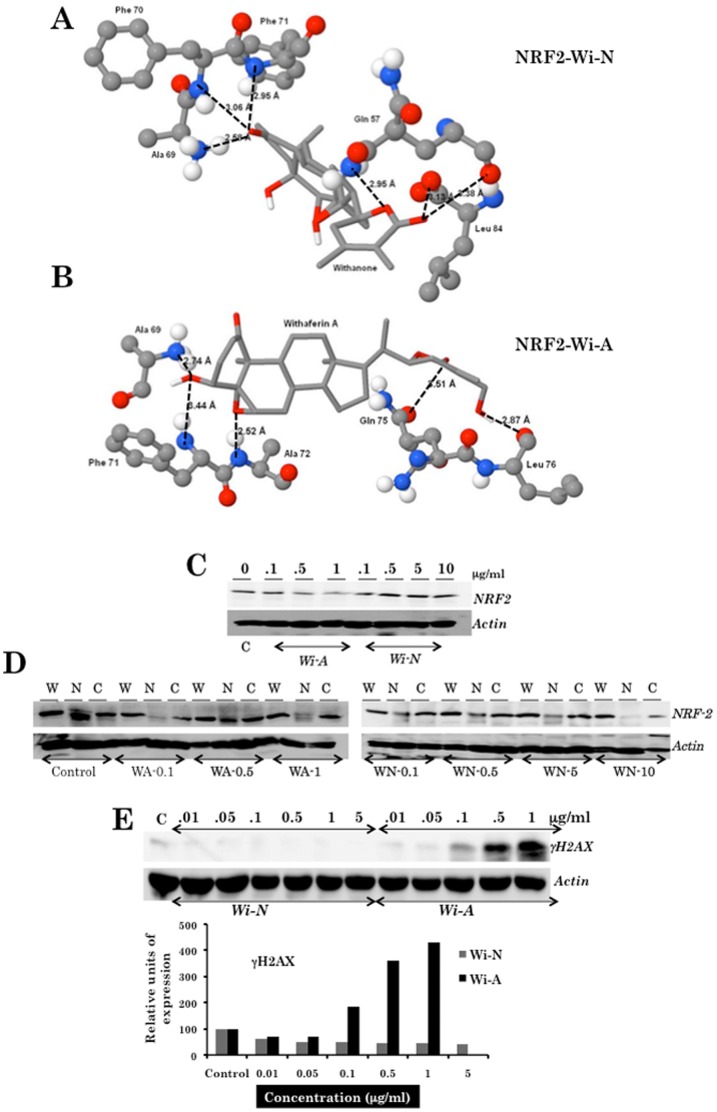
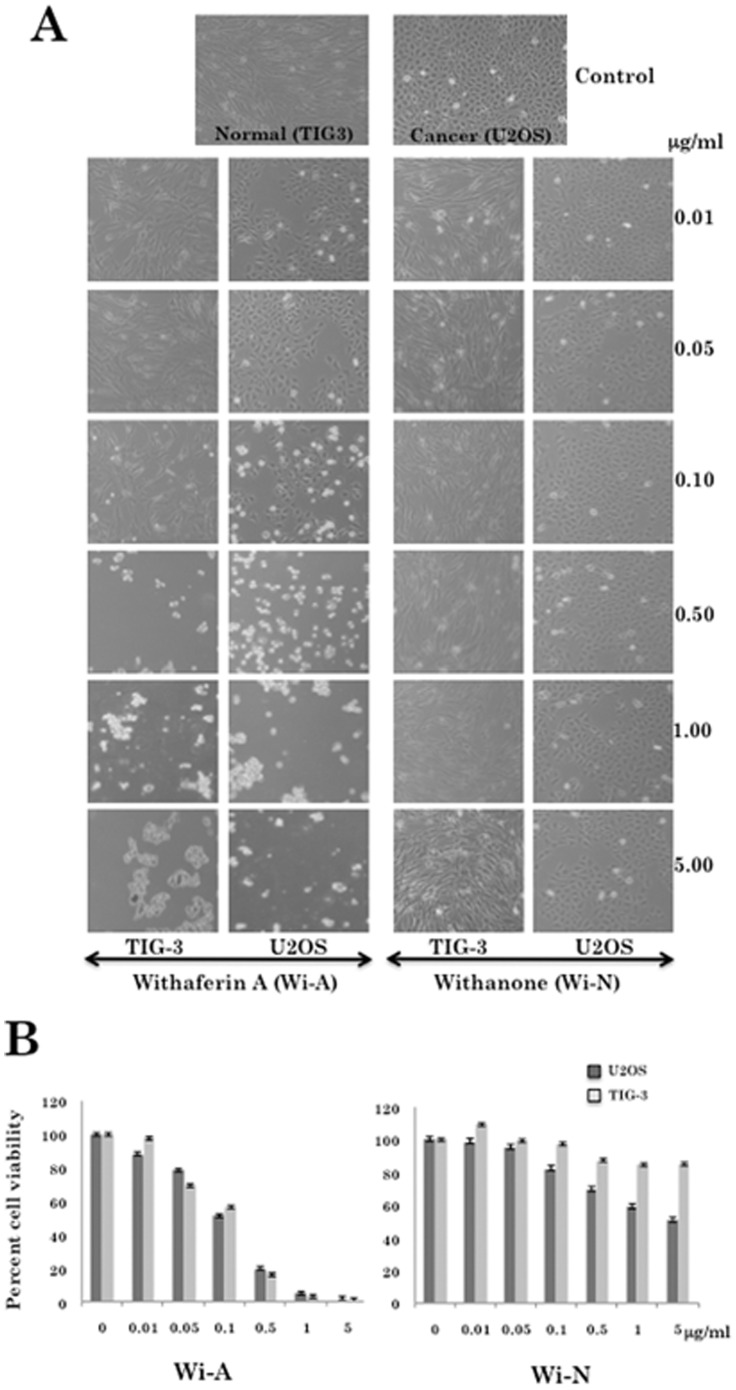
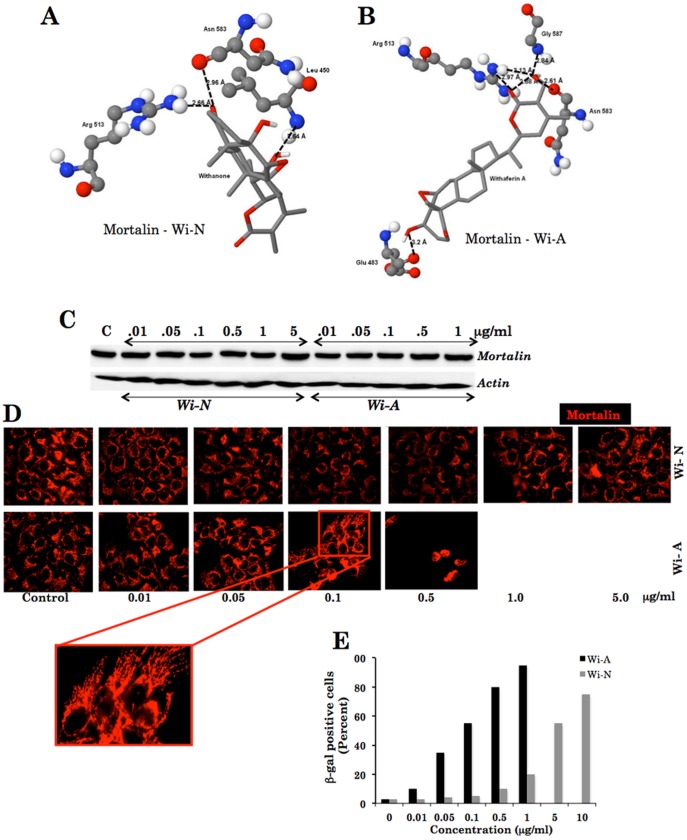
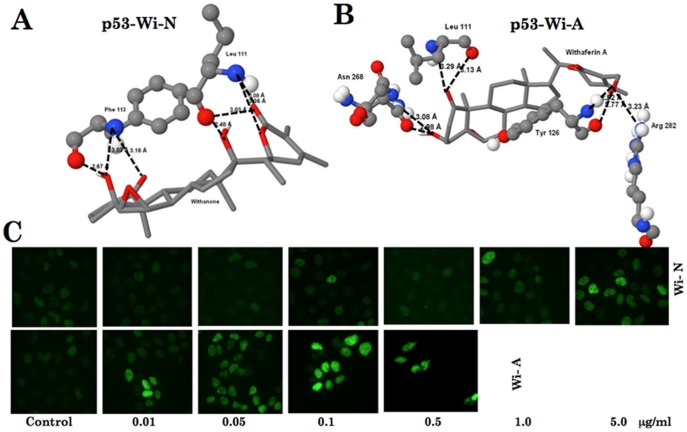
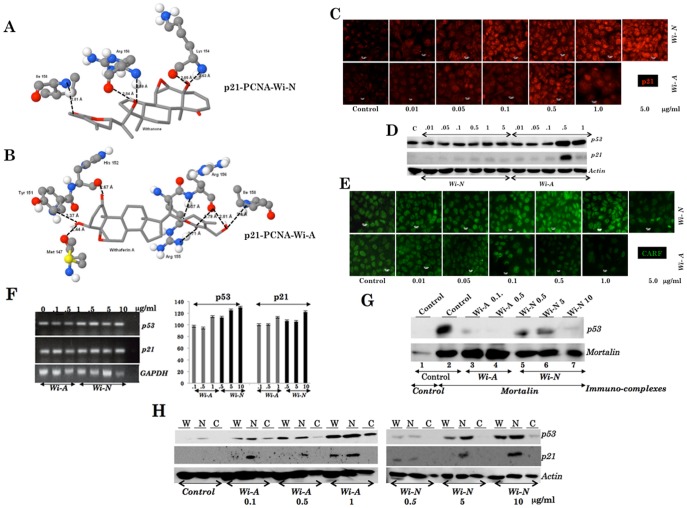
METHODOLOGY/PRINCIPAL FINDINGS: In the present study, we have employed bioinformatics tools on four genes, i.e., mortalin, p53, p21 and Nrf2, identified by loss-of-function screenings. We examined the docking efficacy of Wi-N and Wi-A to each of the four targets and found that the two closely related phytochemicals have differential binding properties to the selected cellular targets that can potentially instigate differential molecular effects. We validated these findings by undertaking parallel experiments on specific gene responses to either Wi-N or Wi-A in human normal and cancer cells. We demonstrate that Wi-A that binds strongly to the selected targets acts as a strong cytotoxic agent both for normal and cancer cells. Wi-N, on the other hand, has a weak binding to the targets; it showed milder cytotoxicity towards cancer cells and was safe for normal cells. The present molecular docking analyses and experimental evidence revealed important insights to the use of Wi-A and Wi-N for cancer treatment and development of new anti-cancer phytochemical cocktails.
醉茄内酯是天然存在的化学化合物。它们是通过类固醇氧化产生的次级代谢产物,结构上由类固醇骨架与内酯或其衍生物结合而成。已知它们可以保护植物免受食草动物的侵害,具有药用价值,包括抗炎、抗癌、适应原和抗氧化作用。从睡茄(Withania somnifera)中分离出的两种结构相似的醉茄内酯,即 Wi-A 和 Wi-N。睡茄在印度阿育吠陀医学中也被称为 Ashwagandha。富含 Wi-N 的 Ashwagandha 酒精叶提取物(i-Extract)已被证明可以选择性杀死癌细胞。此外,两种密切相关的纯化植物化学物质 Wi-A 和 Wi-N 在体外和体内对正常和癌细胞均显示出不同的活性。我们之前通过使用 siRNA 或随机核糖核酸酶文库进行的功能丧失测定,在人类癌细胞中鉴定了几种与 i-Extract 细胞毒性相关的基因。
方法/主要发现:在本研究中,我们利用生物信息学工具对通过功能丧失筛选鉴定的四个基因,即 mortalin、p53、p21 和 Nrf2 进行了研究。我们研究了 Wi-N 和 Wi-A 与这四个靶点的结合效果,发现这两种密切相关的植物化学物质对选定的细胞靶点具有不同的结合特性,这可能引发不同的分子效应。我们通过在人类正常和癌细胞中对特定基因对 Wi-N 或 Wi-A 的反应进行平行实验,验证了这些发现。我们证明,与所选靶点结合能力较强的 Wi-A 对正常和癌细胞均具有较强的细胞毒性。另一方面,Wi-N 与这些靶点的结合能力较弱,对癌细胞的细胞毒性较弱,对正常细胞则较为安全。本分子对接分析和实验证据为 Wi-A 和 Wi-N 用于癌症治疗和开发新的抗癌植物化学鸡尾酒提供了重要的见解。