Department of Zoology, Michigan State University, East Lansing, MI 48824, USA.
Brain Res. 2012 Oct 22;1480:53-60. doi: 10.1016/j.brainres.2012.09.003. Epub 2012 Sep 10.
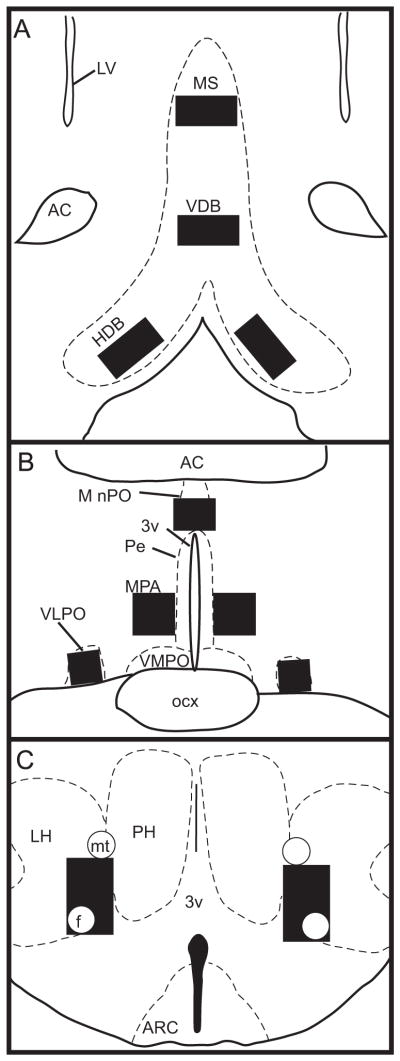
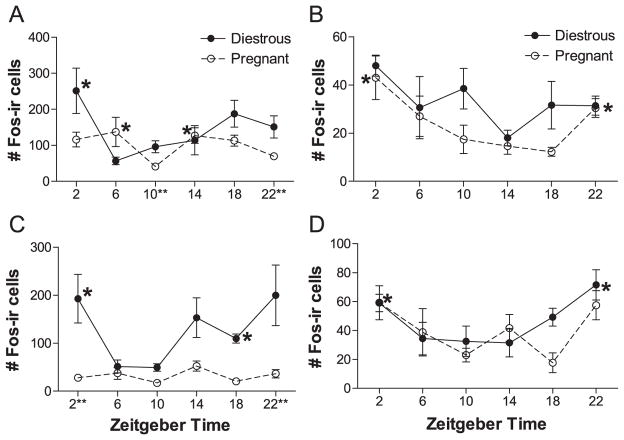
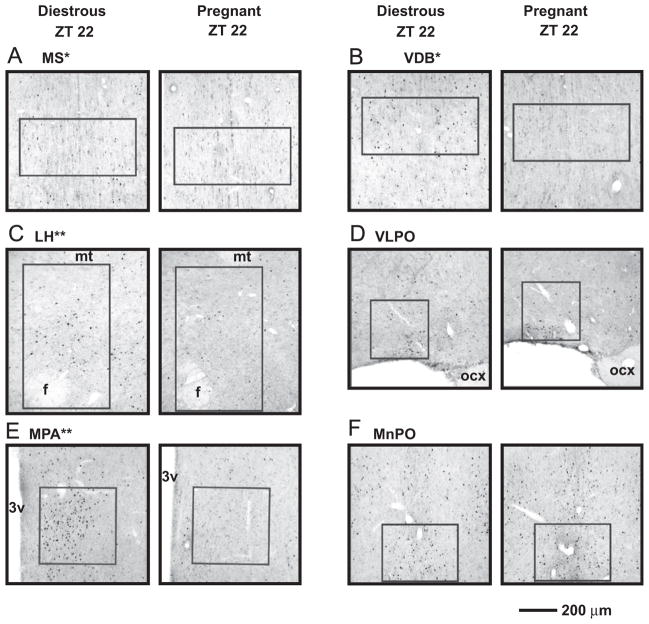
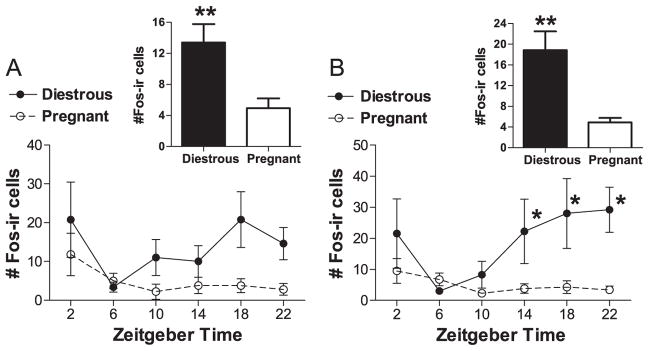
Circadian rhythms in behavior and physiology change substantially as female mammals undergo the transition from a non-pregnant to a pregnant state. Here, we examined the possibility that site-specific changes in brain regions known to regulate the sleep/wake cycle and body temperature might reflect altered rhythms in these overt functions. Specifically, we compared daily patterns of immunoreactive FOS in early pregnant and diestrous rats in the medial septum (MS), vertical and horizontal diagonal bands of Broca (VDB and HDB), perifornical lateral hypothalamus (LH), and ventrolateral, medial, and median preoptic areas (VLPO, MPA, and MnPO, respectively). In the pregnant animals, FOS expression was reduced and the daily rhythms of expression were lost or attenuated in the MS, VDB, and LH, areas known to support wakefulness, and in the MPA, a brain region that may coordinate sleep/wake patterns with temperature changes. However, despite the well-documented differences in sleep patterns between diestrous and pregnant rats, reproductive state did not affect FOS expression in the VLPO or MnPO, two brain regions in which FOS expression usually correlates with sleep. These data indicate that plasticity in sleep/wake patterns during early pregnancy may be driven by a reduction in wakefulness-promotion by the brain, rather than by an increase in sleep drive.
行为和生理的昼夜节律在雌性哺乳动物从非怀孕状态过渡到怀孕状态时会发生显著变化。在这里,我们研究了这样一种可能性,即已知调节睡眠/觉醒周期和体温的大脑区域的特定部位变化可能反映了这些明显功能的节律变化。具体来说,我们比较了早期怀孕和发情期大鼠在中隔(MS)、垂直和水平布罗卡带(VDB 和 HDB)、旁内侧下丘脑(LH)和腹外侧、内侧和中视前区(VLPO、MPA 和 MnPO)中的免疫反应性 FOS 的每日模式。在怀孕动物中,FOS 表达减少,MS、VDB 和 LH 中的表达日节律丢失或减弱,这些区域被认为支持觉醒,而在 MPA 中,可能协调睡眠/觉醒模式与体温变化的脑区。然而,尽管发情期和怀孕期大鼠的睡眠模式存在明显差异,但生殖状态并没有影响 VLPO 或 MnPO 中的 FOS 表达,这两个脑区中的 FOS 表达通常与睡眠相关。这些数据表明,妊娠早期睡眠/觉醒模式的可塑性可能是由大脑促进觉醒的能力下降驱动的,而不是由睡眠驱动力的增加驱动的。