Research Unit of Translational Neurogastroenterology, Institute of Experimental and Clinical Pharmacology, Medical University of Graz, Universitätsplatz 4, A-8010 Graz, Austria.
Neuropeptides. 2012 Dec;46(6):261-74. doi: 10.1016/j.npep.2012.08.005. Epub 2012 Sep 11.
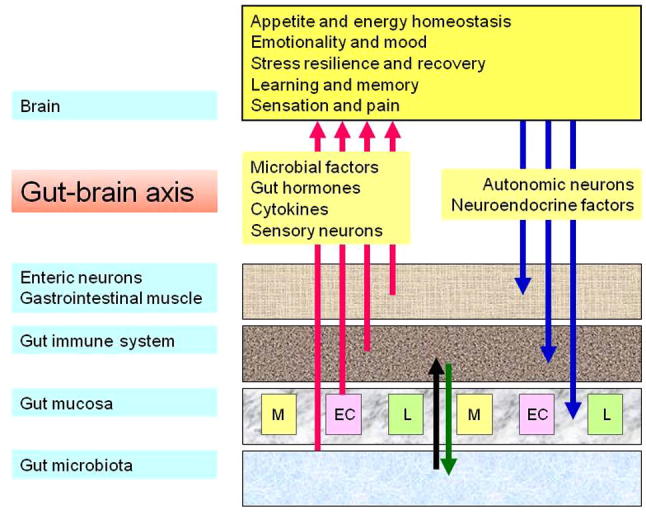
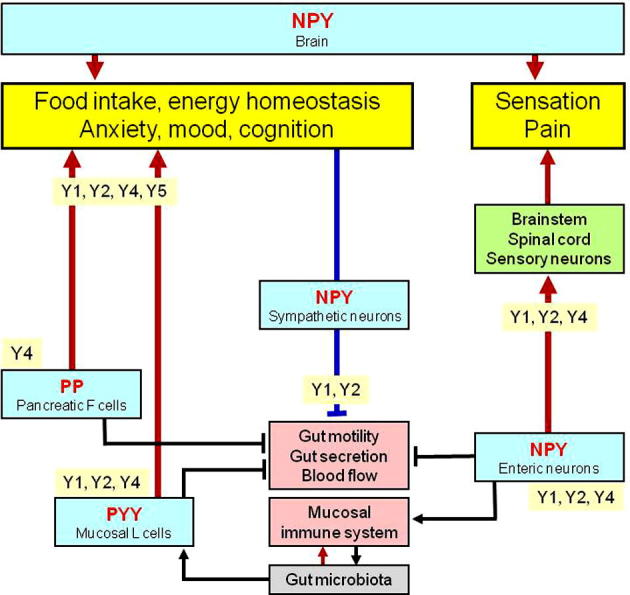
The gut-brain axis refers to the bidirectional communication between the gut and the brain. Four information carriers (vagal and spinal afferent neurons, immune mediators such as cytokines, gut hormones and gut microbiota-derived signalling molecules) transmit information from the gut to the brain, while autonomic neurons and neuroendocrine factors carry outputs from the brain to the gut. The members of the neuropeptide Y (NPY) family of biologically active peptides, NPY, peptide YY (PYY) and pancreatic polypeptide (PP), are expressed by cell systems at distinct levels of the gut-brain axis. PYY and PP are exclusively expressed by endocrine cells of the digestive system, whereas NPY is found at all levels of the gut-brain and brain-gut axis. The major systems expressing NPY comprise enteric neurons, primary afferent neurons, several neuronal pathways throughout the brain and sympathetic neurons. In the digestive tract, NPY and PYY inhibit gastrointestinal motility and electrolyte secretion and in this way modify the input to the brain. PYY is also influenced by the intestinal microbiota, and NPY exerts, via stimulation of Y1 receptors, a proinflammatory action. Furthermore, the NPY system protects against distinct behavioural disturbances caused by peripheral immune challenge, ameliorating the acute sickness response and preventing long-term depression. At the level of the afferent system, NPY inhibits nociceptive input from the periphery to the spinal cord and brainstem. In the brain, NPY and its receptors (Y1, Y2, Y4, Y5) play important roles in regulating food intake, energy homeostasis, anxiety, mood and stress resilience. In addition, PP and PYY signal to the brain to attenuate food intake, anxiety and depression-related behaviour. These findings underscore the important role of the NPY-Y receptor system at several levels of the gut-brain axis in which NPY, PYY and PP operate both as neural and endocrine messengers.
肠脑轴是指肠道和大脑之间的双向通讯。四种信息载体(迷走和脊神经传入神经元、免疫介质如细胞因子、肠道激素和肠道微生物群衍生的信号分子)将信息从肠道传递到大脑,而自主神经元和神经内分泌因子则将输出从大脑传递到肠道。生物活性肽神经肽 Y (NPY) 家族的成员 NPY、肽 YY (PYY) 和胰多肽 (PP) 通过不同水平的肠脑轴的细胞系统表达。PYY 和 PP 仅由消化系统的内分泌细胞表达,而 NPY 则存在于肠脑和脑肠轴的所有水平。表达 NPY 的主要系统包括肠神经元、初级传入神经元、大脑中的几个神经元通路和交感神经元。在消化道中,NPY 和 PYY 抑制胃肠蠕动和电解质分泌,从而改变传入大脑的信息。PYY 也受肠道微生物群的影响,NPY 通过刺激 Y1 受体发挥促炎作用。此外,NPY 系统可预防外周免疫挑战引起的特定行为障碍,减轻急性疾病反应并防止长期抑郁。在传入系统水平,NPY 抑制来自外周的伤害性传入到脊髓和脑干。在大脑中,NPY 及其受体(Y1、Y2、Y4、Y5)在调节食物摄入、能量平衡、焦虑、情绪和应激反应能力方面发挥重要作用。此外,PP 和 PYY 向大脑发出信号以减少食物摄入、焦虑和与抑郁相关的行为。这些发现强调了 NPY-Y 受体系统在肠脑轴的几个水平上的重要作用,其中 NPY、PYY 和 PP 既作为神经递质,也作为内分泌信使发挥作用。