Research Unit of Translational Neurogastroenterology, Institute of Experimental and Clinical Pharmacology, Medical University of Graz, Universitätsplatz 4, 8010, Graz, Austria,
Adv Exp Med Biol. 2014;817:195-219. doi: 10.1007/978-1-4939-0897-4_9.
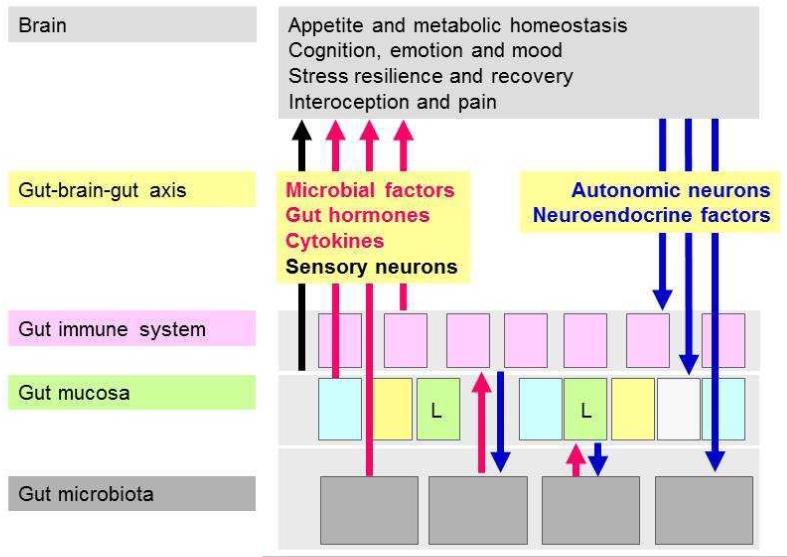
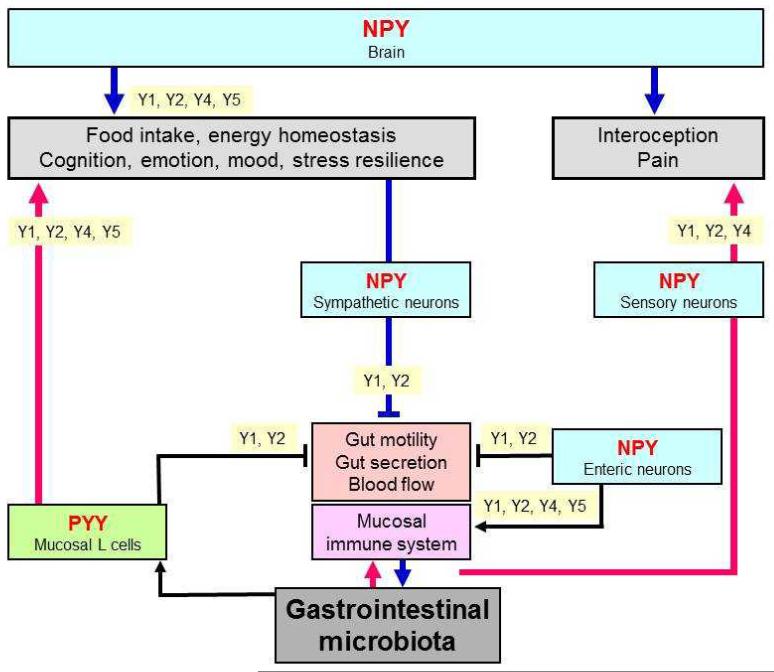
Neuropeptides are important mediators both within the nervous system and between neurons and other cell types. Neuropeptides such as substance P, calcitonin gene-related peptide and neuropeptide Y (NPY), vasoactive intestinal polypeptide, somatostatin and corticotropin-releasing factor are also likely to play a role in the bidirectional gut-brain communication. In this capacity they may influence the activity of the gastrointestinal microbiota and its interaction with the gut-brain axis. Current efforts in elucidating the implication of neuropeptides in the microbiota-gut-brain axis address four information carriers from the gut to the brain (vagal and spinal afferent neurons; immune mediators such as cytokines; gut hormones; gut microbiota-derived signalling molecules) and four information carriers from the central nervous system to the gut (sympathetic efferent neurons; parasympathetic efferent neurons; neuroendocrine factors involving the adrenal medulla; neuroendocrine factors involving the adrenal cortex). Apart from operating as neurotransmitters, many biologically active peptides also function as gut hormones. Given that neuropeptides and gut hormones target the same cell membrane receptors (typically G protein-coupled receptors), the two messenger roles often converge in the same or similar biological implications. This is exemplified by NPY and peptide YY (PYY), two members of the PP-fold peptide family. While PYY is almost exclusively expressed by enteroendocrine cells, NPY is found at all levels of the gut-brain and brain-gut axis. The function of PYY-releasing enteroendocrine cells is directly influenced by short chain fatty acids generated by the intestinal microbiota from indigestible fibre, while NPY may control the impact of the gut microbiota on inflammatory processes, pain, brain function and behaviour. Although the impact of neuropeptides on the interaction between the gut microbiota and brain awaits to be analysed, biologically active peptides are likely to emerge as neural and endocrine messengers in orchestrating the microbiota-gut-brain axis in health and disease.
神经肽是神经系统内以及神经元与其他细胞类型之间的重要介质。神经肽,如 P 物质、降钙素基因相关肽和神经肽 Y(NPY)、血管活性肠肽、生长抑素和促肾上腺皮质激素释放因子,也可能在双向肠道-大脑通讯中发挥作用。在这种情况下,它们可能会影响胃肠道微生物群的活性及其与肠道-大脑轴的相互作用。目前,阐明神经肽在微生物群-肠道-大脑轴中的作用的努力涉及从肠道到大脑的四个信息载体(迷走神经和脊神经传入神经元;免疫介质,如细胞因子;肠道激素;肠道微生物群衍生的信号分子)和从中枢神经系统到肠道的四个信息载体(交感传出神经元;副交感传出神经元;涉及肾上腺髓质的神经内分泌因子;涉及肾上腺皮质的神经内分泌因子)。除了作为神经递质外,许多生物活性肽还作为肠道激素发挥作用。由于神经肽和肠道激素靶向相同的细胞膜受体(通常是 G 蛋白偶联受体),这两个信使角色通常在相同或相似的生物学意义上融合。这一点可以通过 NPY 和肽 YY(PYY)这两个 PP 折叠肽家族的成员来说明。虽然 PYY 几乎完全由肠内分泌细胞表达,但 NPY 存在于肠道-大脑和大脑-肠道轴的所有水平。短链脂肪酸由肠道微生物群从不可消化的纤维中产生,这些短链脂肪酸直接影响释放 PYY 的肠内分泌细胞的功能,而 NPY 可能控制肠道微生物群对炎症过程、疼痛、大脑功能和行为的影响。尽管神经肽对肠道微生物群与大脑相互作用的影响有待分析,但生物活性肽可能作为神经和内分泌信使,在协调健康和疾病中的微生物群-肠道-大脑轴中发挥作用。