Department of Chemistry & Chemical Biology, Harvard University, Cambridge, MA, USA.
Nat Chem Biol. 2012 Nov;8(11):913-9. doi: 10.1038/nchembio.1070. Epub 2012 Sep 16.
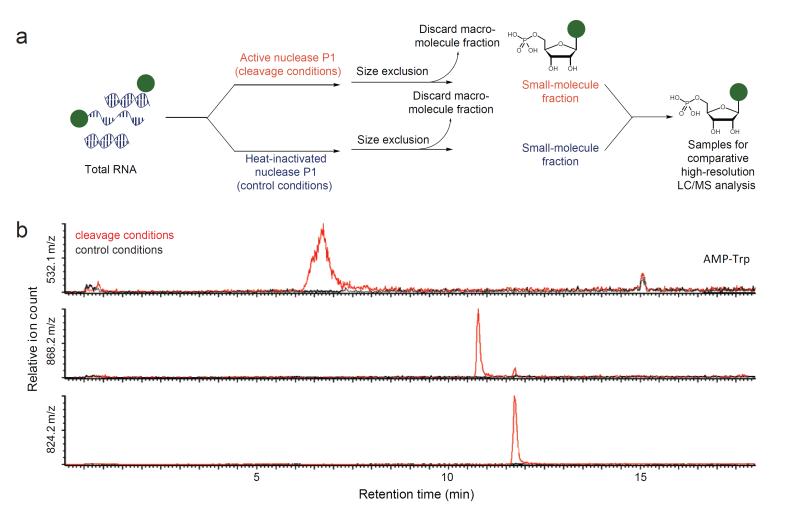
A general MS-based screen for unusually hydrophobic cellular small molecule-RNA conjugates revealed geranylated RNA in Escherichia coli, Enterobacter aerogenes, Pseudomonas aeruginosa and Salmonella enterica var. Typhimurium. The geranyl group is conjugated to the sulfur atom in two 5-methylaminomethyl-2-thiouridine nucleotides. These geranylated nucleotides occur in the first anticodon position of tRNA(Glu)(UUC), tRNA(Lys)(UUU) and tRNA(Gln)(UUG) at a frequency of up to 6.7% (~400 geranylated nucleotides per cell). RNA geranylation can be increased or abolished by mutation or deletion of the selU (ybbB) gene in E. coli, and purified SelU protein in the presence of geranyl pyrophosphate and tRNA can produce geranylated tRNA. The presence or absence of the geranyl group in tRNA(Glu)(UUC), tRNA(Lys)(UUU) and tRNA(Gln)(UUG) affects codon bias and frameshifting during translation. These RNAs represent the first reported examples of oligoisoprenylated cellular nucleic acids.
一种基于 MS 的通用筛选方法可用于鉴定异常疏水性的细胞小分子 RNA 缀合物,该方法在大肠杆菌、产气肠杆菌、铜绿假单胞菌和肠炎沙门氏菌 var. Typhimurium 中发现了香叶基化 RNA。香叶基基团与两个 5-甲基氨甲基-2-硫尿嘧啶核苷酸的硫原子相连。这些香叶基化核苷酸存在于 tRNA(Glu)(UUC)、tRNA(Lys)(UUU)和 tRNA(Gln)(UUG)的第一个反密码子位置,频率高达 6.7%(每个细胞约有 400 个香叶基化核苷酸)。在大肠杆菌中,通过突变或缺失 selU(ybbB)基因可以增加或消除 RNA 香叶基化,并且在香叶基焦磷酸和 tRNA 的存在下,纯化的 SelU 蛋白可以产生香叶基化 tRNA。tRNA(Glu)(UUC)、tRNA(Lys)(UUU)和 tRNA(Gln)(UUG)中香叶基的存在或缺失会影响翻译过程中的密码子偏好和移码。这些 RNA 代表了已报道的首批寡异戊二烯化细胞核酸的实例。